
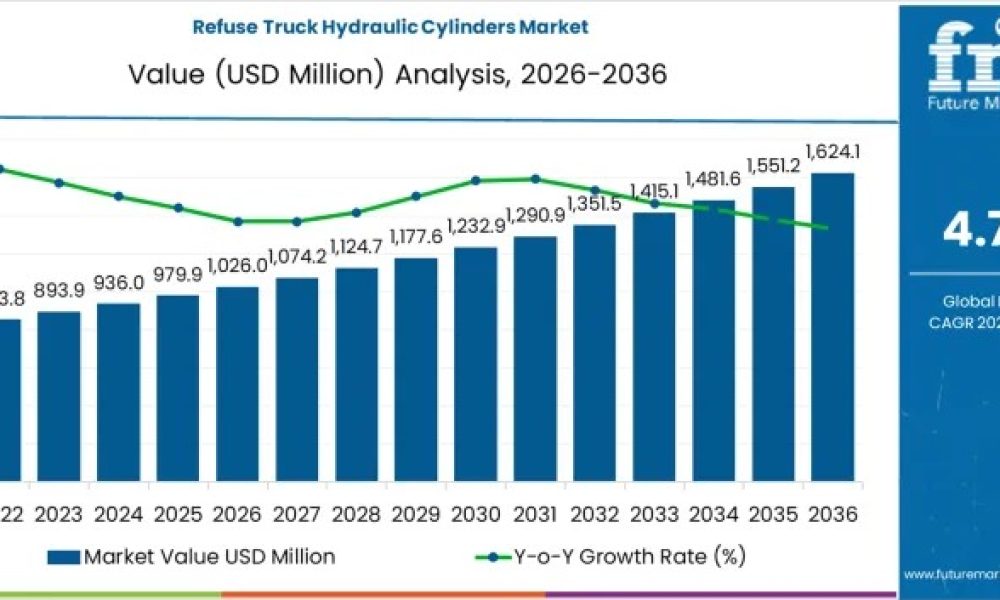
The global refuse truck hydraulic cylinders market is demonstrating resilient, service-led growth as municipal and commercial waste collection fleets prioritise uptime, safety, and mechanical durability over fleet expansion. Valued at USD 1,026.0 million in 2026, the market is projected to reach USD 1,624.1 million by 2036, expanding at a compound annual growth rate (CAGR) of 4.7%. This steady trajectory reflects the essential role hydraulic cylinders play in refuse truck operations, where repeated high-force compaction cycles, contamination exposure, and short-stroke duty profiles accelerate component wear and define replacement economics.
Unlike broader commercial vehicle markets, value generation in refuse truck hydraulic cylinders is anchored in mechanical intensity rather than vehicle volume growth. Cylinders are subjected to misaligned forces, pressure spikes, and abrasive debris that rapidly degrade seals and rods. As a result, cylinder durability directly influences vehicle availability, route completion, and compliance with municipal service schedules. Demand patterns therefore align more closely with maintenance thresholds, inspection outcomes, and rebuild decisions than with discretionary upgrades or fleet size increases.
Operational Stress Profiles Shape Consumption Behaviour
Refuse collection imposes a unique operational environment. Municipal vehicles operate under repeated short-cycle conditions, lifting bins, compacting heterogeneous waste streams, and ejecting loads multiple times per route. Replacement timing is typically triggered by pressure loss, seal failure, leakage tolerance limits, or inconsistent stroke performance observed during compaction cycles. These stress-driven replacement triggers differentiate the market from other hydraulic applications tied to smoother or less frequent duty cycles.
Electrification of refuse trucks is not diminishing the relevance of hydraulic cylinders. While drivetrains evolve toward electric platforms, high-force functions such as compaction, lifting, and tailgate operation continue to rely on hydraulic actuation. This preserves cylinder demand even as vehicle architectures change. However, design evolution remains incremental due to established chassis packaging constraints and proven hydraulic layouts, reinforcing continuity in cylinder geometries and mounting standards.
Get access to comprehensive data tables and detailed market insights — request your sample report today!
Market Growth Outlook: Reliability Over Rapid Scaling
From 2026 to 2036, market growth will be shaped by service-driven replacement and fleet renewal rather than rapid expansion of waste collection coverage. Procurement decisions emphasise rebuildability, seal kit availability, corrosion resistance, and interchangeability across loader configurations. Supply continuity depends on machining capacity, coating processes, and seal material availability, limiting the industry’s ability to respond quickly to sudden volume shifts. As a result, growth remains measured but predictable, anchored in lifecycle replacement demand across municipal fleets.
Telescopic cylinders represent the leading cylinder type, accounting for 34.0% of global demand. Their ability to deliver long stroke lengths within compact installation spaces makes them well suited for compaction and ejection systems. Structural designs support high axial loads, while variable extension capabilities align with complex refuse handling motions. Double-acting cylinders provide controlled bidirectional force for critical applications, while single-acting designs serve simpler lifting functions.
By application, compactor mechanisms dominate with a 44.0% share of demand. Compaction cylinders handle dense, uneven loads and operate at high cycle frequencies, making them the most mechanically stressed components on refuse trucks. Performance reliability at this stage directly affects route efficiency and operational safety. Lift arms and tailgate systems account for additional demand, though with lower cycle intensity.
Municipal refuse trucks account for 62.0% of total demand by vehicle class. City-operated fleets run daily across residential and commercial zones, accelerating wear on hydraulic components. Maintenance programs therefore prioritise proven cylinder designs with predictable service intervals and established replacement pathways. Private and industrial fleets contribute incremental demand but operate under more variable duty profiles.
Regional Growth Driven by Urban Intensity and Maintenance Discipline
Global demand growth reflects urbanisation, waste generation intensity, and structured fleet maintenance practices rather than aggressive fleet expansion. China leads with a projected CAGR of 5.9%, driven by dense urban sanitation requirements and high collection frequency. Continuous-duty compaction and lifting operations accelerate wear, while electrification initiatives require cylinders compatible with optimised hydraulic systems. Large-scale municipal retrofit programs further reinforce maintenance-led demand.
Brazil follows closely at 5.7% CAGR, where operating conditions such as high temperatures, humidity, and uneven road surfaces increase mechanical stress on cylinders. Municipal fleet renewal programs prioritise durability to minimise service interruptions, supporting steady replacement demand. In the United States, growth of 4.5% CAGR is sustained by preventive maintenance economics, high daily utilisation, and increasing automation in side-loader refuse trucks that demand precise hydraulic actuation.
Germany’s market expands at 4.4% CAGR, reflecting disciplined fleet management, environmental compliance, and predictable replacement cycles within mature waste collection systems. South Korea records controlled growth at 4.3%, shaped by compact urban routes, high collection frequency, and standardised municipal procurement practices that favour long-service-life components.
Competitive Landscape Focused on Heavy-Duty Reliability
The competitive landscape is defined by suppliers capable of delivering high-force, contamination-resistant cylinders with consistent quality and global service support. Parker Hannifin holds a leading position through a broad portfolio of heavy-duty hydraulic cylinders widely adopted in municipal refuse applications. Eaton, Bosch Rexroth, and HYDAC support demand with industrial-grade actuator platforms designed for frequent cycling and high load tolerance. Bucher Hydraulics, Wipro Pari, Danfoss, Enerpac, Delta Motion, and CNH Industrial contribute to a competitive environment where differentiation depends on sealing technology, rod coatings, corrosion protection, and field serviceability.
As municipalities and private operators continue to prioritise uptime, safety, and predictable maintenance costs, hydraulic cylinders remain a critical determinant of refuse truck performance. Detailed insight into duty-cycle economics, regional maintenance practices, and supplier capabilities will be essential for stakeholders seeking to understand where value will concentrate in this service-driven market over the coming decade.
Why Choose FMI: Empowering Decisions that Drive Real-World Outcomes: https://www.futuremarketinsights.com/why-fmi
About Future Market Insights (FMI)
Future Market Insights, Inc. (FMI) is an ESOMAR-certified, ISO 9001:2015 market research and consulting organization, trusted by Fortune 500 clients and global enterprises. With operations in the U.S., UK, India, and Dubai, FMI provides data-backed insights and strategic intelligence across 30+ industries and 1200 markets worldwide.



