
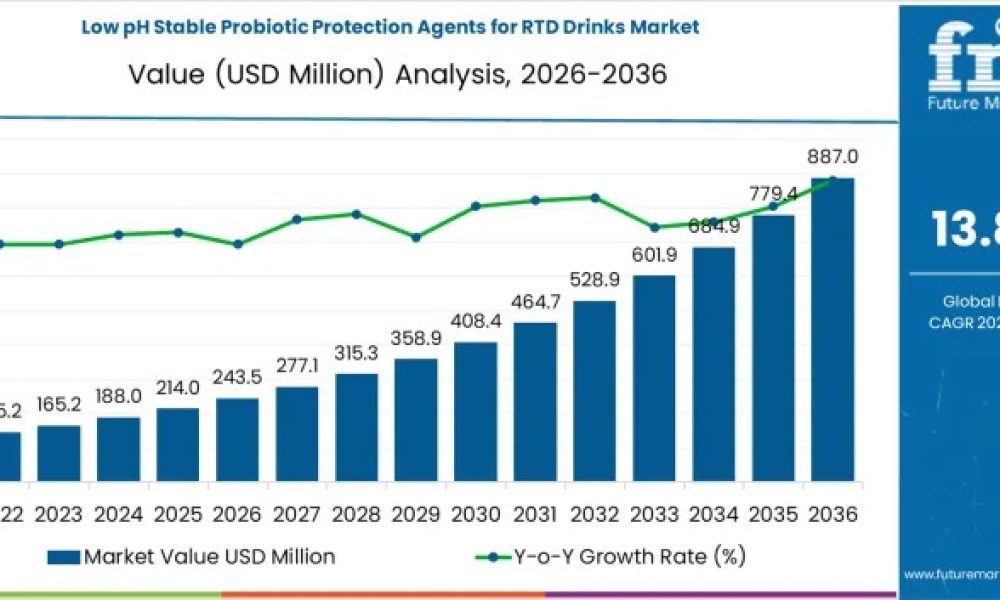
The global low-pH stable probiotic protection agents for RTD beverages market is valued at USD 243.5 million in 2026 and is projected to reach USD 887.0 million by 2036, expanding at a robust CAGR of 13.8%. Growth is not driven by overall probiotic beverage volume alone, but by the technical challenge of maintaining live probiotic viability in acidic liquid systems, where failure directly impacts label claims, regulatory compliance, and brand trust.
Unlike traditional ingredient markets, value in this segment concentrates upstream. Protection agents that reliably preserve viable counts under low pH, oxygen exposure, thermal stress, and long shelf life command pricing power. RTD manufacturers increasingly favor suppliers with proprietary encapsulation chemistries, validated survival data, and seamless integration into high-throughput beverage lines, as these reduce reformulation risk and costly product write-offs. As a result, margins accrue where protection efficacy demonstrably safeguards downstream brand equity.
Explore trends before investing – request a sample report today!
Buyer behavior reinforces this concentration of value. Beverage producers show minimal tolerance for performance variability, prioritizing systems that deliver predictable outcomes across fruit acids, fermented bases, and vitamin-fortified formulations. Switching costs remain high, as protection technologies are validated at the strain, formulation, and shelf-life level, making late-stage changes operationally disruptive. Procurement decisions therefore emphasize reliability, documentation, and regulatory readiness over marginal price differences.
Market Snapshot and Outlook
- Market Value (2026): USD 243.5 million
- Forecast Value (2036): USD 887.0 million
- CAGR (2026–2036): 13.8%
- Fastest-Growing Countries: India, China, USA, Germany
- Leading Application Segment: Standard RTD beverages
Between 2026 and 2036, growth quality will depend on execution discipline, strain-specific performance assurance, and alignment with tightening probiotic labeling standards, rather than rapid expansion of RTD formats alone.
Why Demand Is Accelerating Globally
Rising consumer focus on gut health, digestive wellness, and preventive nutrition is accelerating adoption of probiotic-enriched RTD drinks, including functional juices, kombucha, flavored waters, and dairy alternatives. These beverages typically operate at pH levels below 4, where unprotected probiotics rapidly lose viability. Low-pH stable protection agents—through encapsulation, carrier matrices, and controlled-release systems—enable probiotics to survive production, storage, and gastric transit, supporting consistent delivery of efficacious live counts.
Regulatory scrutiny across regions further strengthens demand. Authorities increasingly emphasize accuracy of probiotic labeling and substantiation of health claims, driving manufacturers toward protection technologies with documented, reproducible performance. Advances in microencapsulation and polymer matrices also improve compatibility with diverse beverage bases while maintaining sensory neutrality and, increasingly, clean-label positioning.
Market Structure and Application Dynamics
Global demand is shaped by the need to balance acid stability, shelf life, and sensory integrity. Protection agents are selected not only for survival rates, but also for their ability to integrate without altering taste, clarity, or processing efficiency.
Application Share of Global Demand:
- Standard applications: 50% – mass-market RTD functional beverages prioritizing cost efficiency and consistency
- Premium applications: 25% – differentiated wellness drinks requiring enhanced strain protection
- Industrial applications: 15% – bulk and institutional formulations demanding processing robustness
- Other niche uses: 10% – clinical and emerging functional concepts
Product Form and Distribution Trends
Liquid protection agents dominate with a 45% share, favored for direct integration and uniform dispersion during blending. Solid formats account for 35%, supporting dosing precision and pre-formulation storage stability. Gas-based systems (15%) and gel formats (5%) remain specialized, used in carbonation-linked or staged-release applications.
Distribution is led by direct supplier-to-manufacturer channels (60%), reflecting the technical complexity of low-pH stabilization and the need for close collaboration. Retail (20%), online (10%), and distributor channels (10%) support standardized solutions and early-stage development.
Regional Growth Highlights
- India: 16.1% CAGR, driven by rapid expansion of acidic, non-dairy probiotic RTDs and demand for cost-efficient, scalable protection systems.
- China: 15.6% CAGR, supported by large-scale RTD production, long distribution cycles, and regulatory focus on probiotic count accuracy.
- USA: 14.9% CAGR, shaped by clean-label expectations, kombucha and juice-based drinks, and heightened scrutiny of shelf-life viability claims.
- Germany: 14.2% CAGR, reflecting strong regulatory oversight, clinical validation culture, and adoption in pharmacy-distributed beverages.
To Access The Full Market Analysis, Strategic Recommendations, And Analyst Support, Purchase The Complete Report Here.
Competitive Landscape
The market is characterized by technology-led differentiation. Buyers evaluate encapsulation efficiency, survival at pH below 4, sensory neutrality, and regulatory documentation.
Key players include IFF, DSM-Firmenich, Kerry, ADM, Novonesis, and Lonza, each leveraging proprietary stabilization platforms and validation capabilities. Competitive advantage increasingly depends on protection reliability under acidic stress and scalability within RTD manufacturing environments.
About Future Market Insights (FMI)
Future Market Insights, Inc. (FMI) is an ESOMAR-certified, ISO 9001:2015 market research and consulting organization, trusted by Fortune 500 clients and global enterprises. With operations in the U.S., UK, India, and Dubai, FMI delivers data-backed insights and strategic intelligence across 30+ industries and 1,200 markets worldwide.



