
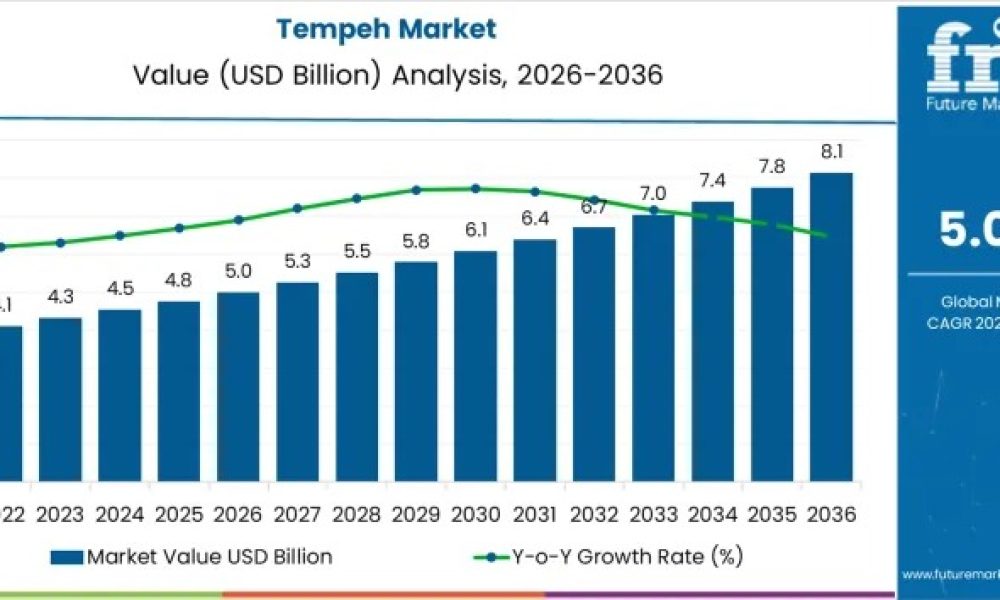
The global tempeh market is entering a structurally stronger growth phase, supported by rising demand for plant-based proteins and disciplined value capture strategies. The market is expected to reach USD 5 billion in 2026 and expand to USD 8.2 billion by 2036, registering a steady CAGR of 5% over the forecast period. While consumption growth remains consistent, competitive advantage is increasingly shaped by cost optimization, pricing control, and scalable production models, allowing leading players to preserve margins amid intensifying competition.
Explore trends before investing – request a sample report today!
Unlike early-stage plant-based categories driven purely by volume expansion, the tempeh market is transitioning toward margin concentration, where profitability depends on efficient sourcing of soybeans and multigrain inputs, streamlined fermentation processes, and operational scale. Companies that tightly manage cost of goods sold while reinforcing brand trust and quality credentials are capturing disproportionate value as the category matures.
Tempeh’s rise is closely linked to broader shifts in consumer behavior. Demand for nutrient-dense, minimally processed, and sustainable foods continues to climb, particularly among flexitarians, vegetarians, and health-focused consumers. As a fermented soy product rich in protein, fiber, and probiotics, tempeh is increasingly positioned as both a functional food and a meat alternative, expanding its relevance across retail and foodservice channels.
From a product economics perspective, frozen tempeh currently leads the market, accounting for approximately 45% of total sales. Its extended shelf life, reduced spoilage risk, and compatibility with large-scale distribution make it the preferred format for both retailers and foodservice operators. Frozen offerings also support better inventory management, reinforcing margin stability for manufacturers operating at scale.
Flavor segmentation further illustrates how value is distributed within the market. Plain tempeh dominates with a 65% share, reflecting its versatility and wide culinary adoption. Its neutral profile allows consumers to customize flavors, making it attractive across cuisines and cultural preferences. This adaptability has helped plain tempeh remain the backbone of the category, particularly in households experimenting with plant-based meals for the first time.
At the same time, margin expansion opportunities are emerging through value-added and premium formats. Flavored, marinated, and ready-to-eat tempeh products are enabling producers to command higher price points while responding to demand for convenience. Brands that successfully balance premium positioning with cost-efficient production are outperforming volume-led competitors, especially in urban markets with higher disposable incomes.
Regionally, Asia Pacific and North America remain the most influential growth engines. Asia Pacific benefits from cultural familiarity with fermented foods and rising interest in modernized plant-based diets. North America, meanwhile, is driven by strong adoption of vegan and flexitarian lifestyles, supported by widespread retail availability and foodservice integration.
Country-level growth data highlights uneven but promising expansion patterns. The United States leads with an 11.7% CAGR, reflecting strong demand for plant-based proteins, heightened environmental awareness, and innovation in ready-to-cook formats. India follows at 9.9%, fueled by rising health consciousness, a large vegetarian population, and increasing availability of tempeh through modern retail and specialty food outlets. The UK grows at 6.7%, supported by clean-label preferences and sustainability-driven purchasing. Japan (4.6%) and Germany (4.4%) show steady growth, anchored by interest in fermented foods, gut health, and reduced meat consumption.
Underlying these trends is a competitive landscape focused less on aggressive price wars and more on operational excellence and brand differentiation. Leading players are investing in clean labeling, non-GMO sourcing, sustainable packaging, and transparent fermentation practices to reinforce consumer trust. Strategic pricing discipline, combined with scale efficiencies, is enabling established brands to defend margins while expanding distribution.
To Access The Full Market Analysis, Strategic Recommendations, And Analyst Support, Purchase The Complete Report Here.
Looking ahead, the tempeh market’s growth between 2026 and 2036 will be defined by how effectively companies align cost control with innovation. Players that scale production without compromising quality, diversify raw material sourcing, and introduce premium yet convenient product lines will be best positioned to lead. As plant-based eating evolves from a trend into a mainstream dietary shift, tempeh’s balance of nutrition, sustainability, and affordability positions it as a durable growth category rather than a short-term alternative.
Key Players in the Global Tempeh Market
- Lightlife Foods
- Turtle Island Foods (Tofurky)
- The Bridge
- Hain Celestial
- Nutrisoy Pty Ltd
About Future Market Insights (FMI)
Future Market Insights, Inc. (FMI) is an ESOMAR-certified, ISO 9001:2015 market research and consulting organization, trusted by Fortune 500 clients and global enterprises. With operations in the U.S., UK, India, and Dubai, FMI provides data-backed insights and strategic intelligence across 30+ industries and 1,200 markets worldwide.



