
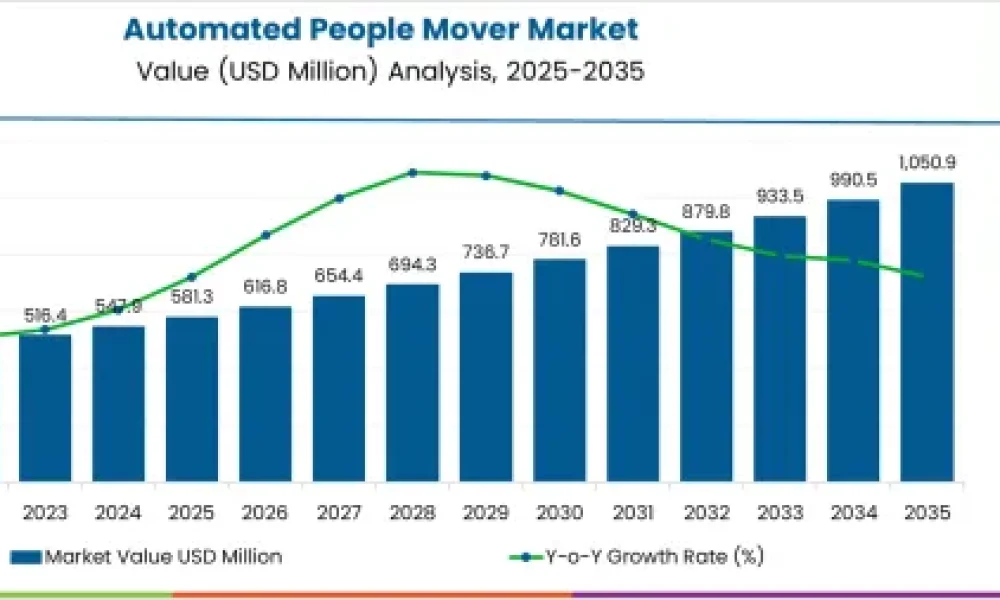
The global automated people mover (APM) market is entering a phase of sustained, infrastructure-led growth, supported by accelerating urbanization, airport expansion, and the prioritization of efficient, low-emission mobility solutions. Valued at USD 616.8 million in 2026, the market is projected to reach USD 1,115.1 million by 2036, expanding at a compound annual growth rate (CAGR) of 6.1%. This trajectory reflects the growing strategic role of automated transit systems in managing passenger flows within high-density, high-traffic environments.
Automated people movers—driverless, fixed-guideway systems designed for short- to medium-distance transport—have become integral to modern airport design, urban transit hubs, and large-scale commercial and mixed-use developments. Their ability to deliver predictable, high-frequency service with minimal operational variability continues to underpin adoption across global transportation networks.
Growth Outlook and Market Maturity Dynamics
Between 2026 and 2031, the APM market is expected to expand from USD 616.8 million to USD 879.9 million, driven by active infrastructure investment cycles and the integration of automated systems into new airport terminals, urban rail interchanges, and smart city developments. During this period, demand will be supported by capacity expansion in air travel, congestion mitigation initiatives in major cities, and policy frameworks favoring electrified, automated transport.
From 2031 to 2036, market growth is forecast to continue at a moderated pace, rising from USD 879.9 million to USD 1,115.1 million. This deceleration reflects gradual saturation in highly urbanized regions with established transit infrastructure, where automated people mover technology is already widely deployed. Nevertheless, incremental growth will persist, driven by system upgrades, efficiency improvements, network extensions, and adoption in emerging urban centers.
Get access to comprehensive data tables and detailed market insights — request your sample report today!
Key Demand Drivers Shaping Market Expansion
Historically, the APM market has been anchored by airport applications, where the need to move large passenger volumes efficiently between terminals, concourses, parking facilities, and intermodal connections has been critical. As global air travel expanded, automated people movers emerged as a proven solution to reduce walking distances, improve connectivity, and enhance overall passenger experience.
Today, airports remain the dominant application segment, accounting for 67% of the global market. Ongoing airport expansions, rising passenger throughput, and the operational imperative to reduce congestion and dwell times continue to support demand. Automated systems also align with sustainability objectives, as electric, driverless operations reduce emissions and long-term operating costs compared with conventional shuttle services.
Beyond airports, urban transit applications are gaining momentum as cities seek reliable, high-capacity solutions for dense corridors with predictable demand patterns. Automated people movers are increasingly integrated into metro systems, central business districts, and large campuses, offering seamless first- and last-mile connectivity.
System Type Leadership and Technology Preference
By system type, duo rail technology dominates the global APM market, holding an estimated 82% share. Duo rail systems are favored for their operational reliability, cost efficiency, and ability to handle high passenger volumes with minimal maintenance requirements. Their fixed-track design, electric propulsion, and proven safety record make them particularly suitable for airports and urban transit nodes where uptime and predictability are critical.
Alternative system types—including automated guideway transit (AGT), maglev, monorail, and cable-propelled systems—serve niche applications and specialized environments. However, duo rail systems continue to set the industry benchmark, benefiting from standardization, easier integration with existing infrastructure, and favorable lifecycle economics.
Regional Growth Patterns and Country-Level Momentum
Geographically, Asia-Pacific is emerging as the primary growth engine for the automated people mover market. China leads global expansion, with a projected CAGR of 6.5% from 2026 to 2036. Rapid urbanization, large-scale airport construction, and substantial investment in smart city initiatives are driving widespread adoption of automated transit systems across major metropolitan areas.
Saudi Arabia follows closely, with an estimated CAGR of 6.4%, supported by ambitious infrastructure programs, airport modernization, and the development of new urban centers. India’s market is projected to grow at 6.3%, reflecting increasing urban density, expanding airport capacity, and government-led initiatives promoting sustainable mobility. South Korea and Singapore continue to demonstrate steady demand, driven by continuous upgrades to mature transportation networks and a focus on operational efficiency.
Market Risks and Execution Considerations
Despite its favorable outlook, the automated people mover market faces notable execution risks. Large-scale infrastructure projects are inherently complex, particularly in dense urban environments, where land constraints, system integration challenges, and regulatory approvals can lead to delays and cost overruns. High upfront capital expenditure remains a barrier in budget-constrained regions, influencing project timelines and procurement decisions.
Economic sensitivity is another critical factor. Shifts in government spending priorities or private sector funding availability can affect the pace of adoption, as stakeholders weigh long-term operational benefits against initial investment requirements. Market success will increasingly depend on suppliers’ ability to manage these risks through disciplined project execution, modular system design, and cost-effective delivery without compromising safety or quality.
Competitive Landscape and Strategic Positioning
The competitive environment is characterized by established global players with deep expertise in automated transit and rail technologies. Companies such as Thyssenkrupp AG, Hitachi Rail, CRRC Corporation, Mitsubishi Heavy Industries, Siemens Mobility, Bombardier Transportation, and Alstom lead the market through innovation, scalability, and proven deployment capabilities. Specialized providers including Intamin Transportation, Doppelmayr Cable Car, and Poma Group further enhance competition by addressing niche and cable-based applications.
As urban mobility strategies evolve and sustainability targets become more stringent, automated people movers are positioned as a foundational component of future-ready transportation networks. Detailed market intelligence, segmentation analysis, and competitive benchmarking will be essential for stakeholders seeking to navigate this increasingly sophisticated landscape and capitalize on long-term growth opportunities.
Why Choose FMI: Empowering Decisions that Drive Real-World Outcomes: https://www.futuremarketinsights.com/why-fmi
About Future Market Insights (FMI)
Future Market Insights, Inc. (FMI) is an ESOMAR-certified, ISO 9001:2015 market research and consulting organization, trusted by Fortune 500 clients and global enterprises. With operations in the U.S., UK, India, and Dubai, FMI provides data-backed insights and strategic intelligence across 30+ industries and 1200 markets worldwide.



