
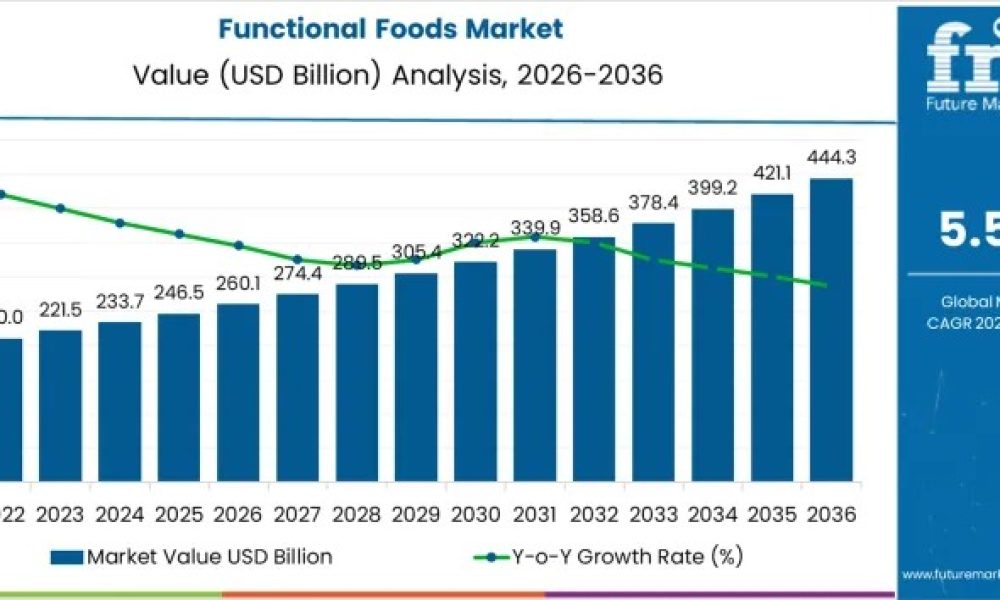
The global functional foods market is entering a phase of sustained, quality-driven expansion, projected to grow from USD 260.1 billion in 2026 to USD 442.1 billion by 2036, registering a CAGR of 5.50%. Growth is no longer defined solely by consumer demand for health benefits, but increasingly by how buyers manage risk, regulatory exposure, and long-term supplier reliability. Procurement strategies across food manufacturers, retailers, and institutional buyers now prioritize vendors with proven scientific credibility, regulatory compliance, and consistent product performance.
Functional foods—products enhanced with probiotics, prebiotics, omega-3 fatty acids, vitamins, minerals, and bioactive compounds—are becoming a core part of everyday diets rather than niche wellness options. As preventive healthcare gains traction globally, buyers are shifting toward established suppliers that can demonstrate validated health claims, robust quality systems, and scalable production. This preference is particularly strong in high-impact segments such as digestive health, immunity support, and metabolic wellness, where product efficacy and safety directly influence brand trust.
Explore trends before investing – request a sample report today!
Market Snapshot: Functional Foods at a Glance
- Market Value (2026): USD 260.1 Billion
- Forecast Value (2036): USD 442.1 Billion
- CAGR (2026–2036): 5.50%
- Leading Product Type: Dairy Products
- Key Growth Regions: Asia Pacific, North America
Procurement Dynamics Reinforce Vendor Stability
Vendor lock-in plays a defining role in the functional foods supply chain. Complex formulations, proprietary ingredient blends, and integrated sourcing models create high switching costs, making buyers cautious about changing suppliers. Long-term partnerships are favored, especially where consistency in taste, functionality, and regulatory documentation is critical. As a result, procurement decisions emphasize continuity, risk mitigation, and alignment with evolving nutrition science rather than short-term cost advantages.
Market Advancement Driven by Health-Focused Lifestyles
Rising awareness of the relationship between diet and long-term health continues to fuel steady demand. Consumers increasingly seek foods that support immunity, digestive balance, heart health, weight management, and cognitive performance. This shift is amplified by aging populations in developed economies and urbanizing middle-class consumers in emerging markets, both of whom are more inclined to invest in functional nutrition.
Clean-label expectations and demand for natural ingredients are accelerating innovation. Manufacturers are reformulating products to remove artificial additives while maintaining functionality. Plant-based functional foods are also gaining traction, reflecting dietary shifts toward vegetarian, vegan, and flexitarian lifestyles across Asia Pacific, Europe, and North America.
Segment Performance Highlights
Dairy products dominate the functional foods market with a 32.10% share, supported by widespread consumption and high compatibility with functional ingredients such as probiotics, calcium, and fortified proteins. Yogurt, kefir, and fortified milk continue to anchor this segment due to strong associations with gut health and bone strength.
On the application side, digestive health accounts for 26.40% of total demand. Products targeting gut microbiome balance address common concerns such as bloating, indigestion, and nutrient absorption, making them a priority for both consumers and institutional buyers.
Regional Growth Patterns Reflect Diverse Health Priorities
Asia Pacific and North America remain the fastest-growing regions, driven by rising disposable incomes, advanced retail infrastructure, and proactive health awareness campaigns. Country-level growth underscores this momentum:
- China: 7.4% CAGR, driven by urban health awareness and premium nutrition demand
- India: 6.8% CAGR, supported by preventive healthcare focus and plant-based adoption
- Germany: 6.3% CAGR, led by organic and functional food integration
- France: 5.7% CAGR, emphasizing digestive health and clean-label products
- UK: 5.2% CAGR, fueled by gut health and immune-support trends
To Access the Full Market Analysis, Strategic Recommendations, And Analyst Support, Purchase The Complete Report Here.
Competitive Landscape: Science, Trust, and Brand Equity
Competition in the functional foods market centers on scientific validation, ingredient quality, and consumer confidence. Leading players position themselves through differentiated strategies:
- General Mills Inc. leverages mainstream brands with fortified formulations focused on fiber, protein, and whole grains.
- BASF strengthens the ecosystem as an ingredient supplier, emphasizing clinically supported bioactives and regulatory reliability.
- Amway focuses on personalized, direct-to-consumer functional nutrition supported by education-driven marketing.
- Arla Foods advances dairy-based functional solutions with a strong emphasis on gut and immune health.
- GFR Pharma targets specialized health outcomes through clinically researched, high-bioavailability formulations.
As functional foods transition from optional wellness products to everyday dietary staples, market success increasingly depends on credibility, compliance, and consistency. Vendors able to balance innovation with trust are best positioned to capture long-term value in this steadily expanding global market.
About Future Market Insights (FMI)
Future Market Insights, Inc. (FMI) is an ESOMAR-certified, ISO 9001:2015 market research and consulting organization, trusted by Fortune 500 clients and global enterprises. With operations in the U.S., UK, India, and Dubai, FMI provides data-backed insights and strategic intelligence across 30+ industries and 1,200 markets worldwide.



