
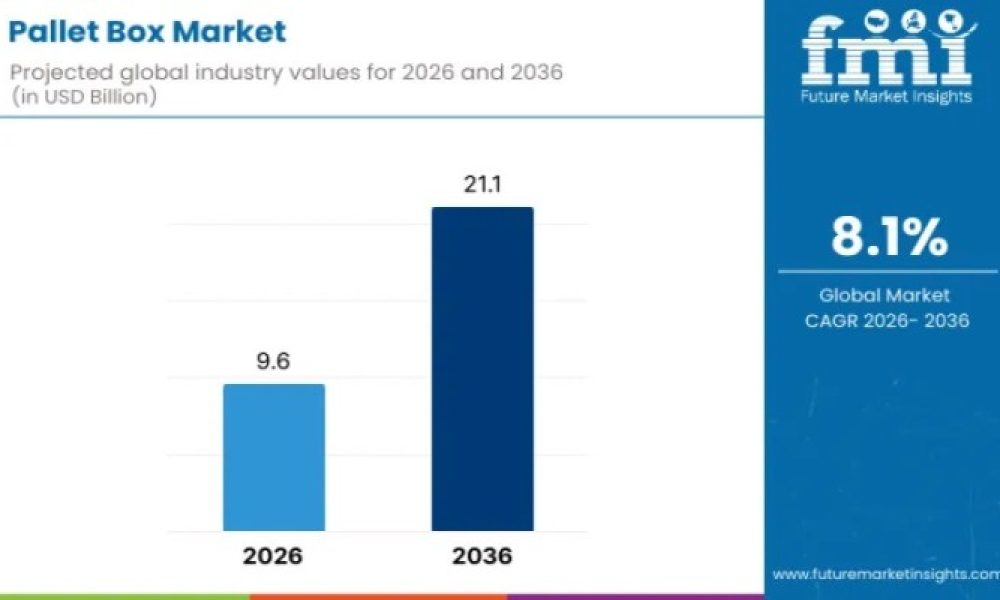
The global pallet box market is entering a decade of accelerated transformation as supply chains worldwide prioritize efficiency, durability, and sustainability. Between 2026 and 2036, pallet boxes are expected to evolve from being simple transport containers into strategic logistics assets. Valued at USD 9.6 billion in 2026, the market is forecast to more than double, reaching USD 21.1 billion by 2036, expanding at a robust CAGR of 8.1%. This growth reflects the rising complexity of global trade, the surge in automation, and the demand for reusable, high-performance packaging across industries.
Meaning and Market Definition
Pallet boxes are heavy-duty bulk containers designed for stacking, storing, and transporting goods efficiently within modern logistics systems. Typically compatible with forklifts and automated handling equipment, they combine the structural advantages of pallets with the protective enclosure of boxes. Available in plastic, metal, corrugated, and composite materials, pallet boxes are widely used in sectors where product protection, hygiene, and load stability are critical.
Unlock Growth Potential and Explore Market Opportunities With Our Comprehensive Industry Overview. Request Your Sample Now
Market Overview
The pallet box market is benefiting from structural shifts in warehousing, distribution, and manufacturing. Industries are moving away from disposable packaging toward returnable and reusable solutions that lower long-term costs and environmental impact. Pallet boxes offer durability, standardized dimensions, and ease of handling—qualities that make them indispensable in high-volume logistics environments.
Quick Market Highlights:
- Market Value (2026): USD 9.6 billion
- Forecast Value (2036): USD 21.1 billion
- Forecast CAGR (2026–2036): 8.1%
- Leading Design Type: Rigid Pallet Boxes (68%)
- Dominant End Use: Food & Agriculture (42%)
- Key Regions: North America, Europe, Asia Pacific
Market Growth Outlook
Growth in the pallet box market is tightly linked to the expansion of global trade, e-commerce, and automated logistics infrastructure. As warehouses become more mechanized, packaging formats must withstand repetitive handling, stacking pressure, and long distribution cycles. Rigid pallet boxes, in particular, are gaining traction due to their compatibility with automated storage and retrieval systems.
Additionally, regulatory pressure to reduce packaging waste is accelerating adoption. Reusable pallet boxes align well with circular economy models, making them attractive for companies aiming to meet sustainability targets without compromising operational performance.
Demand Dynamics
Demand for pallet boxes is strongest in industries that manage high volumes, heavy loads, or sensitive goods. Food, pharmaceuticals, automotive, and chemicals increasingly rely on pallet boxes to minimize damage, ensure hygiene, and improve handling efficiency.
Key Demand Drivers Include:
- Rising warehouse automation and robotics adoption
- Expansion of e-commerce and omnichannel distribution
- Need for hygienic, contamination-resistant packaging
- Long-term cost benefits of reusable packaging systems
The food and agriculture sector leads demand, driven by the need for ventilated, easy-to-clean containers that preserve freshness and meet strict safety regulations.
Segmentation Overview
The pallet box market is segmented to address diverse operational requirements:
- By Material Type
- Plastic pallet boxes
- Metal pallet boxes
- Corrugated pallet boxes
- Wood composite pallet boxes
- By Design Type
- Rigid pallet boxes
- Foldable pallet boxes
- Collapsible sleeve pallet boxes
- By Load Capacity
- Below 500 kg
- 500–1000 kg
- 1000–1500 kg
- Above 1500 kg
- By End-Use Industry
- Food & agriculture
- Automotive
- Pharmaceuticals & healthcare
- Chemicals & hazardous materials
- Others
Key Market Trends
The pallet box market is undergoing a technological and structural upgrade. Smart logistics and sustainability are no longer optional—they are shaping purchasing decisions.
Major Trends Shaping the Market:
- IoT-enabled pallet boxes for real-time tracking and asset visibility
- Automation-ready designs compatible with robotic handling
- Lightweight yet high-strength materials to improve efficiency
- Eco-friendly and recyclable materials supporting sustainability goals
Smart pallet boxes with tracking sensors are increasingly used for temperature-sensitive and high-value goods, reducing losses and improving inventory accuracy.
Regional and Country-Level Outlook
Asia Pacific is emerging as the fastest-growing region, with China leading at a CAGR of 10.2% through 2036. China’s dominance stems from its massive manufacturing base, expanding logistics infrastructure, and shift toward standardized material handling systems.
Country Growth Snapshot:
- China: 10.2% CAGR
- USA: 7.5% CAGR
- Germany: 7.1% CAGR
- UK: 6.8% CAGR
- Japan: 6.4% CAGR
North America follows closely, driven by e-commerce growth, warehouse automation, and sustainability initiatives. Europe’s growth is supported by strong industrial activity and advanced logistics networks, while Japan continues to focus on precision, quality, and automation-driven efficiency.
Competitive Landscape
Competition in the pallet box market is intensifying as manufacturers move beyond product sales toward integrated packaging solutions. Leading players are investing in material innovation, advanced molding techniques, and smart features to differentiate their offerings.
Key Competitive Strategies:
- Development of automation-compatible designs
- Focus on reusable and returnable packaging systems
- Customization for industry-specific applications
- Long-term partnerships with logistics operators
Market leaders such as Schoeller Allibert, ORBIS Corporation, and Craemer Group dominate through scale, innovation, and global reach. Meanwhile, companies like DS Smith and Rehrig Pacific Company strengthen the market with corrugated and reusable packaging expertise.
Why FMI: https://www.futuremarketinsights.com/why-fmi
About Future Market Insights (FMI)
Future Market Insights, Inc. (FMI) is an ESOMAR-certified, ISO 9001:2015 market research and consulting organization, trusted by Fortune 500 clients and global enterprises. With operations in the U.S., UK, India, and Dubai, FMI provides data-backed insights and strategic intelligence across 30+ industries and 1200 markets worldwide.



