
The global market for bio-based coagulants in municipal water treatment stands at USD 285.5 million in 2026 and is projected to expand to USD 727.1 million by 2036, achieving a compound annual growth rate (CAGR) of 9.8%. This robust trajectory underscores a pivotal shift toward sustainable coagulation solutions, propelled by stringent regulatory limits on aluminum- and iron-based residuals, heightened emphasis on low-toxicity sludge management, and accelerating adoption of biodegradable treatment inputs amid rising environmental compliance demands.
Municipal utilities worldwide are transitioning from conventional inorganic salts and synthetic polymers to bio-derived alternatives, including plant-based, microbial, and bio-polymer systems. These innovations deliver superior charge neutralization, enhanced turbidity removal, organic matter reduction, and color control across diverse raw water conditions—while slashing secondary pollution risks, chemical dosages, and sludge volumes. As potable water quality standards tighten and carbon reduction goals intensify, bio-based coagulants enable operators to align treatment processes with eco-design principles and circular economy objectives.
Bio-Polymer Coagulants Dominate Demand with 38% Share
Bio-polymer coagulants, sourced from chitosan, starch, and guar, command the largest segment at 38.0% of global demand. Their biodegradability and low environmental persistence outperform alternatives, fostering efficient floc formation and clarification. Plant-derived tannin-based coagulants follow at 26.0%, leveraging polyphenolic interactions for solids removal. Bio-modified hybrids hold 22.0%, blending organic polymers with enhancements for optimized performance, while other natural options account for 14.0%. This distribution signals a clear preference for scalable, renewable systems that minimize lifecycle impacts.
Drinking water treatment leads applications with 42.0% adoption, prioritizing human health safeguards and residue-free outputs. Sewage and wastewater clarification captures 28.0%, bolstering solids management and biological process stability. Sludge thickening/dewatering claims 16.0% by enabling volume reduction and easier handling, with stormwater/surface water at 10.0% and other uses at 4.0%. Large urban utilities drive 40.0% of demand, navigating high volumes and intense regulatory scrutiny, followed by medium-sized municipalities at 32.0%, small/rural systems at 20.0%, and decentralized setups at 8.0%.
Get access to comprehensive data tables and detailed market insights — request your sample report today!
Fastest-Growing Markets: India Leads at 11.2% CAGR
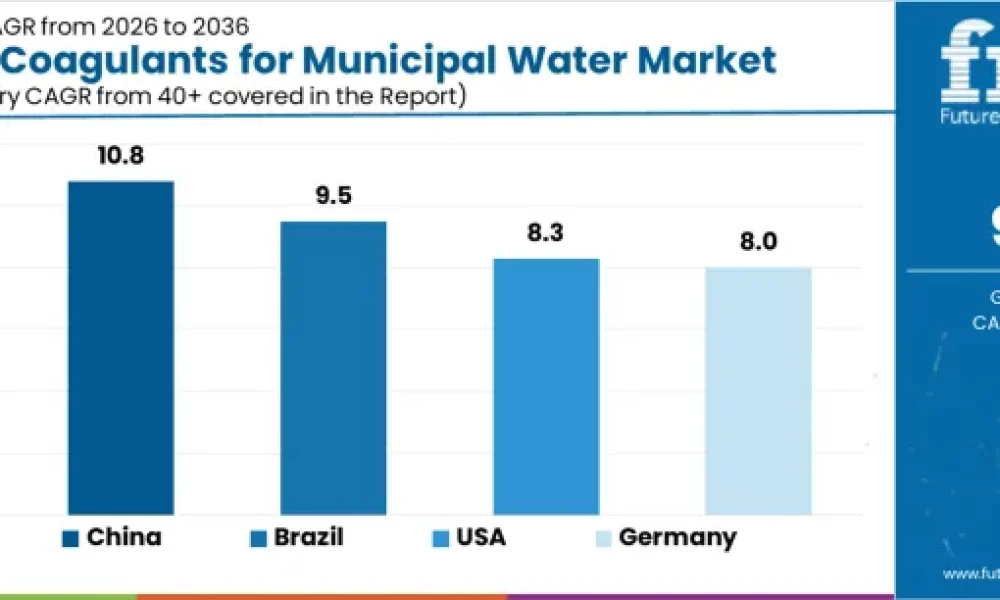
Regional dynamics reveal accelerated growth in emerging and developed economies alike. India tops the list with an 11.2% CAGR, fueled by municipal infrastructure expansion, rural water schemes, and policies favoring low-residual, locally sourced coagulants to curb aluminum/iron toxicity and disposal costs. China follows at 10.8%, propelled by urban upgrades, green procurement, and hybrid system pilots in massive treatment plants. Brazil achieves 9.5% via seasonal turbidity management and resilient formulations for variable climates. The USA records 8.3%, driven by sustainability programs, sludge cost reductions, and seamless integration into legacy infrastructure. Germany sustains 8.0% growth through circular economy mandates, precision dosing, and lifecycle assessments.
These markets reflect broader trends: regulatory enforcement on turbidity, byproducts, and residuals; public demands for green chemistry; and operational needs for performance across pH extremes, organic loads, and particulates. Cost competitiveness hinges on total ownership metrics—including dosing efficiency and sludge dewatering—despite raw material variability. Scalability demands innovation in supply chains, operator training, and automated dosing for consistent outcomes.
Competitive Landscape Positions Leaders for Expansion
Key players dominate through bio-polymer optimization, reliable sourcing, and municipal integration. SNF Floerger excels with hybrid systems and global production networks. Kemira advances bio-derived blends for phased transitions. Solenis delivers renewable-content solutions tied to sustainability programs. Ecolab pairs chemistries with monitoring services for peak efficiency. Veolia Water Technologies embeds coagulants in comprehensive treatment suites, ensuring compliance and impact reduction.
This evolving landscape demands strategic foresight as utilities prioritize suppliers offering proven efficacy, regulatory alignment, and supply security. Bio-based coagulants not only meet current mandates but position operations for future resilience amid potable reuse, decentralization, and net-zero goals.
Why Choose FMI: Empowering Decisions that Drive Real-World Outcomes: https://www.futuremarketinsights.com/why-fmi
About Future Market Insights (FMI)
Future Market Insights, Inc. (FMI) is an ESOMAR-certified, ISO 9001:2015 market research and consulting organization, trusted by Fortune 500 clients and global enterprises. With operations in the U.S., UK, India, and Dubai, FMI provides data-backed insights and strategic intelligence across 30+ industries and 1200 markets worldwide.



