
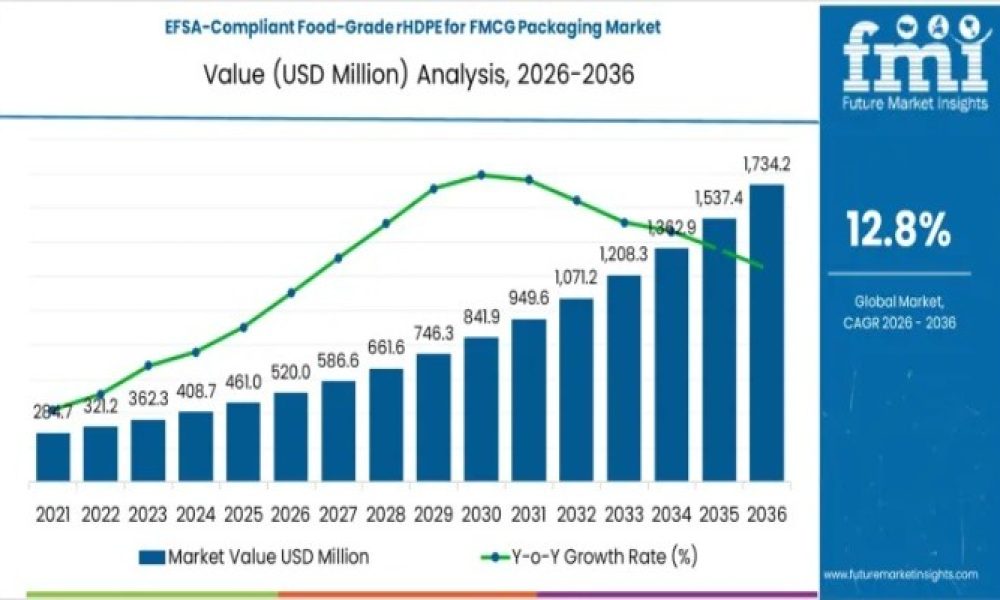
The EFSA-compliant food-grade rHDPE for FMCG packaging market is valued at USD 520 million in 2026 and is projected to reach USD 1,734.2 million by 2036, expanding at a CAGR of 12.8%. Growth is supported by regulatory mandates promoting recycled content, sustainability commitments from major FMCG brands, and rapid improvements in recycling and purification technologies.
EFSA-compliant food-grade rHDPE refers to recycled high-density polyethylene that has been processed using approved recycling technologies and validated by the European Food Safety Authority for direct food contact applications. Unlike conventional recycled plastics, EFSA-compliant rHDPE must meet rigorous requirements related to contaminant removal, traceability, migration limits, and quality assurance. This compliance enables its use in sensitive FMCG packaging formats such as food bottles, dairy containers, edible oil packaging, and closures.
Explore Opportunities – Get Your Sample of Our Industry Overview Now!
The global packaging industry is undergoing a structural shift as sustainability, regulatory compliance, and circular economy goals reshape material selection. Within this transformation, EFSA-compliant food-grade recycled high-density polyethylene (rHDPE) has emerged as a critical material for fast-moving consumer goods (FMCG) packaging.
From food and beverages to household essentials, FMCG brands are under mounting pressure to reduce virgin plastic use while maintaining strict food safety standards. Between 2026 and 2036, EFSA-compliant food-grade rHDPE is expected to move from a niche solution to a mainstream packaging material across Europe and beyond.
Quick Market Highlights
- Market Value (2026): USD 520 million
- Forecast Value (2036): USD 1,734.2 million
- Forecast CAGR (2026–2036): 12.8%
- Leading Source Material: Post-consumer food bottles & jugs (45%)
- Leading Packaging Type: Rigid bottles & jugs (42%)
- Key Growth Market: Germany
Market Outlook (2026–2036)
The market outlook remains strongly positive over the next decade. From 2026 to 2031, adoption will accelerate as FMCG companies integrate recycled content to meet sustainability targets and regulatory obligations. This phase is expected to witness moderate growth volatility as supply chains adjust to food-grade requirements. From 2031 onward, the market is projected to stabilize as EFSA-compliant rHDPE becomes a standardized packaging material, supported by scaled recycling capacity and reduced production costs.
Growth Drivers
Several structural factors are driving sustained growth in the EFSA-compliant food-grade rHDPE market:
- Tightening EU regulations encouraging recycled content in food contact materials
- Corporate sustainability and ESG commitments by global FMCG brands
- Rising consumer preference for environmentally responsible packaging
- Improved sorting, decontamination, and purification technologies
- Expansion of closed-loop recycling systems for food packaging
Germany leads growth due to its advanced recycling infrastructure, strong regulatory enforcement, and early adoption of circular economy principles.
Demand Dynamics
Demand for EFSA-compliant food-grade rHDPE is primarily driven by its ability to replace virgin plastics without compromising food safety. Historically, recycled HDPE was limited to non-food applications due to contamination risks. EFSA approvals have changed this landscape by enabling legally compliant food contact usage.
Key Demand Factors
- Legal authorization for direct food contact applications
- Cost stability compared to volatile virgin polymer pricing
- Increased use in dairy, beverages, sauces, and edible oils
- Retailer pressure on brands to disclose recycled content
As FMCG companies aim to future-proof packaging portfolios, EFSA-compliant rHDPE is increasingly viewed as a strategic material rather than an experimental alternative.
Market Segmentation Insights
By Source Material
- Post-consumer food bottles & jugs – 45%
- Closed-loop crates & containers
- Post-industrial food HDPE waste
- Mixed PCR with enhanced sorting
Post-consumer food bottles and jugs dominate due to consistent availability, established collection systems, and proven recyclability into food-grade material.
By Packaging Type
- Rigid bottles & jugs – 42%
- Closures & lids
- Crates & pallets
- Other rigid food-contact packaging
Rigid bottles and jugs lead due to their widespread use across FMCG food and beverage categories and compatibility with recycled HDPE.
Emerging Trends
The market is being shaped by innovation across the recycling and packaging value chain:
- Digital traceability systems to verify material origin and compliance
- Hybrid recycling models combining mechanical and advanced purification
- Deposit-return schemes improving feedstock quality and volume
- Collaboration between recyclers, brands, and certification bodies
- Circular packaging design focused on recyclability and closed-loop recovery
These trends are improving supply reliability while strengthening regulatory confidence in recycled food-grade plastics.
Competitive Landscape
The EFSA-compliant food-grade rHDPE market is moderately consolidated, with competition centered on technology capability, regulatory expertise, and supply consistency.
Leading Market Participants
- Schoeller Allibert
- Alpla
- Biffa Polymers
- Morssinkhof Plastics
- Veolia
- Indorama Ventures
- Plastipak Packaging
- Suez / Recycling Units
- Michelman
- Krones AG
Market leaders are investing heavily in advanced recycling technologies, certification pathways, and partnerships with FMCG brands to scale food-grade rHDPE adoption. Competitive advantage increasingly depends on the ability to deliver consistent quality, traceability, and compliance at scale.
Why FMI: https://www.futuremarketinsights.com/why-fmi
About Future Market Insights (FMI)
Future Market Insights, Inc. (FMI) is an ESOMAR-certified, ISO 9001:2015 market research and consulting organization, trusted by Fortune 500 clients and global enterprises. With operations in the U.S., UK, India, and Dubai, FMI provides data-backed insights and strategic intelligence across 30+ industries and 1200 markets worldwide.



