
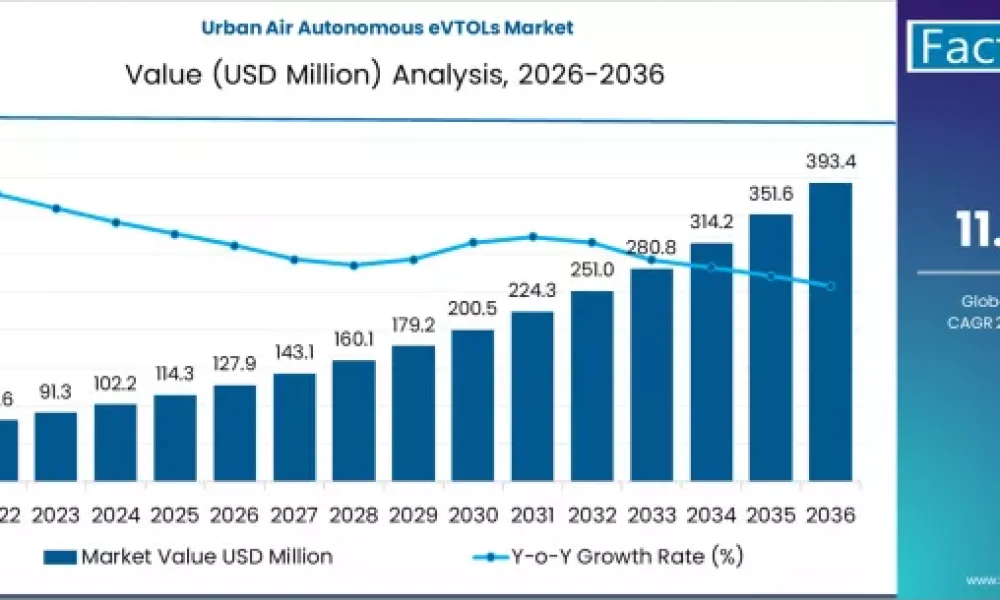
The urban air autonomous electric vertical take-off and landing (eVTOL) market is transitioning from experimental pilots to a structured, investment-ready mobility ecosystem. Between 2026 and 2036, autonomous and semi-autonomous eVTOLs are expected to reshape urban logistics, emergency response, and passenger mobility, supported by rapid advances in autonomy software, battery density, and regulatory sandboxes across major economies.
Market Valuation and Size Outlook (2026–2036)
The urban air autonomous eVTOLs market is projected to be valued at approximately USD 127.9 million in 2026 and is expected to reach USD 393.4 million by 2036, representing a compound annual growth rate (CAGR) of nearly 12% over the decade. While this figure reflects the narrowly defined autonomous eVTOL segment, it sits within a much larger and faster-growing urban air mobility (UAM) ecosystem.
Broader urban air mobility forecasts underline the scale of the opportunity. The global UAM market is expected to expand from roughly USD 6 billion in 2026 to nearly USD 70 billion by 2040, growing at a CAGR above 20%. Autonomous eVTOLs are expected to capture an increasing share of this value pool as certification frameworks mature and pilotless operations prove cost-efficient at scale.
From a regional perspective, North America currently dominates revenues, driven by early regulatory engagement and strong venture funding, while Asia-Pacific is the fastest-growing region, led by China, Japan, and Singapore. Double-digit growth rates are expected in the United States, China, Japan, and the UAE for autonomous eVTOL deployments through 2036.
To access the complete data tables and in-depth insights, request a Discount On The Report here: https://www.factmr.com/connectus/sample?flag=S&rep_id=13376
ROI Potential: Economics of Autonomous eVTOLs
The investment thesis for autonomous eVTOLs is underpinned by structural cost advantages compared with piloted aircraft. Industry benchmarks indicate that pilot costs account for 20–30% of operating expenses in early air-taxi models. Full autonomy, once certified, can materially improve margins by removing this constraint while enabling higher aircraft utilization rates.
Cargo logistics is emerging as the highest-ROI near-term use case. In 2026, cargo applications are expected to account for over a third of the autonomous eVTOL market, benefiting from fewer regulatory hurdles and clearer unit economics. Autonomous eVTOLs used for medical supplies, e-commerce, and just-in-time manufacturing can achieve utilization rates above 8–10 flight hours per day, significantly higher than early passenger air-taxi services.
On the passenger side, long-term ROI is driven by scale. The overall urban air mobility market is expected to grow from under USD 10 billion in 2026 to more than USD 90 billion by 2034, implying strong growth during peak commercialization years. As autonomous operations expand within this market, operators are expected to move toward per-seat-mile costs comparable to premium ground ride-hailing, unlocking mass-market demand rather than niche luxury usage.
Infrastructure investments further enhance returns. The eVTOL charging and vertiport ecosystem alone is projected to quadruple over the next decade, creating ancillary revenue streams for early investors and municipalities.
Technology and Cost Curves
Technological learning curves are central to long-term profitability. The broader eVTOL aircraft market is forecast to grow rapidly, reflecting advances in battery innovation, distributed electric propulsion, and automotive-style manufacturing. As production volumes rise, unit costs are expected to fall by 40–60% over the next decade, significantly improving capital efficiency for fleet operators.
Autonomy software represents another value lever. Advances in AI-based detect-and-avoid systems, redundant flight controls, and urban traffic management platforms are accelerating certification pathways. While piloted aircraft dominate early deployments, autonomous variants are projected to grow at a significantly faster pace through 2040, outpacing other segments and establishing dominance in the long term.
Long-Term Growth Prospects (2030–2036 and Beyond)
Looking beyond initial commercialization, long-term growth prospects are closely tied to urbanization and sustainability goals. Long-range projections estimate hundreds of billions of dollars in cumulative passenger revenue opportunities and demand for tens of thousands of aircraft over the next two decades, driven by traffic congestion and decarbonization mandates.
Policy momentum is also strengthening globally. Several countries are investing in low-altitude airspace frameworks and urban air infrastructure, aiming to deploy thousands of eVTOLs within the next decade. These initiatives could bring vehicle prices down, creating step-change adoption curves and accelerating market growth.
From an investor standpoint, autonomous eVTOLs offer a portfolio-style return profile: moderate risk in the near term due to regulatory dependencies, followed by outsized upside as autonomy unlocks network effects and operating leverage. Conservative financial models suggest that mature autonomous eVTOL operators could achieve EBITDA margins of 25–35% once fleets exceed several hundred aircraft per metro area, aligning them with high-margin mobility platforms rather than traditional aviation.
Conclusion
Between 2026 and 2036, the urban air autonomous eVTOLs market is set to evolve from a USD 100-million-scale niche into a core pillar of the multi-billion-dollar urban air mobility industry. With double-digit market growth, improving unit economics, and expanding infrastructure, autonomous eVTOLs present a compelling long-term investment narrative. For stakeholders willing to navigate early regulatory and technological hurdles, the coming decade offers a rare opportunity to participate in the formation of an entirely new urban transportation layer—one defined by autonomy, electrification, and scalable returns.
Related Reports
Urban Air Mobility Flight Test Systems Market
Aircraft Cabin Management System Market
“



