
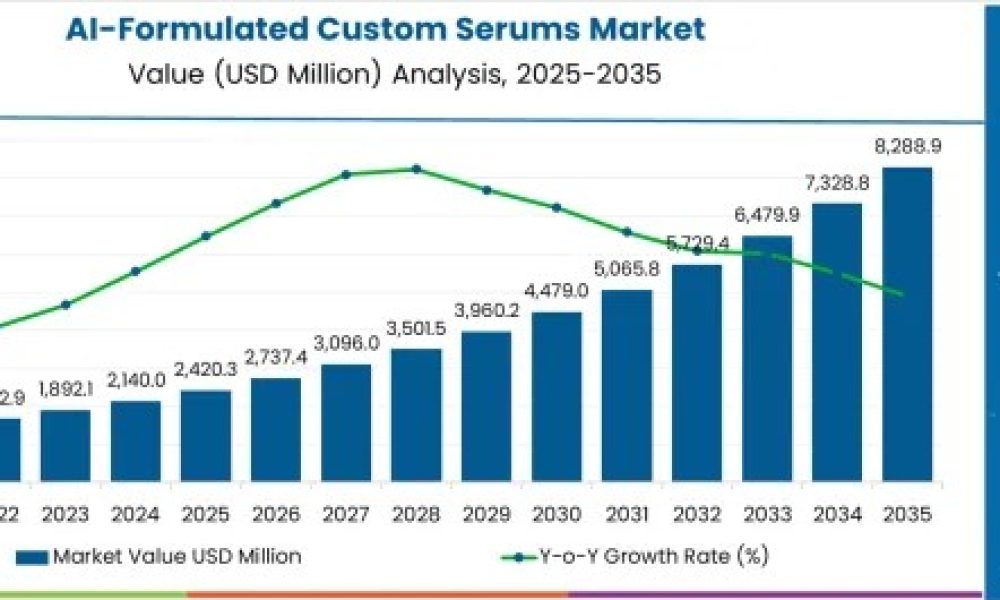
The global AI-formulated custom serums market is entering a transformative growth phase, fueled by rapid advances in artificial intelligence, rising demand for hyper-personalized skincare, and the strategic expansion of both established beauty brands and emerging technology-driven manufacturers. According to the latest market outlook, the industry is projected to grow from USD 2,420.3 million in 2025 to USD 8,288.9 million by 2035, registering a robust CAGR of 13.1% over the forecast period. This represents an absolute value increase of USD 5,834.74 million, with the market expected to expand nearly 3.4X in size.
Explore comprehensive market trends, regional outlooks, and competitive intelligence – Get a Sample Copy Now
Quick Market Highlights
- Market Value (2025): USD 2,420.3 million
- Forecast Value (2035): USD 8,288.9 million
- CAGR (2025–2035): 13.1%
- Leading Function: Anti-aging (54.6% share)
- Top Growth Regions: Asia Pacific, North America, Europe
- Key Players: Atolla (Function of Beauty), Proven Skincare, Skinsei, Clinique iD, L’Oréal Perso, Curology, Skin Inc, Shiseido Optune, Neutrogena Skin360, Alyx AI Beauty
Market Growth Outlook: A Decade of Accelerated Expansion
2025–2030: Foundation Phase
Between 2025 and 2030, the AI-formulated custom serums market is expected to expand from USD 2,420.3 million to USD 4,469.4 million, accounting for 35.1% of total decade growth. This phase is driven by:
- Growing adoption of AI-powered personalization platforms
- Rising consumer awareness of tailored skincare benefits
- Expansion of D2C subscription-based beauty models
- Increased investments by brands to strengthen AI and data analytics capabilities
2030–2035: Innovation Acceleration Phase
From 2030 to 2035, the market will witness faster momentum, adding USD 3,784.0 million, or 64.9% of total forecast growth. Key drivers include:
- Advanced AI algorithms for real-time skin analysis
- Integration of genetic, lifestyle, and environmental data
- Expansion of omnichannel delivery models
- Emergence of predictive and adaptive skincare formulations
Why the AI-Formulated Custom Serums Market Is Growing
The market’s expansion is strongly supported by:
- Rising demand for personalized beauty solutions tailored to individual skin profiles
- Increasing use of genetic testing, AI imaging, and lifestyle analysis
- Growing consumer preference for science-backed and data-driven skincare
- Brand differentiation through AI-enabled customization and measurable results
Modern consumers expect skincare products that evolve with their skin conditions, making AI-powered custom serums a long-term solution rather than a trend.
Key Market Segments
By Customization Basis
- Genetic/DNA Analysis
- Skin Type Mapping
- Lifestyle & Environmental Data
- Real-Time Skin Imaging
Genetic/DNA analysis leads with 51.2% market share, offering long-term insights into skin aging, elasticity, pigmentation, and sensitivity.
By Function
- Anti-aging
- Hydration
- Acne & Blemish Care
- Brightening
- Others
Anti-aging dominates with 54.6% share, driven by global aging concerns and demand for preventive skincare.
By Delivery Model
- D2C Subscription Kits
- In-Store Kiosks
- Dermatology-Linked AI Platforms
- Online Consultation-Driven
D2C subscription kits account for 49.5%, enabling continuous personalization and strong customer retention.
By Channel
- D2C Websites
- Specialty Beauty Retail
- Pharmacies
- Salons & Clinics
Regional Growth Insights
- India (CAGR 22.8%): Fastest-growing market, powered by digital beauty adoption, urban millennials, and rising disposable income.
- China (21.1%): Strong e-commerce ecosystem and AI integration across beauty platforms.
- Japan (17.9%): Innovation-driven market blending advanced technology with premium skincare traditions.
- United Kingdom (14.4%): Focus on premium personalized beauty and transparent formulations.
- Germany (10.9%): Emphasis on scientific precision, quality standards, and regulatory compliance.
- United States (9.6%): Mature yet steadily expanding market with strong D2C and dermatology-linked platforms.
Competitive Landscape: Established Brands and Emerging Innovators
The AI-formulated custom serums market features a dynamic mix of global beauty leaders and agile new entrants, all investing heavily in AI, data analytics, and personalization technologies.
- Proven Skincare leads with an estimated 8% global value share, known for its science-driven personalization model.
- Atolla (Function of Beauty) focuses on genetic-based customization and subscription kits.
- Skinsei leverages mobile-based skin analysis and AI recommendations.
- Clinique iD integrates in-store customization with professional consultation.
- L’Oréal Perso and Shiseido Optune showcase advanced AI hardware and formulation systems.
- Curology and Neutrogena Skin360 bridge dermatology expertise with AI personalization.
- Alyx AI Beauty represents new-generation manufacturers focusing on lifestyle and multi-channel customization.
These players are actively forming strategic partnerships, investing in R&D, and expanding globally to capture emerging opportunities.
Outlook for Manufacturers and Investors
The AI-formulated custom serums market presents significant opportunities for:
- Established brands seeking differentiation through technology
- New manufacturers aiming to scale via AI-first business models
- Technology providers developing skin analysis, genetic testing, and formulation platforms
As personalization becomes the new standard in beauty, companies that combine AI innovation, scientific validation, and consumer-centric delivery models are expected to lead the market through 2035.
Have a specific Requirements and Need Assistant on Report Pricing or Limited Budget please contact us – [email protected]
About Future Market Insights (FMI)
Future Market Insights, Inc. (FMI) is an ESOMAR-certified, ISO 9001:2015 market research and consulting organization, trusted by Fortune 500 clients and global enterprises. With operations in the U.S., UK, India, and Dubai, FMI provides data-backed insights and strategic intelligence across 30+ industries and 1200 markets worldwide.



