
The rapid evolution of aerial warfare—defined by autonomous platforms, drone swarms, and network-centric operations—is reshaping global defense priorities. At the center of this transformation lies combat aircraft swarm radar technology, a next-generation capability designed to detect, track, classify, and neutralize coordinated aerial threats in highly contested environments. Between 2026 and 2036, this market is expected to transition from an emerging niche to a core pillar of air superiority, offering compelling valuation growth, strong return-on-investment (ROI) potential, and long-term strategic relevance.
Market Valuation Outlook: A Decade of Sustained Expansion
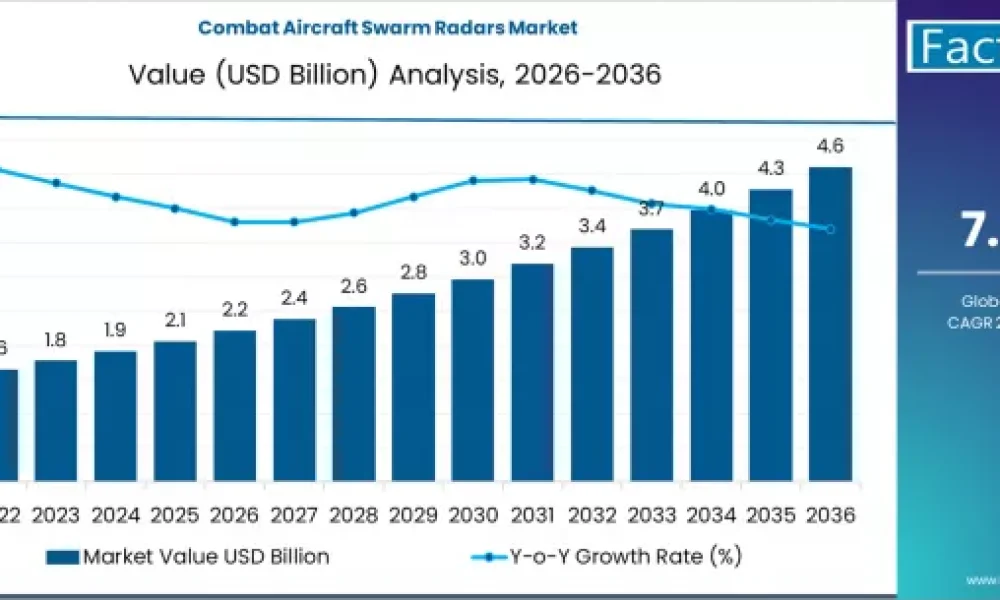
The global combat aircraft swarm radars market is projected to grow from approximately USD 2.2 billion in 2026 to USD 4.6 billion by 2036, representing a compound annual growth rate (CAGR) of about 7.6% over the forecast period. This growth rate outpaces several traditional radar subsegments, reflecting the urgency among defense forces to counter low-cost, high-volume swarm threats.
The broader airborne radar market is also expanding rapidly, providing a strong ecosystem for swarm-specific radar solutions. Overall radar demand is expected to nearly double over the next decade, underscoring the long-term relevance of advanced sensing technologies across military domains.
To access the complete data tables and in-depth insights, request a Discount On The Report here: https://www.factmr.com/connectus/sample?flag=S&rep_id=13301
Key Growth Drivers: Why Swarm Radars Matter
Several structural factors are accelerating investment in combat aircraft swarm radars:
Proliferation of Drone Swarms
Drone swarms are becoming increasingly common in military operations, with their use projected to grow significantly over the next decade. As offensive swarm capabilities mature, air forces must deploy equally sophisticated detection and engagement systems—driving demand for multi-target, high-refresh-rate radars.Shift to AESA and GaN-Based Architectures
Active Electronically Scanned Array (AESA) radars are favored for their beam agility, resilience to jamming, and ability to track dozens or even hundreds of targets simultaneously. Gallium Nitride (GaN) semiconductors further enhance power efficiency and range, reducing lifecycle costs while improving performance.Geopolitical Tensions and Defense Modernization
Rising defense budgets across North America, Europe, and parts of Asia are accelerating fleet upgrades. This includes investments in air and missile defense radar systems to counter evolving threats, ensuring robust long-term demand for swarm radar technologies.
ROI Potential: Compelling Economics for Defense Investors
From an ROI perspective, combat aircraft swarm radars offer multi-layered value creation:
High-Value Contracts & Long Program Lifecycles
Radar systems are typically embedded in multi-decade aircraft and defense programs, ensuring recurring revenues through upgrades, software-defined enhancements, maintenance, and training.Dual-Use and Export Opportunities
While primarily military-focused, swarm detection radar technologies also have applications in homeland security, critical infrastructure protection, and counter-UAS systems—expanding total addressable market potential.Strong Venture and Strategic Investment Momentum
Defense tech startups specializing in next-generation radar solutions have seen significant funding, reflecting expectations of strong long-term returns. With operating margins in advanced defense electronics often ranging from 15% to 25%, swarm radar programs present an attractive risk-adjusted return profile.
Competitive and Regional Landscape
North America currently leads the market, driven by initiatives focused on collaborative combat aircraft, loyal wingman programs, and counter-swarm defense. Europe follows closely, supported by rising defense spending and pan-European modernization efforts. Meanwhile, Asia-Pacific is expected to record the fastest growth due to expanding air forces and regional security concerns.
Major defense electronics firms are leveraging their radar portfolios to integrate AI-enabled target classification, sensor fusion, and networked battle management, while specialized startups are pushing innovation in software-defined radar and low-probability-of-intercept (LPI) technologies.
Long-Term Growth Prospects (2026–2036)
Looking beyond near-term procurement cycles, the long-term outlook for combat aircraft swarm radars remains highly favorable:
Integration with AI and Autonomous Systems will transform radars from passive sensors into intelligent decision-support nodes.
Interoperability with space-based and ground-based sensors will create resilient, multi-domain detection networks.
Continuous software upgrades will extend system relevance without requiring full hardware replacement, enhancing lifetime value.
By 2036, swarm-capable radar systems are expected to be standard equipment on next-generation fighters and unmanned combat aerial vehicles, cementing their role as a foundational technology in future air combat doctrines.
Conclusion
The combat aircraft swarm radars market represents a rare convergence of technological necessity, strong budgetary support, and long-term strategic importance. With market valuation set to more than double by 2036, attractive ROI dynamics, and deep integration into future air warfare concepts, the sector stands out as one of the most promising defense technology investments of the coming decade. For governments, primes, and investors alike, swarm radar capabilities are no longer optional—they are mission-critical.
Have a specific Requirements and Need Assistant on Report Pricing or Limited Budget please contact us – [email protected]
To View Related Report :
Aircraft Cabin Management System Market https://www.factmr.com/report/2769/aircraft-cabin-management-system-market
Aircraft Communication Systems Market https://www.factmr.com/report/2883/aircraft-communication-systems-market
Demand for Aircraft Fuel Cells in USA https://www.factmr.com/report/united-states-aircraft-fuel-cells-market
Swarm Robotics Market https://www.factmr.com/report/swarm-robotics-market



