
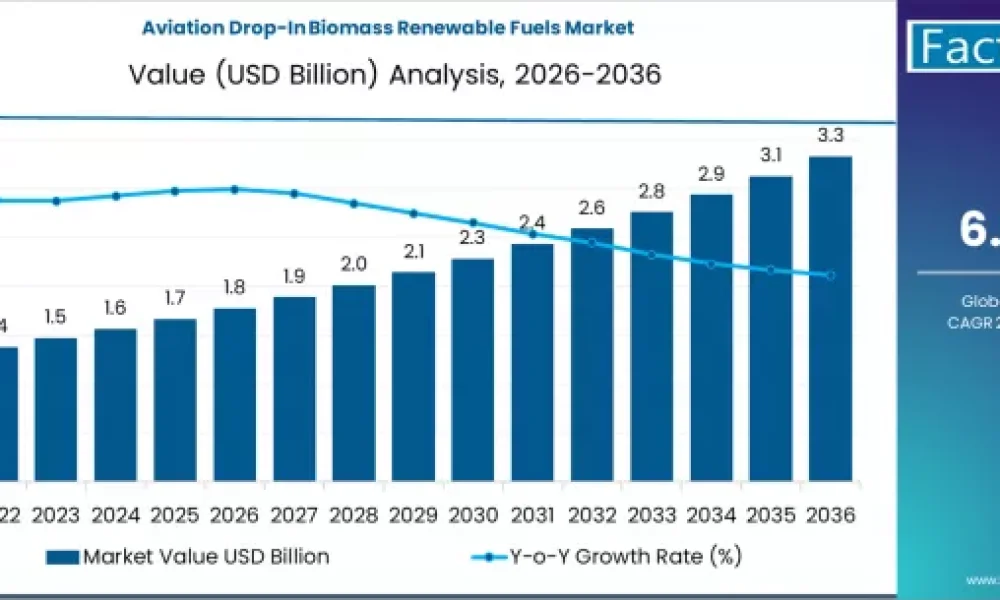
The global Aviation Drop-In Biomass Renewable Fuels Market is poised for significant expansion through 2036 as airlines, airports, fuel producers, and regulators accelerate efforts to reduce greenhouse gas emissions and decarbonize the aviation sector. Aviation drop-in biomass renewable fuels are sustainable alternatives to conventional jet fuels that can be used directly in existing aircraft engines and fuel distribution infrastructure without modification. These fuels are produced from biomass feedstocks such as agricultural residues, forestry wastes, energy crops, and other biological sources, offering a pathway to substantially lower lifecycle carbon emissions compared with fossil-derived aviation fuels.
With international commitments to carbon neutrality, increasing corporate sustainability goals, and stringent emission reduction policies across North America, Europe, and Asia Pacific, demand for drop-in renewable aviation fuels is gaining traction. The market is supported by investments in feedstock supply chains, innovative conversion technologies, and strategic partnerships between fuel producers and airlines seeking to improve environmental performance while maintaining operational reliability.
Market Outlook (2026–2036)
Market Value in 2026: USD 1.9 Billion (estimated)
Market Value in 2036: USD 8.3 Billion (projected)
Forecast CAGR (2026–2036): Approximately 15.0%
Leading Fuel Type: Hydroprocessed Esters and Fatty Acids (HEFA)
Dominant End Use: Commercial Aviation
Primary Regions of Adoption: North America, Europe, Asia Pacific
The high projected growth rate reflects increasing adoption of sustainable aviation fuels (SAFs) as carriers seek to meet emission targets, reduce carbon intensity, and strengthen environmental credentials.
To Access the Complete Data Tables & in-depth Insights, Request a Discount on this report: https://www.factmr.com/connectus/sample?flag=S&rep_id=13339
Market Overview
Aviation drop-in biomass renewable fuels are designed to be functionally equivalent to conventional jet fuels, complying with existing specifications for energy content, cold flow properties, and combustion characteristics. Because these fuels can be blended with traditional jet fuels and used with no changes to aircraft engines, fueling systems, or airport infrastructure, they offer a practical, scalable solution for reducing carbon emissions in the aviation sector.
Key production pathways include hydroprocessing of biomass oils and fats, gasification followed by Fischer-Tropsch synthesis, and advanced cellulosic conversion technologies. Among these, hydroprocessed esters and fatty acids (HEFA) fuels currently dominate due to technological maturity and established certification frameworks for aviation use.
Key Market Drivers
1. Global Decarbonization Initiatives and Regulation
Governments, international aviation bodies, and environmental agencies worldwide are advancing policies aimed at reducing the aviation industry’s carbon footprint. Incentives, mandates, and sustainability criteria are driving investment in renewable fuel production and usage.
2. Airline Sustainability Commitments
Major airlines are increasingly committing to net-zero emission goals and aggressive short-term climate targets, catalyzing demand for sustainable aviation fuels. Drop-in biomass renewable fuels are a key solution for immediate emission reductions without compromising flight operations.
3. Corporate and Consumer Pressure
Corporations with robust environmental, social, and governance (ESG) strategies are collaborating with airlines and fuel suppliers to procure sustainable fuel credits or direct fuel supply agreements. At the same time, consumer awareness of climate impacts encourages airlines to adopt cleaner fuel alternatives.
4. Technological Advancements in Fuel Production
Ongoing research and development in biomass conversion technologies, catalytic processes, and feedstock diversification are increasing production efficiency, lowering costs, and expanding the range of eligible renewable feedstocks.
Market Segmentation Insights
By Fuel Type:
Hydroprocessed Esters and Fatty Acids (HEFA)
Fischer-Tropsch Synthetic Paraffinic Kerosene (FT-SPK)
Alcohol-to-Jet (ATJ) Fuel
Other Advanced Biofuel Pathways
By End Use:
Commercial Aviation
Military and Defense Aircraft
Business Jets and General Aviation
Cargo and Freight Aviation
By Feedstock:
Waste Oils and Fats
Agricultural Residues
Forestry Biomass
Algal Biomass
Other Renewable Biomass Sources
By Distribution Channel:
Airport Jet Fuel Supply Contracts
Fuel Blending and Distribution Partnerships
Renewable Fuel Credit and Offset Markets
Direct offtake Agreements
Regional Demand Dynamics
North America is anticipated to capture a major share of the market, driven by strong regulatory frameworks, active airline sustainability commitments, and substantial investments in renewable fuel production facilities. The United States and Canada are leaders in SAF research, feedstock development, and commercial adoption initiatives.
Europe is also a significant market as countries pursue ambitious climate goals for aviation and incentivize renewable fuel usage through policy mechanisms, blending mandates, and sustainability certification programs.
Asia Pacific is expected to exhibit rapid growth, supported by expanding aviation networks, rising environmental awareness, and increasing public and private sector investment in renewable energy infrastructure. Countries with large domestic airline markets are exploring sustainable fuel strategies to meet future demand.
Emerging regions in Latin America and Middle East & Africa are gradually adopting renewable aviation fuel initiatives as part of broader energy transition efforts, with strategic investments in feedstock resources and renewable energy partnerships.
Competitive Landscape
The competitive landscape of the aviation drop-in biomass renewable fuels market is characterized by collaborations between energy companies, technology developers, airlines, and policy stakeholders. Key players focus on scaling production capacity, securing feedstock supply agreements, and advancing technology pathways that improve yield and cost-competitiveness. Strategic partnerships between fuel producers and carriers are shaping long-term supply contracts and blended fuel deployment strategies.
Innovation efforts center on improving conversion efficiency, expanding feedstock availability, and achieving higher renewable content without compromising fuel performance. Certifications and compliance with international aviation fuel standards remain pivotal for market acceptance and growth.
Future Outlook
The Aviation Drop-In Biomass Renewable Fuels Market is expected to maintain strong momentum through 2036 as the aviation industry intensifies efforts to decarbonize and adopt sustainable energy solutions. Continued technological advancements, robust policy support, and growing corporate sustainability commitments will further drive adoption of renewable aviation fuels.
With increasing airline demand, evolving regulatory landscapes, and rising environmental awareness, drop-in biomass renewable fuels are set to play a critical role in the transition toward a lower-carbon aviation ecosystem. As production costs decline and supply chains mature, these sustainable fuels will become increasingly accessible, supporting long-term environmental and economic goals for global air travel.
Have specific requirements or need assistance on report pricing or have a limited budget? Please contact [email protected]
About Fact.MR:
Fact.MR is a global market research and consulting firm, trusted by Fortune 500 companies and emerging businesses for reliable insights and strategic intelligence. With a presence across the U.S., UK, India, and Dubai, we deliver data-driven research and tailored consulting solutions across 30+ industries and 1,000+ markets. Backed by deep expertise and advanced analytics, Fact.MR helps organizations uncover opportunities, reduce risks, and make informed decisions for sustainable growth



