
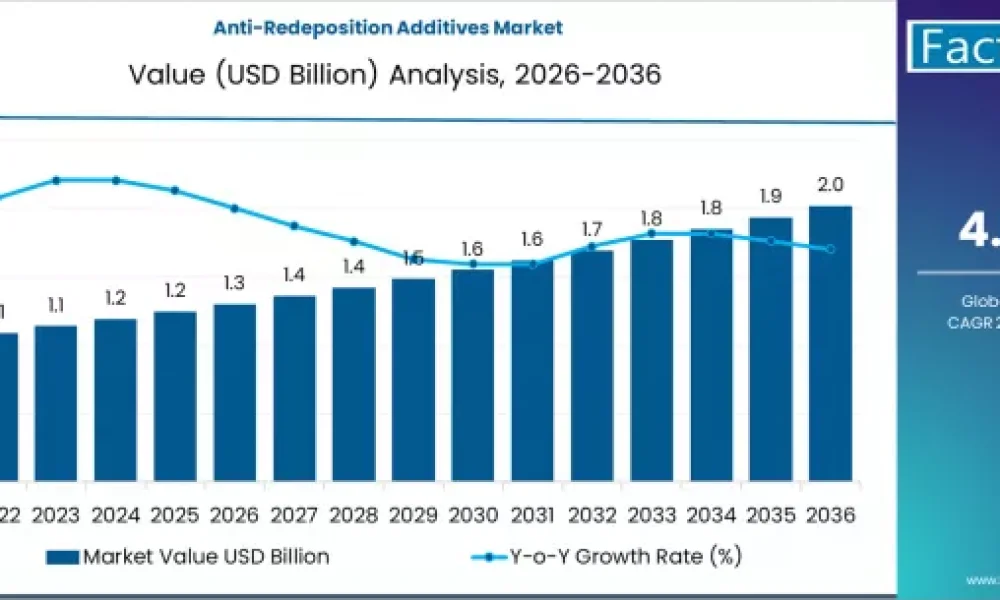
The global Anti-Redeposition Additives Market is poised for steady expansion through 2036 as consumer and industrial demand for high-performance cleaning products continues to grow. Anti-redeposition additives are specialized chemical agents used in detergents and cleaning formulations to prevent soil and dirt that have been removed from surfaces or textiles from reattaching during the cleaning process. These additives enhance overall cleaning efficiency, protect fabric appearance, support stain suspension, and improve wash performance across consumer and industrial applications.
Anti-redeposition additives are widely used in household laundry detergents, automatic dishwashing products, industrial and institutional cleaners, and specialty cleaning agents. With increasing awareness of cleanliness standards, rising disposable incomes, and a focus on sustainability and efficiency, manufacturers are incorporating advanced anti-redeposition chemistries into next-generation cleaning formulations.
Market Outlook (2026–2036)
Market Value in 2026: USD 2.15 Billion (estimated)
Market Value in 2036: USD 3.98 Billion (projected)
Forecast CAGR (2026–2036): Approximately 6.8%
Leading Product Type: Polymeric Anti-Redeposition Agents
Dominant End Use: Laundry Detergents
Primary Distribution Channels: Retail FMCG, Industrial Supply Networks
The expected growth reflects continuous innovation in cleaning technologies, increasing preference for advanced household care products, and expanding industrial cleaning applications.
To Access the Complete Data Tables & in-depth Insights, Request a Discount on this report: https://www.factmr.com/connectus/sample?flag=S&rep_id=13335
Market Overview
Anti-redeposition additives are formulated to interact with soils and detergents to maintain removed dirt in suspension, preventing it from resettling on cleaned surfaces or textiles. In laundry applications, these additives help maintain whiteness and color brightness, reduce greying over multiple wash cycles, and improve overall fabric care. In dishwashing and surface cleaners, they enable effective removal of food residues, grease, and particulate matter without leaving residues that compromise cleanliness.
The growing middle-class population worldwide, rising urbanization, and increasing use of formulated cleaning products are driving demand for enhancements that improve wash performance. At the same time, consumer interest in sustainable and gentle cleaning products is encouraging manufacturers to develop anti-redeposition agents with improved biodegradability and low environmental impact.
Key Market Drivers
1. Rising Demand for High-Performance Cleaning Products
Consumers and businesses alike are increasingly seeking detergents and cleaners that deliver superior results, particularly on tough stains and during frequent wash cycles. Anti-redeposition additives enhance product performance and are critical to formulating effective cleaning solutions.
2. Growth in Laundry and Household Care Markets
The household care segment remains a key driver of anti-redeposition additive demand, particularly in emerging economies where disposable incomes and living standards are rising. Increased adoption of automated laundry systems further amplifies demand for advanced cleaners.
3. Expansion of Industrial and Institutional Cleaning
Industrial facilities, hospitality operations, healthcare institutions, and commercial laundries prioritize rigorous cleanliness standards. Anti-redeposition additives support these requirements by improving soil removal and preventing reattachment during repeated cleaning operations.
4. Innovation in Eco-Friendly Formulations
Environmental concerns and regulatory emphasis on sustainability are leading manufacturers to innovate with anti-redeposition additives that offer high performance while meeting biodegradability and safety standards. Such developments enable broader adoption in eco-certified products.
Market Segmentation Insights
By Product Type:
Polymeric Anti-Redeposition Agents
Natural and Bio-Based Additives
Surfactant-Derived Anti-Redeposition Agents
Specialty Performance Blends
By Application:
Laundry Detergents
Automatic Dishwashing Detergents
Hard Surface Cleaners
Industrial Cleaning Formulations
Specialty Cleaning Products
By End Use:
Household Care
Industrial and Institutional
Hospitality and Commercial Laundries
Healthcare Facilities
Automotive and Transportation
By Distribution Channel:
Supermarkets and Hypermarkets
Specialty Retailers
Industrial Supply Chains
E-Commerce Platforms
Regional Demand Dynamics
Asia Pacific is expected to dominate market growth due to expanding consumer markets, rapid urbanization, and rising household expenditures on cleanliness and personal care products. Growth in manufacturing and institutional sectors further supports demand for high-performance cleaning additives in the region.
North America remains a significant market driven by established cleaning product usage, strong retail networks, and continuous product innovation. Europe shows steady adoption supported by consumer preference for sustainable formulations and stringent cleaning standards for commercial applications.
Emerging markets in Latin America, the Middle East, and Africa are gradually increasing consumption of formulated cleaners and advanced additives as awareness and access to modern cleaning solutions expand.
Competitive Landscape
The anti-redeposition additives market is moderately competitive, featuring participation from global chemical manufacturers, specialty additive producers, and cleaning technology innovators. Companies are focusing on product performance, sustainability profiles, regulatory compliance, and formulation flexibility to meet diverse application needs.
Innovation in polymer chemistry, bio-based raw materials, and compatibility with concentrated and low-temperature cleaners are key differentiators. Strategic initiatives include partnerships with detergent manufacturers, expansion of production capacities, and development of multifunctional additive blends that combine anti-redeposition performance with fabric care, scent delivery, and environmental compliance.
Future Outlook
The Anti-Redeposition Additives Market is expected to sustain healthy growth through 2036 as demand for advanced cleaning performance and sustainable formulations increases globally. Continued research into eco-friendly chemistries, expanding industrial cleaning requirements, and rising consumer expectations for superior product efficacy will drive broader adoption of anti-redeposition technologies.
As cleaning product portfolios evolve to meet performance and environmental goals, anti-redeposition additives will remain foundational components in modern formulation strategies that deliver both functional benefits and consumer satisfaction.
Have specific requirements or need assistance on report pricing or have a limited budget? Please contact [email protected]
About Fact.MR:
Fact.MR is a global market research and consulting firm, trusted by Fortune 500 companies and emerging businesses for reliable insights and strategic intelligence. With a presence across the U.S., UK, India, and Dubai, we deliver data-driven research and tailored consulting solutions across 30+ industries and 1,000+ markets. Backed by deep expertise and advanced analytics, Fact.MR helps organizations uncover opportunities, reduce risks, and make informed decisions for sustainable growth



