
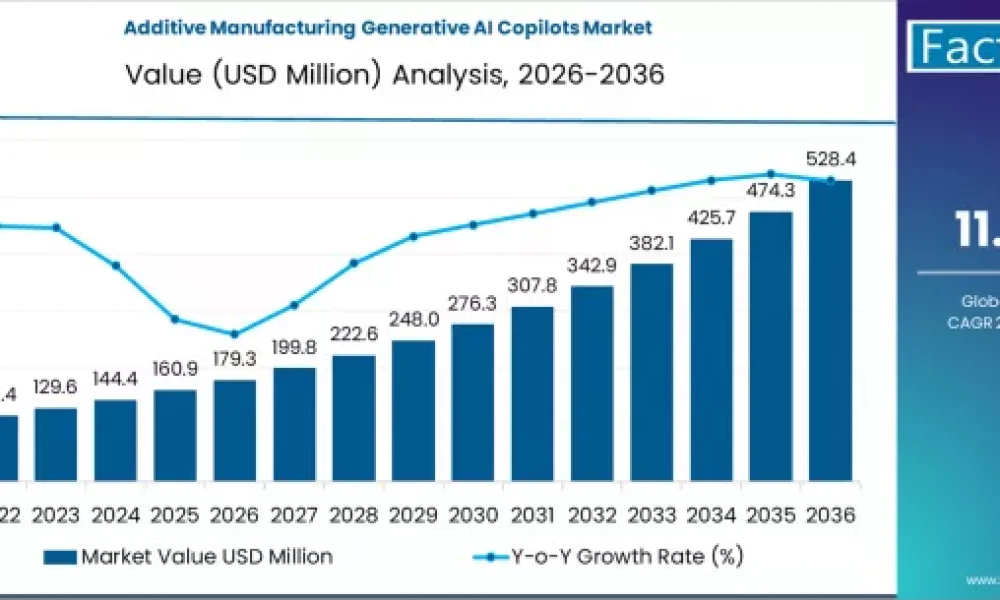
The global Additive Manufacturing Generative AI Copilots Market is poised for significant expansion over the next decade as artificial intelligence (AI) tools become deeply integrated with additive manufacturing (AM) workflows. These generative AI copilots — intelligent software assistants that help engineers, designers, and production teams optimize designs, anticipate manufacturing challenges, and automate complex decision tasks — are emerging as key enablers of next-generation manufacturing efficiency, quality, and innovation.
Generative AI copilots for additive manufacturing leverage machine learning, physics-aware modeling, and vast repositories of historical design and process data to assist users with topology optimization, material selection, process parameter recommendations, defect prediction, and simulation-linked validation. By blending domain expertise with AI-driven insights, these copilots help reduce trial-and-error cycles, shorten development times, and improve manufacturing outcomes across multiple industries that rely on 3D printing technologies.
Market Outlook (2026–2036)
Market Value in 2026: USD 480 Million (estimated)
Market Value in 2036: USD 2,150 Million (projected)
Forecast CAGR (2026–2036): ~15.2%
Leading Application Segment: Design Optimization and Simulation
Primary End Users: Aerospace, Automotive, Healthcare & Medical Devices
Key Drivers: Integration of AI with AM systems, demand for rapid innovation
The projected strong compound annual growth rate reflects increasing adoption of AI copilots by manufacturers seeking greater agility, improved part performance, and reduced production costs.
To Access the Complete Data Tables & in-depth Insights, Request a Discount on this report: https://www.factmr.com/connectus/sample?flag=S&rep_id=13331
Market Overview
Additive manufacturing has transformed production across industries by enabling complex geometries, part consolidation, localized manufacturing, and rapid prototyping. However, unlocking its full potential requires deep expertise in design, materials science, and process control — domains where generative AI copilots are proving invaluable. These advanced AI assistants help translate design intents into manufacturable geometries, optimize internal structures for weight and strength, and recommend machine settings to achieve target tolerances.
Unlike traditional CAD tools that rely heavily on user input and manual iterations, generative AI copilots use data-driven insights to propose multiple optimized design variants, evaluate trade-offs between performance and printability, and suggest corrections before parts enter production. Integration with simulation tools further helps anticipate issues such as residual stress, part distortion, or build failure, allowing corrective actions early in the workflow. The result is faster validation cycles, fewer physical prototypes, and more predictable outcomes.
Key Market Drivers
1. Increasing Integration of AI in Engineering Workflows
As engineering teams adopt AI technologies, generative AI copilots are becoming essential companions in design and manufacturing workflows. These tools help automate monotonous tasks, surface hidden insights, and improve consistency across design projects.
2. Demand for Accelerated Innovation and Time-to-Market Gains
Industries with high innovation pressures — particularly aerospace, automotive, and medical devices — are turning to AI copilots to compress design cycles, iterate rapidly on new concepts, and validate performance digitally before committing to production.
3. Complex Part Requirements and Material Performance Needs
Applications involving complex geometries, multi-material components, and stringent performance requirements benefit from AI-assisted optimization. Generative AI copilots help navigate these complexities by proposing balanced designs that satisfy structural, thermal, and functional constraints.
4. Expansion of Additive Manufacturing Adoption Across Sectors
As 3D printing technologies expand from prototyping to full-scale production, there is growing need for tools that support quality assurance, predictive maintenance, and process consistency. Generative AI copilots that integrate with AM hardware and software ecosystems are meeting this need by enabling real-time adjustments and process monitoring.
Market Segmentation Insights
By Capability Type:
Design Optimization and Topology Generation
Process Parameter Suggestion and Simulation Integration
Defect Prediction and Quality Assurance
Material Recommendation Engines
Workflow Automation and Integration Tools
By End User Industry:
Aerospace and Defense
Automotive and Transportation
Healthcare and Medical Devices
Industrial Equipment and Machinery
Consumer Electronics and Wearables
Energy and Power Sector
By Deployment Mode:
Cloud-Based AI Copilot Platforms
On-Premises AI Integration Suites
Embedded Copilot Modules with AM Software
Hybrid Deployment Models
By Organization Size:
Large Enterprises
Mid-Size Manufacturers
Small and Emerging Firms
Regional Demand Dynamics
North America is expected to hold a significant share of the market due to its strong base of advanced manufacturing companies, early adoption of AI and AM technologies, and substantial R&D investments in digital engineering tools. The presence of major aerospace, automotive, and healthcare manufacturers further supports demand for generative AI copilots that can accelerate design and production workflows.
Europe remains a key regional market as well, driven by manufacturing innovation initiatives, a strong emphasis on Industry 4.0 adoption, and regulatory focus on quality and safety standards. Collaboration between industrial consortia and technology providers continues to foster integration of AI into additive manufacturing ecosystems.
Asia Pacific is projected to record rapid growth, fueled by expanding manufacturing sectors, increasing investment in smart factory technologies, and rising adoption of additive manufacturing in automotive and consumer electronics. Emerging markets in China, Japan, South Korea, and Southeast Asia are driving demand for tools that support local innovation and production efficiency.
Latin America and the Middle East & Africa are also gaining traction as organizations invest in digital transformation and seek competitive differentiation through advanced manufacturing technologies.
Competitive Landscape
The additive manufacturing generative AI copilot market is moderately competitive, featuring participation from global software providers, AI innovators, AM platform developers, and consultancies specializing in digital manufacturing. Key strategies among market participants include enhancing AI model accuracy with domain-specific datasets, expanding integration with AM machines and CAD systems, and offering modular solutions that can scale across enterprise environments.
Product differentiation is driven by copilot responsiveness, ease of integration, ability to support multi-physics simulation, and compatibility with diverse AM technologies such as powder bed fusion, directed energy deposition, and material extrusion. Strategic partnerships between AI vendors and AM hardware manufacturers are helping accelerate product deployment and adoption across industries seeking faster innovation cycles.
Future Outlook
The Additive Manufacturing Generative AI Copilots Market is expected to sustain strong growth through 2036 as digital engineering and manufacturing systems become increasingly interconnected. Advancements in AI algorithms, simulation fidelity, and sensor-linked process feedback will further enhance the capabilities of copilots, making them indispensable tools for organizations striving to innovate rapidly and produce high-quality components.
As additive manufacturing moves deeper into mainstream production, businesses that leverage generative AI copilots are likely to realize improvements in design productivity, material efficiency, process reliability, and overall competitive advantage. With ongoing investment in AI-augmented manufacturing workflows, the market for these intelligent companions is set to remain at the forefront of industrial digitization and advanced manufacturing excellence.
Have specific requirements or need assistance on report pricing or have a limited budget? Please contact [email protected]
About Fact.MR:
Fact.MR is a global market research and consulting firm, trusted by Fortune 500 companies and emerging businesses for reliable insights and strategic intelligence. With a presence across the U.S., UK, India, and Dubai, we deliver data-driven research and tailored consulting solutions across 30+ industries and 1,000+ markets. Backed by deep expertise and advanced analytics, Fact.MR helps organizations uncover opportunities, reduce risks, and make informed decisions for sustainable growth



