
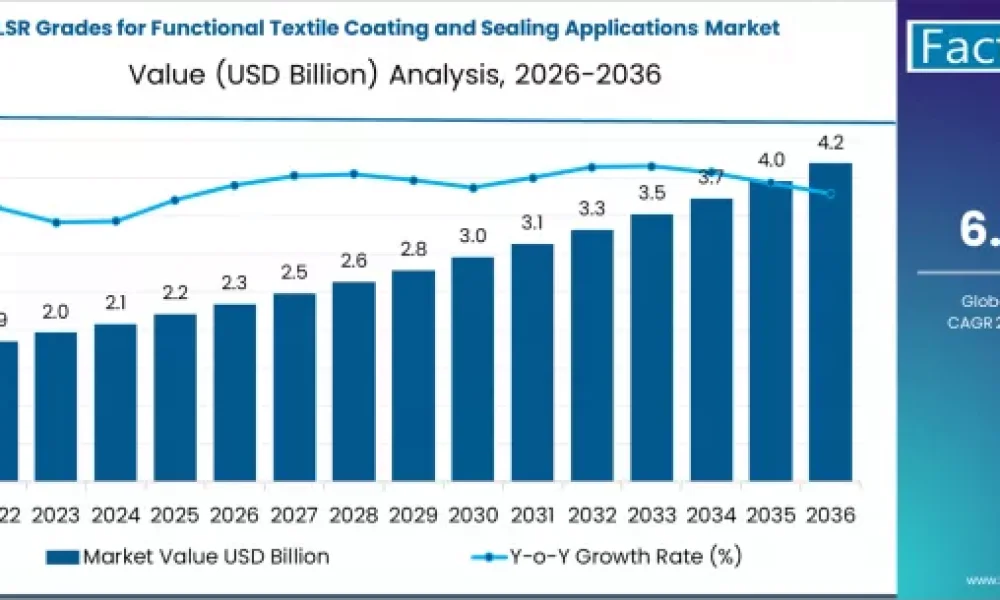
The U.S. market for liquid silicone rubber (LSR) grades used in functional textile coating and sealing applications is projected to witness steady growth from 2025 to 2035, supported by rising demand for high-performance textiles across medical, protective, industrial, and consumer end-use sectors. LSR grades are increasingly preferred in textile coating and sealing due to their superior flexibility, durability, thermal stability, and resistance to chemicals and moisture. These properties make LSR an ideal material for advanced textile solutions requiring long service life and consistent performance under demanding conditions.
Functional textiles coated or sealed with LSR are widely used in medical garments, personal protective equipment (PPE), outdoor and sportswear, automotive interiors, and industrial fabrics. As U.S. manufacturers prioritize performance enhancement, regulatory compliance, and sustainability, the adoption of LSR-based coatings and sealants is expected to rise steadily over the forecast period.
Market Size and Growth Outlook
The U.S. LSR grades for functional textile coating and sealing applications market is expected to grow at a healthy mid-single-digit CAGR between 2025 and 2035. Growth is supported by continuous innovation in silicone formulations, increasing domestic production of technical textiles, and expanding applications in healthcare and safety-critical industries. The market’s long-term outlook remains positive, driven by consistent replacement demand and the shift toward advanced materials that outperform traditional polymer coatings.
Key Growth Drivers
Rising demand for high-performance textiles: Industries such as healthcare, defense, and industrial manufacturing are increasingly relying on functional textiles that offer flexibility, breathability, and protection. LSR-based coatings enable textiles to meet stringent performance requirements, including biocompatibility, waterproofing, and resistance to extreme temperatures.
Growth in medical and protective applications: The U.S. healthcare sector remains a major consumer of LSR-coated textiles, particularly for medical gowns, wound care materials, wearable medical devices, and sealing components. In addition, sustained demand for PPE and protective clothing continues to support market expansion.
Material advantages of LSR: Compared to conventional rubber and thermoplastic coatings, LSR offers excellent elasticity, long-term durability, UV stability, and chemical resistance. These advantages make LSR grades highly suitable for sealing seams, bonding layers, and enhancing textile functionality without compromising comfort.
Advancements in coating and processing technologies: Improvements in precision coating, curing efficiency, and application techniques are making LSR grades more accessible to textile manufacturers. Automation and process optimization are further reducing material waste and production costs.
To access the complete data tables and in-depth insights, request a Discount On The Report here: https://www.factmr.com/connectus/sample?flag=S&rep_id=13170
U.S. Market Dynamics
The U.S. remains a key market for LSR-based textile solutions due to its strong manufacturing base, advanced healthcare infrastructure, and focus on innovation. Domestic textile producers are increasingly collaborating with silicone material suppliers to develop customized LSR grades tailored to specific performance and regulatory requirements.
Regulatory compliance, particularly in medical and food-contact textiles, plays a critical role in shaping product development. LSR grades that meet FDA and other U.S. regulatory standards gain faster adoption, especially in high-value applications.
Technology Trends and Competitive Landscape
Key trends shaping the market include:
- Development of low-VOC and eco-friendly LSR formulations
- Increased use of platinum-cured LSR grades for medical and wearable textiles
- Customizable viscosity and curing profiles for improved coating precision
- Integration of LSR coatings with smart and sensor-enabled textiles
The competitive landscape includes global silicone manufacturers and specialized material suppliers focusing on performance differentiation, application-specific solutions, and long-term supply partnerships with textile producers.
Challenges
Despite favorable growth prospects, the market faces challenges such as relatively high material costs compared to traditional coatings, technical complexity in processing, and the need for skilled labor and specialized equipment. Additionally, price sensitivity among small and mid-sized textile manufacturers may limit rapid adoption in cost-driven applications.
Outlook Summary
From 2025 to 2035, the U.S. LSR grades for functional textile coating and sealing applications market is expected to expand steadily, driven by demand for advanced, durable, and high-performance textile solutions. While cost and processing challenges persist, ongoing innovation, regulatory support, and growing application diversity position LSR grades as a critical material for the future of functional textiles in the U.S. market.
Have a specific Requirements and Need Assistant on Report Pricing or Limited Budget please contact us – [email protected]
About Fact.MR
Fact.MR is a global market research and consulting firm, trusted by Fortune 500 companies and emerging businesses for reliable insights and strategic intelligence. With a presence across the U.S., UK, India, and Dubai, we deliver data-driven research and tailored consulting solutions across 30+ industries and 1,000+ markets. Backed by deep expertise and advanced analytics, Fact.MR helps organizations uncover opportunities, reduce risks, and make informed decisions for sustainable growth.



