
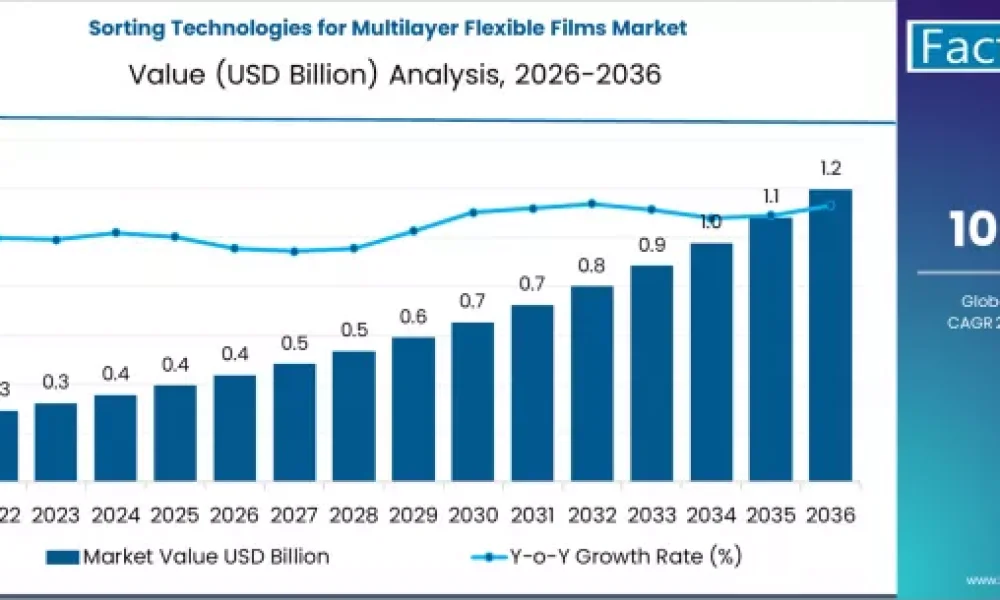
The global Sorting Technologies for Multilayer Flexible Films Market is projected to experience substantial growth over the next decade as demand increases for advanced recycling solutions, sustainable packaging processing, and efficient material recovery systems. Multilayer flexible films — widely used in food packaging, pouches, wrappers, and industrial applications — present significant recycling challenges due to their composite structures. As sustainability imperatives tighten and circular economy strategies are phased into supply chains, sophisticated sorting technologies that accurately identify, separate, and route multilayer films for effective recycling are becoming essential.
Sorting technologies for multilayer flexible films encompass a range of hardware and software solutions including optical sorters, near-infrared (NIR) spectroscopy systems, machine vision and artificial intelligence (AI) enabled scanners, sensor-based separation systems, and automated conveyor integration. These technologies support improved sorting accuracy, higher throughput, and superior material quality for downstream processing, enabling recyclers and waste processors to recover valuable polymers and reintegrate them into closed-loop applications.
Market Outlook (2026–2036)
Market Value in 2026: USD 320 Million (estimated)
Market Value in 2036: USD 810 Million (projected)
Forecast CAGR (2026–2036): Approximately 9.8%
Key Technology Segment: Optical and NIR Sorting Systems
Leading End Users: Recycling and Waste Management Firms
Primary Growth Regions: Europe, North America, Asia Pacific
The anticipated growth reflects rising global emphasis on reducing plastic waste, enhancing material recovery, and meeting regulatory mandates for packaging recycling and extended producer responsibility.
To Access the Complete Data Tables & in-depth Insights, Request a Discount on this report: https://www.factmr.com/connectus/sample?flag=S&rep_id=13476
Market Overview
Multilayer flexible films combine different polymer layers, each with distinct characteristics such as barrier protection, flexibility, strength, and printability. While these properties make the films excellent for packaging performance, they pose significant difficulties in recycling due to the complex separation requirements. Traditional material recovery facilities often cannot distinguish multilayer films from single-material films, resulting in contamination of recycling streams and lower value recovery.
Advanced sorting technologies address this challenge by using sensors, imaging, and algorithmic analysis to identify specific polymer types and film structures. Once identified, these films can be separated efficiently for further processing or directed to specialized recycling pathways. By increasing the purity of sorted fractions and reducing contamination, these technologies significantly improve the economic viability of recycling multilayer films and support broader plastic waste reduction efforts.
Key Market Drivers
1. Regulatory Pressure and Sustainability Targets
Governments and environmental agencies worldwide are enforcing stricter recycling rates and waste diversion targets. Legislation around extended producer responsibility and single-use plastic reduction is driving investment in high-performance sorting technologies to meet compliance requirements.
2. Growth in Flexible Packaging Demand
The flexible packaging segment continues to grow due to its cost efficiency, lightweight profile, and protective performance. As multilayer flexible films proliferate across food, beverage, pharmaceutical, and consumer goods sectors, efficient sorting technologies are critical to managing end-of-life streams and enabling recycling.
3. Innovation in Sensor and AI-Driven Systems
Advances in sensor sensitivity, machine vision, and artificial intelligence (AI) are enhancing the accuracy and speed of sorting systems. Integration of real-time data processing and smart controls enables recyclers to optimize operations and improve separation performance for complex materials.
4. Circular Economy and Brand Commitments
Major brands and packaging converters are committing to sustainable packaging design and circular economy goals. Adoption of sorting technologies for multilayer films helps validate recycled content claims, supports sustainable sourcing strategies, and reduces reliance on virgin resins.
Market Segmentation Insights
By Technology Type:
Optical Sorting Systems
Near-Infrared (NIR) Spectroscopy
Machine Vision and AI-Assisted Sorting
Sensor-Based Mechanical Separation
Hybrid Sorting Systems
By End User:
Recycling and Waste Management Companies
Plastic Packaging Manufacturers
Material Recovery Facilities (MRFs)
Chemical and Feedstock Recyclers
Automotive and Industrial Plastics Recyclers
By Application Area:
Food and Beverage Flexible Films
Pharmaceutical and Healthcare Packaging
Personal Care and Household Products
Industrial and Agricultural Films
Other Consumer Goods Packaging
By Sales Channel:
Direct OEM Sales
System Integrators and Automation Partners
Aftermarket Support and Retrofits
Regional Demand Dynamics
Europe is anticipated to lead the market due to advanced recycling infrastructure, stringent environmental regulations, and strong producer responsibility frameworks that mandate high recycling rates and circular material flows. Countries with ambitious plastic waste reduction goals are early adopters of sorting technologies for multilayer flexible films.
North America is another significant market, supported by growing investment in recycling technologies, expansion of material recovery facilities, and sustainability commitments from major consumer goods brands and waste processing companies.
Asia Pacific is projected to exhibit rapid growth as urbanization, packaging consumption, and environmental awareness increase. Expanding waste management infrastructure and government initiatives aimed at reducing plastic pollution contribute to rising adoption of advanced sorting systems.
Latin America and Middle East & Africa are emerging growth regions as waste management modernization and regulatory focus on sustainable materials accelerate.
Competitive Landscape
The market for sorting technologies for multilayer flexible films is moderately competitive, featuring global instrumentation and automation companies, sensor technology providers, and specialized recycling equipment manufacturers. Vendors focus on improving detection accuracy, system throughput, ease of integration with existing processing lines, and data analytics capabilities.
Strategic partnerships with waste management firms, research collaborations with technology institutes, and solution bundling with conveyor and robotics systems are key approaches used by leading providers to enhance market penetration and deliver full-service sorting solutions tailored to specific recycling challenges.
Future Outlook
The Sorting Technologies for Multilayer Flexible Films Market is expected to maintain solid growth through 2036 as demand for efficient recycling solutions increases globally. Continued innovation in sensing technologies, machine learning algorithms, and integrated control systems will further enhance sorting efficiency, reduce operational costs, and enable broader recycling of complex film structures.
As sustainability targets become integral to corporate strategy and regulatory frameworks, sorting technologies will remain central to closing the loop for flexible packaging materials, reducing environmental impact, and supporting circular economy goals across industries worldwide.
Have specific requirements or need assistance on report pricing or have a limited budget? Please contact [email protected]
About Fact.MR:
Fact.MR is a global market research and consulting firm, trusted by Fortune 500 companies and emerging businesses for reliable insights and strategic intelligence. With a presence across the U.S., UK, India, and Dubai, we deliver data-driven research and tailored consulting solutions across 30+ industries and 1,000+ markets. Backed by deep expertise and advanced analytics, Fact.MR helps organizations uncover opportunities, reduce risks, and make informed decisions for sustainable growth



