
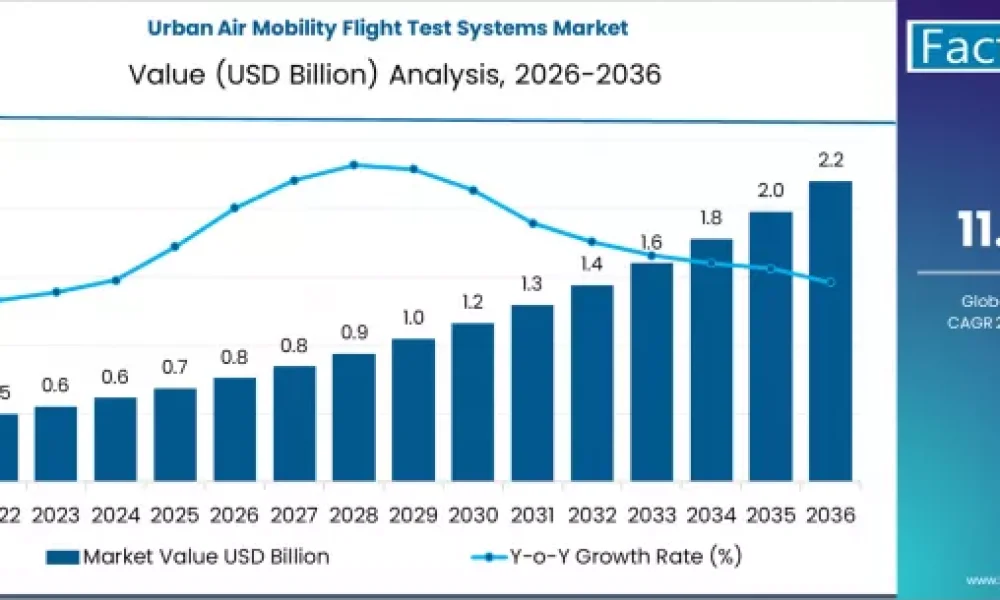
The global Urban Air Mobility (UAM) Flight Test Systems Market is poised for strong growth over the coming decade, supported by rapid advancements in electric vertical takeoff and landing (eVTOL) aircraft, increasing regulatory scrutiny, and expanding investments in next-generation aviation technologies. As urban transportation models evolve to include air taxis, cargo drones, and hybrid-electric aircraft, the need for advanced flight testing and validation systems is becoming increasingly critical.
Urban air mobility flight test systems play a vital role in validating aircraft performance, safety, and regulatory compliance. These systems encompass data acquisition and recording units, telemetry and communication equipment, tracking and range systems, and simulation-based testing platforms. Together, they enable manufacturers and test operators to collect real-time flight data, assess system behavior under diverse operating conditions, and ensure readiness for certification and commercial deployment.
Market Outlook (2026–2036)
Market Value in 2026: USD 0.76 Billion
Market Value in 2036: USD 2.19 Billion
Forecast CAGR (2026–2036): 11.2%
Leading Instrumentation Segment: Data Acquisition and Recording Systems
Dominant End User Segment: Original Equipment Manufacturers (OEMs)
The market outlook reflects growing confidence in urban air mobility concepts and rising test activity as multiple eVTOL programs progress from prototype development to certification testing.
To Access the Complete Data Tables & in-depth Insights, Request a Discount on this report: https://www.factmr.com/connectus/sample?flag=S&rep_id=13106
Market Overview
Urban air mobility aircraft differ significantly from conventional fixed-wing and rotary-wing platforms. They incorporate distributed electric propulsion, fly-by-wire controls, autonomous or semi-autonomous flight systems, and advanced energy storage technologies. These innovations introduce new testing challenges that require high-precision, real-time flight test systems capable of handling complex data streams and dynamic flight profiles.
Flight test systems support the entire development lifecycle of UAM aircraft, from early engineering evaluations to certification campaigns and production acceptance testing. By providing accurate insights into flight behavior, power consumption, control system performance, and structural loads, these systems help developers reduce technical risks and shorten development timelines.
Key Market Drivers
1. Rapid Development of eVTOL Aircraft
The surge in eVTOL development programs worldwide is a major driver of demand for flight test systems. Each aircraft design must undergo extensive flight testing to validate performance, safety, and reliability before entering commercial service. As the number of test flights increases, so does the need for reliable and scalable testing infrastructure.
2. Stringent Certification and Safety Requirements
Regulatory authorities are developing new certification frameworks tailored to urban air mobility vehicles. Compliance with these evolving standards requires comprehensive flight data and repeatable testing procedures, driving adoption of advanced instrumentation, telemetry, and simulation-linked test systems.
3. Increasing Complexity of UAM Platforms
Urban air mobility vehicles integrate propulsion, avionics, energy management, and flight control systems more tightly than traditional aircraft. Flight test systems enable engineers to evaluate interactions between these subsystems under real-world conditions, helping identify potential issues early in the development process.
4. Focus on Faster Time-to-Market
OEMs and startups alike are under pressure to accelerate development while maintaining safety and performance benchmarks. Modern flight test systems support rapid data analysis and decision-making, reducing the need for repeated test cycles and enabling faster certification readiness.
Market Segmentation Insights
By Instrumentation Type
Data Acquisition and Recording Systems
Telemetry and Communication Systems
Flight Control Hardware-in-the-Loop and Simulation Platforms
Tracking and Range Systems
By Aircraft Type
Passenger eVTOL Aircraft
Cargo and Logistics Drones
Hybrid-Electric and Experimental Aircraft
Other Urban Air Mobility Platforms
By End User
Original Equipment Manufacturers
Tier-1 Aerospace Suppliers
Test Range Operators and Service Providers
Research Institutions and Regulatory Bodies
Regional Demand Dynamics
North America is expected to hold a leading share of the market, supported by strong aerospace infrastructure, active eVTOL development programs, and well-established flight testing facilities. Europe follows closely, driven by collaborative aviation initiatives, sustainability-focused mobility strategies, and growing investment in urban air transport ecosystems.
Asia Pacific is emerging as a high-growth region as governments and private players invest in domestic urban air mobility programs and testing capabilities. Expanding aerospace manufacturing bases and supportive policy frameworks are contributing to rising demand for advanced flight test systems across the region.
Competitive Landscape
The Urban Air Mobility Flight Test Systems Market is moderately competitive, featuring established aerospace instrumentation providers and specialized testing solution companies. Market participants focus on enhancing system accuracy, real-time data processing, modular design, and compatibility with diverse UAM platforms. Strategic partnerships with aircraft developers and test facilities remain a key approach to expanding market presence.
Future Outlook
The Urban Air Mobility Flight Test Systems Market is expected to experience sustained growth through 2036 as UAM aircraft move closer to commercial operations. Increasing test flight activity, evolving certification standards, and continued innovation in flight instrumentation and simulation technologies will support long-term market expansion. As safety, reliability, and performance remain top priorities, flight test systems will continue to serve as a cornerstone of successful urban air mobility deployment worldwide.
Have specific requirements or need assistance on report pricing or have a limited budget? Please contact [email protected]
About Fact.MR:
Fact.MR is a global market research and consulting firm, trusted by Fortune 500 companies and emerging businesses for reliable insights and strategic intelligence. With a presence across the U.S., UK, India, and Dubai, we deliver data-driven research and tailored consulting solutions across 30+ industries and 1,000+ markets. Backed by deep expertise and advanced analytics, Fact.MR helps organizations uncover opportunities, reduce risks, and make informed decisions for sustainable growth
Have specific requirements or need assistance on report pricing or have a limited budget? Please contact [email protected]
About Fact.MR:
Fact.MR is a global market research and consulting firm, trusted by Fortune 500 companies and emerging businesses for reliable insights and strategic intelligence. With a presence across the U.S., UK, India, and Dubai, we deliver data-driven research and tailored consulting solutions across 30+ industries and 1,000+ markets. Backed by deep expertise and advanced analytics, Fact.MR helps organizations uncover opportunities, reduce risks, and make informed decisions for sustainable growth



