
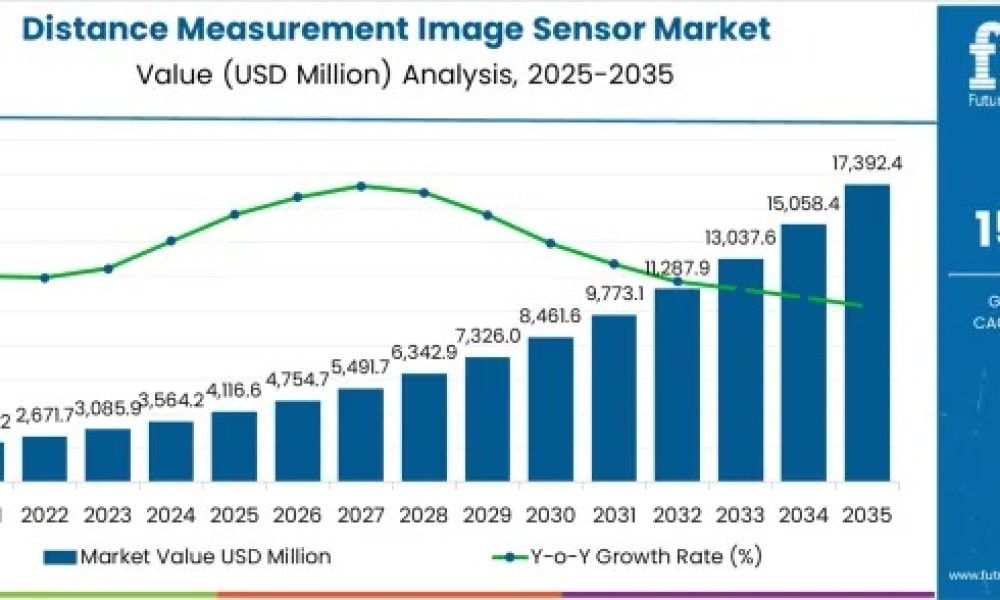
The Distance Measurement Image Sensor Market is entering a phase of remarkable expansion, projected to grow from USD 4,116.6 million in 2025 to approximately USD 17,392.4 million by 2035. Representing an absolute increase of USD 13,275.8 million, the market is expected to achieve a CAGR of 15.5%, translating into a near 4.23X expansion over the forecast period. This growth is propelled by rising adoption of advanced sensing technologies and increasing demand across autonomous systems, augmented reality applications, and industrial automation solutions.
Subscribe for Year-Round Insights → Stay ahead with quarterly and annual data updates:
Between 2025 and 2030, the market will expand from USD 4,116.6 million to USD 7,326.0 million, accounting for 24.2% of total growth. This phase is influenced by heightened penetration of advanced sensors in consumer devices, automotive systems, and industrial automation platforms. From 2030 to 2035, the market is expected to accelerate significantly, reaching USD 17,392.4 million, driven by AI integration, enhanced measurement precision, and the adoption of multi-dimensional sensing systems in AR, smart city, and industrial applications.
Technological Innovations Driving Market Expansion
- AI-Powered Sensing: Integration of artificial intelligence enables predictive analytics, adaptive measurements, and object recognition capabilities, allowing sensors to deliver superior performance across multiple domains.
- Multi-Dimensional Sensing: Advanced systems combine depth perception, gesture recognition, and real-time tracking, enhancing operational efficiency and reducing system complexity.
- Enhanced Accuracy & Miniaturization: Next-generation optical designs and signal processing advancements deliver higher measurement precision in compact, low-power solutions.
- Sustainable & Eco-Friendly Applications: In sectors like demining, modern tools incorporating sensors, drones, and robotics improve safety while minimizing environmental disruption.
Segment Insights
- Sensor Type: Structured Light Sensors dominate with a 54% market share due to reliability, accuracy, and proven performance across consumer electronics and industrial applications.
- Application: Consumer Electronics lead with 48% of demand, reflecting the growing emphasis on AR/VR integration, gesture recognition, and immersive user experiences.
- Geography: China, India, and Germany are key growth regions, benefiting from industrial automation, technology infrastructure expansion, and smart manufacturing initiatives.
Market Drivers and Trends
- Rising Automation Initiatives: Expansion of industrial automation and robotics increases demand for precise distance sensors.
- Complex Sensing Requirements: Increasing technological sophistication requires high-precision measurement solutions.
- Digitalization & AR/VR Adoption: Growing consumer demand for augmented reality applications drives need for advanced sensors.
- Energy Efficiency: Low-power consumption designs are critical for prolonged operational performance across devices.
Regional Growth Highlights
- China: Highest CAGR of 20.9% driven by manufacturing modernization, smart city projects, and AR adoption.
- India: CAGR of 19.4% supported by infrastructure expansion, consumer electronics growth, and automation awareness.
- Germany: CAGR of 17.8% fueled by manufacturing precision, sensor quality standards, and Industry 4.0 integration.
- Brazil: CAGR of 16.3% through industrial modernization and automotive sector expansion.
- USA: CAGR of 14.7%, reflecting established tech ecosystem and innovation-driven demand.
- UK & Japan: Steady growth at 13.2% and 11.6% respectively, emphasizing precision manufacturing and sensor reliability.
Competitive Landscape
The market features strong competition among sensor manufacturers and technology solution providers. Leading companies include:
Hamamatsu, Sony, Panasonic, STMicroelectronics, Samsung, PixelPlus, Pixart, Canon, Nikon, ON Semiconductor, Toshiba, SiliconFile, GalaxyCore, MURATA, TDK, OmniVision, Infineon Technologies, AMS-OSRAM, Broadcom, Jiaozuo Keruisen, Dongguan Changyuan Spray.
These players focus on technological innovation, miniaturization, AI integration, and global expansion to strengthen their market position.
Strategic Opportunities
- AI & Smart Sensing: Revenue potential USD 850–1,200 million
- Multi-Dimensional & Advanced Features: USD 1,100–1,600 million
- Enhanced Accuracy & Miniaturization: USD 700–1,000 million
- Emerging Market Penetration: USD 1,300–1,900 million
- Automotive & Autonomous Systems: USD 950–1,400 million
- Industrial Automation & Robotics: USD 650–950 million
- Consumer Electronics & AR/VR: USD 800–1,150 million
Conclusion
The global distance measurement image sensor market is poised for exponential growth, driven by automation, AI, and AR/VR adoption. Companies that invest in advanced sensing technologies, operational precision, and market-specific solutions are best positioned to capitalize on emerging opportunities.
Get data that aligns with your strategic priorities — ask for report customization today:
Have a specific Requirements and Need Assistant on Report Pricing or Limited Budget please contact us – [email protected]
About Future Market Insights (FMI)
Future Market Insights, Inc. (FMI) is an ESOMAR-certified, ISO 9001:2015 market research and consulting organization, trusted by Fortune 500 clients and global enterprises. With operations in the U.S., UK, India, and Dubai, FMI provides data-backed insights and strategic intelligence across 30+ industries and 1200 markets worldwide.
Contact Us:
Future Market Insights Inc.
Christiana Corporate, 200 Continental Drive,
Suite 401, Newark, Delaware – 19713, USA
T: +1-347-918-3531



