
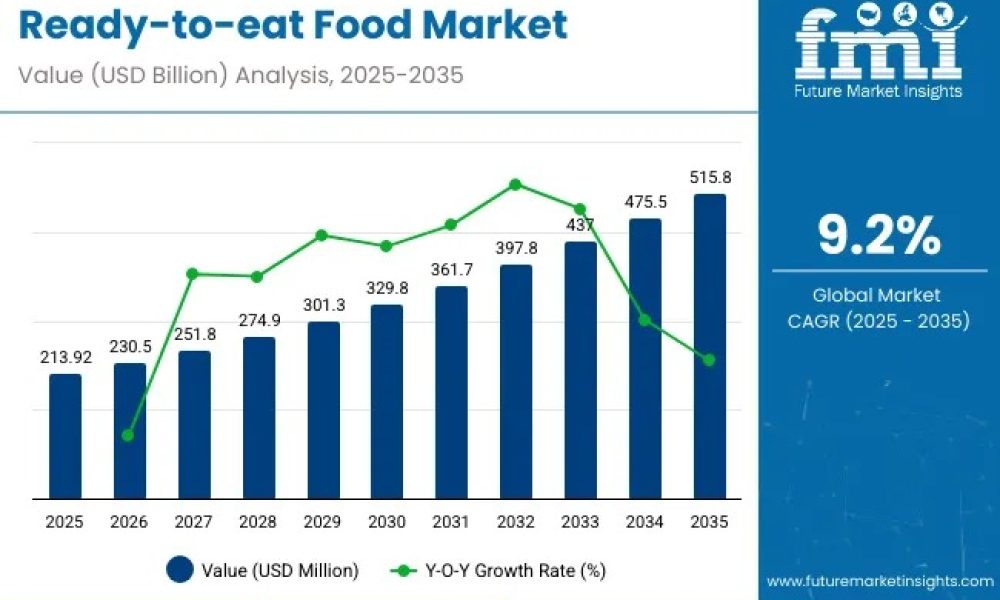
The global ready-to-eat food market is on a robust growth trajectory, projected to rise from USD 213.92 billion in 2025 to USD 515.80 billion by 2035, reflecting a CAGR of 9.2%. The market expansion is fueled by evolving consumer lifestyles, increasing urbanization, and the rising demand for convenient meal solutions that save time without compromising quality.
As modern life becomes busier, more individuals juggle work, commuting, and personal responsibilities, leaving limited time for traditional meal preparation. This dynamic has positioned ready-to-eat foods as a preferred solution for busy households and single-person residences. These products offer pre-cooked, packaged meals that can be quickly heated and consumed, meeting the demand for convenience and efficiency.
Explore trends before investing – request a sample report today!
The rising number of dual-income families and single-person households further accelerates market growth, as these demographics prioritize quick meal options. Advancements in packaging technology and cold chain logistics have enhanced storage and distribution capabilities, enabling wider availability of RTE products across supermarkets, convenience stores, and online platforms.
Consumer perception of ready-to-eat foods has also shifted significantly. Once associated with low quality or poor nutrition, RTE offerings now cater to health-conscious preferences. The market has diversified to include organic, vegan, gluten-free, and protein-rich meals, appealing to a broad spectrum of dietary requirements.
Market Snapshot – Ready-to-Eat Food (2025 vs 2035)
- Market Value (2025): USD 213.92 billion
- Forecast Value (2035): USD 515.80 billion
- CAGR: 9.2%
- Top Product Segment (2025): Snacks & Baked Goods & Confectioneries – 55% share
- Leading Sales Channel (2025): Retail – 64% share
- Key Growth Region: Asia Pacific (India fastest-growing at 11.8% CAGR)
The snacks, baked goods, and confectioneries segment dominates the market, accounting for 55% of total sales in 2025. Busy lifestyles drive demand for these products, which offer convenience, long shelf life, and a wide variety of flavors. Attractive packaging and on-the-go suitability further enhance their popularity among urban and rural consumers alike.
Retail remains the leading sales channel, with 64% of global sales occurring through brick-and-mortar and online retail platforms. The expansion of e-commerce and food delivery apps has made it easier for consumers to access RTE foods, particularly in urban areas. Innovations like vacuum sealing and retort packaging have improved shelf life while preserving taste and nutrition.
Per Capita Spending on Ready-to-Eat Foods
Spending on RTE foods varies across regions:
- Developed Economies: The United States, Europe, and Japan see higher per capita spending due to busy lifestyles and disposable income, emphasizing pre-packaged entrees and restaurant-to-home meal services.
- Emerging Markets: India, Brazil, and Southeast Asia demonstrate rapid growth driven by urbanization, rising middle-class incomes, and expanding retail and e-commerce channels.
Global Trade Landscape
The trade of ready-to-eat foods continues to grow, with leading exporters such as India, China, and the United States catering to international demand. Major importers include the U.S., Australia, and Canada, while Southeast Asia and Latin America show increasing imports as urbanization and income levels rise.
Country-Specific Insights
- USA: Projected CAGR of 7.5% through 2035, driven by frozen pizza and other prepared meals, with growing consumer demand for quality, fresh, and affordable options.
- India: Leading growth at 11.8% CAGR, supported by a large working population and increasing disposable income, offering diverse RTE options including snacks, soups, and international cuisines.
- China: Rapid adoption of e-commerce platforms and demand for natural, healthier options are reshaping RTE food consumption, with producers tailoring offerings to regional tastes.
Subscribe for Year-Round Insights → Stay ahead with quarterly and annual data updates.
Industry Players and Competitive Landscape
The RTE market is fragmented, comprising Tier 1 global leaders with extensive portfolios, mid-size Tier 2 regional players, and Tier 3 small-scale niche operators. Leading manufacturers include:
- Nestlé
- Campbell Soup Company
- Dr. Oetker
- Nomad Foods
- Vietnam Hanfimex Corporation
- Danone
- General Mills Inc.
- McCain Foods Ltd.
- California Pizza Kitchen
- Conagra Brands, Inc.
- MTR Foods Private Limited
- Atkins Nutritionals, Inc.
These companies are prioritizing product innovation and health-focused offerings to meet evolving consumer demands worldwide.
The ready-to-eat food market is poised for sustained expansion as convenience, health-conscious options, and global trade integration continue to shape consumption patterns. Rising urban populations, technological advances in food preservation, and evolving consumer preferences will further drive adoption across regions.
About Future Market Insights (FMI)
Future Market Insights, Inc. (FMI) is an ESOMAR-certified, ISO 9001:2015 market research and consulting organization, trusted by Fortune 500 clients and global enterprises. With operations in the U.S., UK, India, and Dubai, FMI provides data-backed insights and strategic intelligence across 30+ industries and 1,200 markets worldwide.



