
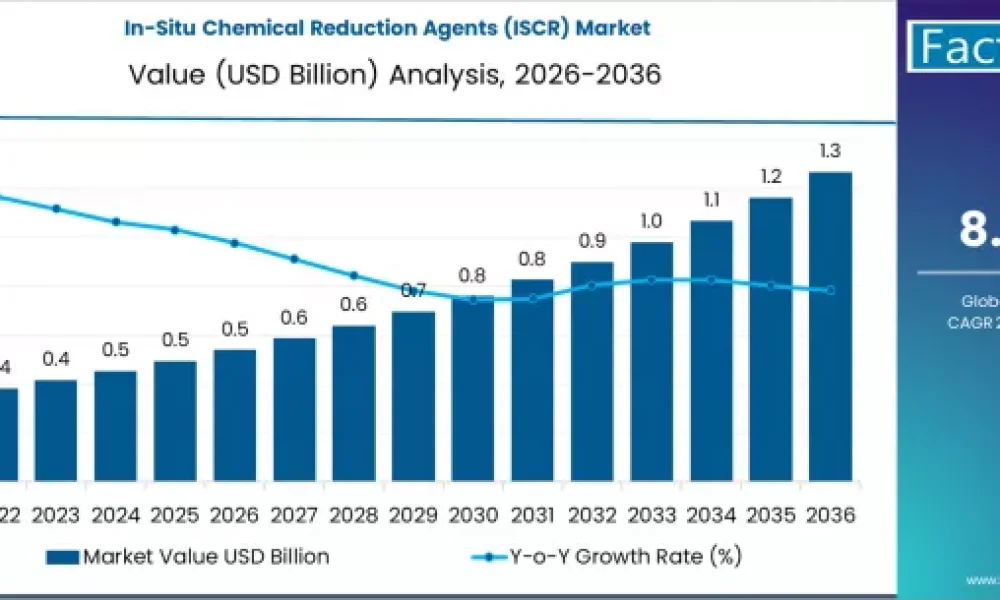
The global In-Situ Chemical Reduction (ISCR) Agents Market is poised for strong expansion, fueled by increasing environmental contamination concerns, stricter groundwater remediation regulations, and growing adoption of sustainable soil and water treatment technologies. According to a recent analysis by Fact.MR, the market is projected to grow from USD 0.54 billion in 2026 to USD 1.27 billion by 2036, registering a robust CAGR of 8.9% during the assessment period.
This growth reflects the rising need for cost-effective, minimally disruptive remediation solutions capable of treating complex contaminants such as chlorinated solvents, heavy metals, and hydrocarbons directly at contaminated sites.
To access the complete data tables and in-depth insights, request a Discount On The Report here: https://www.factmr.com/connectus/sample?flag=S&rep_id=13056
Strategic Market Drivers
Growing Demand for Groundwater & Soil Remediation
Rapid industrialization, urban expansion, and legacy pollution from manufacturing, mining, and chemical processing activities have led to widespread soil and groundwater contamination. ISCR agents offer an effective in-situ treatment method that reduces contaminants without excavation, significantly lowering remediation costs and environmental disruption.
Government agencies and environmental consultants are increasingly adopting ISCR solutions to address contaminated land and brownfield redevelopment projects.
Stringent Environmental Regulations Fuel Adoption
Stricter environmental protection laws across North America, Europe, and parts of Asia-Pacific are compelling industries to invest in advanced remediation technologies. ISCR agents help organizations meet regulatory compliance by transforming hazardous compounds into less toxic or inert forms directly underground.
Shift Toward Sustainable & Green Remediation Technologies
ISCR techniques align with sustainability goals by:
- Minimizing site disturbance
- Reducing carbon footprint compared to excavation-based methods
- Offering long-term contaminant stabilization
The growing emphasis on eco-friendly remediation approaches is significantly boosting ISCR market penetration.
Technological Advancements in Reduction Chemistry
Innovations in zero-valent iron (ZVI), bi-metallic reagents, sulfur-based compounds, and stabilized reducing agents are enhancing treatment efficiency, longevity, and applicability across diverse contamination profiles.
Improved delivery methods and monitoring technologies are further expanding ISCR adoption.
Regional Growth Highlights
North America: Regulatory Enforcement & Legacy Site Cleanup
North America leads the global ISCR market due to strict environmental regulations, extensive legacy contamination sites, and strong government funding for remediation projects. The United States dominates regional demand, particularly for groundwater cleanup at industrial and military sites.
Europe: Sustainability-Driven Remediation Initiatives
European countries such as Germany, the U.K., France, and the Netherlands are witnessing increased ISCR adoption due to stringent EU environmental directives and a strong focus on sustainable land redevelopment and groundwater protection.
Asia-Pacific: Industrial Growth & Environmental Awareness
Rapid industrialization in China, India, and Southeast Asia has increased soil and groundwater contamination risks. Growing environmental awareness and government-led cleanup initiatives are driving ISCR market growth across the region.
Emerging Markets: Infrastructure Expansion & Environmental Protection
Latin America, the Middle East, and Africa are gradually adopting ISCR solutions as infrastructure development, mining activities, and industrial expansion increase the need for efficient contamination management.
Market Segmentation Insights
By Product Type
- Zero-Valent Iron (ZVI) – Dominant segment due to high effectiveness in treating chlorinated solvents
- Sulfur-Based Reduction Agents – Growing use for heavy metal remediation
- Bi-Metallic Agents – Enhanced reactivity and faster contaminant breakdown
By Contaminant Type
- Chlorinated Solvents – Largest share driven by industrial pollution
- Heavy Metals – Rising demand due to mining and manufacturing activities
- Petroleum Hydrocarbons – Increasing remediation in fuel storage and spill sites
By Application
- Groundwater Remediation – Leading segment globally
- Soil Remediation – Growing use in brownfield redevelopment
- Industrial Site Cleanup – Strong demand from chemical and manufacturing sectors
Challenges Impacting Market Growth
High Initial Treatment Costs
While ISCR reduces long-term remediation expenses, upfront costs related to site assessment, agent selection, and injection systems can limit adoption in cost-sensitive regions.
Site-Specific Effectiveness
ISCR performance varies based on soil composition, contaminant type, and groundwater flow, requiring detailed site characterization and expert implementation.
Technical Complexity
Designing and deploying effective ISCR systems demands specialized expertise, which can restrict adoption among smaller remediation firms.
Competitive Landscape
The ISCR agents market is moderately fragmented, with key players focusing on advanced formulations, long-lasting reduction agents, and strategic collaborations with environmental consulting firms.
Key Companies Profiled
- BASF SE
- Evoqua Water Technologies
- PeroxyChem (Solvay)
- Regenesis
- Tersus Environmental
- Carus Corporation
- Veolia Environment
Companies are investing in enhanced ZVI formulations, combined remediation approaches, and improved injection technologies to strengthen market presence.
Recent Developments
- 2024: Introduction of stabilized ISCR agents with extended subsurface reactivity
- 2023: Increased adoption of ISCR solutions in large-scale groundwater remediation projects
- 2022: Integration of ISCR with bioremediation techniques for enhanced contaminant removal
Future Outlook: Accelerated Growth Through Environmental Responsibility
The ISCR market is expected to witness sustained growth through 2036, driven by:
- Increasing groundwater contamination concerns
- Expansion of industrial and infrastructure projects
- Rising regulatory pressure for environmental compliance
- Advancements in reduction agent chemistry
- Growing adoption of sustainable remediation practices
As governments and industries worldwide prioritize long-term environmental protection and cost-effective cleanup solutions, the global In-Situ Chemical Reduction Agents market is set for strong and consistent expansion over the next decade.
Have a specific Requirements and Need Assistant on Report Pricing or Limited Budget please contact us – [email protected]
About Fact.MR
Fact.MR is a global market research and consulting firm, trusted by Fortune 500 companies and emerging businesses for reliable insights and strategic intelligence. With a presence across the U.S., UK, India, and Dubai, we deliver data-driven research and tailored consulting solutions across 30+ industries and 1,000+ markets. Backed by deep expertise and advanced analytics, Fact.MR helps organizations uncover opportunities, reduce risks, and make informed decisions for sustainable growth.



