
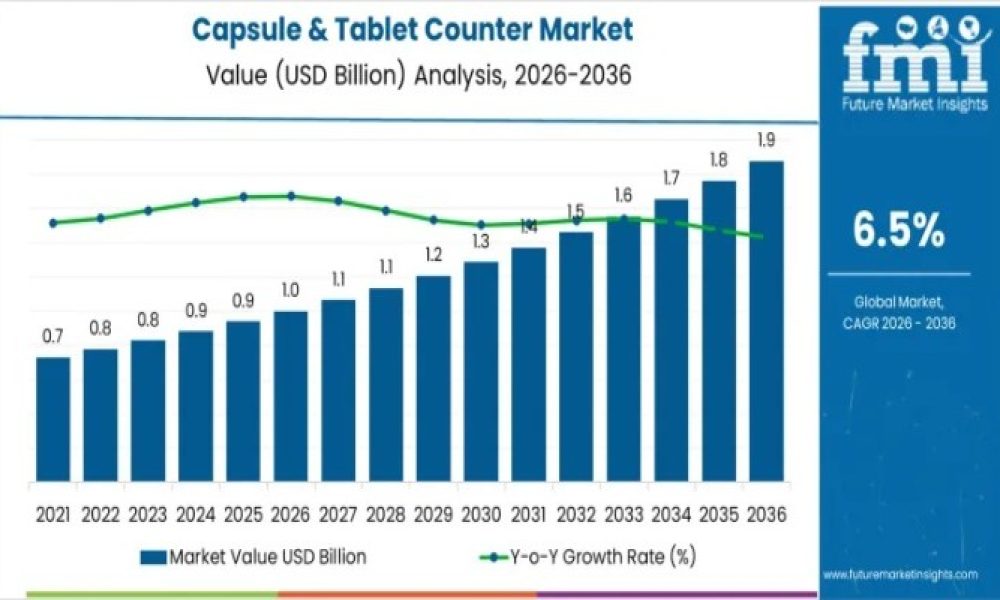
The global Capsule & Tablet Counter Market is entering a decade of steady, compliance-driven expansion as pharmaceutical and nutraceutical manufacturers intensify their focus on accuracy, throughput, and operational control. Valued at USD 1.0 billion in 2026, the market is projected to reach approximately USD 1.9–2.0 billion by 2036, advancing at a CAGR of 6.5%. This growth reflects not just rising production volumes of solid oral dosage forms, but a structural shift toward automated counting technologies as a critical quality checkpoint within regulated packaging environments.
Across North America, Europe, and Asia Pacific, capsule and tablet counters are becoming embedded components of pharmaceutical production lines rather than optional productivity tools. Automatic counters dominate the market with a 45% share, primarily serving pharmaceutical manufacturing applications that account for 55% of total demand. End users are led by direct OEMs (45%), supported by distributors and CMOs/CDMOs seeking scalable, validated counting solutions for multi-client operations.
Discover Market Opportunities – Get Your Sample of Our Industry Overview Today!
Market Outlook: From Selective Adoption to Standardized Deployment
Between 2026 and 2031, the market grows from USD 1.0 billion to roughly USD 1.3 billion, representing an early adoption phase. During this period, annual value additions rise from USD 0.08 billion to USD 0.10 billion, driven by investments in high-volume pharmaceutical plants, contract packaging facilities, and hospital pharmacies. North America and Europe together account for nearly 60% of early adoption, reflecting mature regulatory frameworks and established manufacturing bases where counting accuracy and audit readiness are non-negotiable.
From 2031 to 2036, the market enters a late adoption phase, expanding from USD 1.3 billion to around USD 1.9 billion. Annual increments accelerate to USD 0.14 billion, supported by multi-site deployments, repeat procurement, and expansion into emerging pharmaceutical markets in Asia Pacific and Latin America. What begins as targeted installation in flagship plants evolves into portfolio-wide standardization, reinforcing capsule and tablet counters as integral infrastructure within global solid-dose manufacturing.
What Is Driving Demand?
Demand for capsule and tablet counters originated from practical constraints rather than automation trends alone. Manual and semi-manual counting methods proved increasingly inadequate as prescription volumes, SKU complexity, and regulatory scrutiny intensified. Counting errors posed risks to patient safety, inventory reconciliation, and compliance with GMP and labeling standards.
Today, future demand is shaped less by marginal speed gains and more by system integration and traceability. Manufacturers and healthcare facilities are prioritizing counters that interface with inventory systems, batch records, and digital audit trails. As regulatory bodies emphasize data integrity and end-to-end visibility, counting technology is evolving into a control point for medication safety and compliance rather than a standalone mechanical function.
Product Type Leadership: Automation Sets the Pace
Automatic capsule and tablet counters account for approximately 45% of market demand, reflecting their alignment with high-speed, high-accuracy packaging environments. These systems integrate vision inspection, electronic validation, and reject mechanisms to ensure consistent performance under regulatory oversight. Their compatibility with bottle filling, blister packaging, and downstream inspection lines further strengthens adoption among pharmaceutical manufacturers.
Semi-automatic counters remain relevant for mid-scale operations seeking improved accuracy without full automation investment, while manual counters persist in niche roles such as pilot production, specialty batches, and after-market service. However, market direction is clearly defined by automation, scalability, and compliance intensity rather than basic affordability.
Application Analysis: Pharmaceutical Manufacturing Leads
Pharmaceutical manufacturing represents around 55% of total demand, driven by the dominance of solid oral dosage forms and stringent regulatory requirements. Accurate counting is essential for serialization, labeling compliance, and quality assurance, making automated counters indispensable in high-volume production.
Nutraceutical manufacturers contribute steadily to demand, supported by rising consumer health awareness, though purchasing decisions remain more cost-sensitive. CMOs and CDMOs adopt counters based on client specifications, often investing in automation to meet diverse regulatory expectations across global markets. Application leadership therefore reflects production scale, regulatory risk, and operational standardization, rather than sheer facility numbers.
Regional Growth Highlights
- India (CAGR 8.7%) leads global growth, supported by expanding generics production, export-oriented manufacturing, and rising nutraceutical output.
- China (8.5%) follows closely, driven by large-scale pharmaceutical facilities and tightening quality standards.
- Brazil (8.0%) benefits from growing domestic pharmaceutical production and healthcare demand.
- United States (7.5%) shows consistent growth, anchored in established pharmaceutical infrastructure and predictable replacement cycles.
- Germany (5.7%) reflects steady adoption in a mature, highly regulated manufacturing environment.
Across regions, growth is reinforced by recurring production cycles, regulatory compliance requirements, and the need to reduce human error in high-volume packaging.
Competitive Landscape: Precision and Integration Define Success
Competition in the capsule and tablet counter market is shaped by reliability under real production conditions rather than headline speed metrics. IMA Group, Syntegon, ACG, Romaco, and Marchesini lead the market through platforms designed for seamless integration with regulated packaging lines.
- IMA Group and Marchesini emphasize end-to-end line compatibility and validation support.
- Syntegon focuses on vision-based flexibility and rapid changeovers across dosage formats.
- ACG aligns counting systems with its broader solid-dose and packaging ecosystem, prioritizing service continuity.
- Romaco competes through compact designs and adaptability for CMOs and space-constrained facilities.
Purchasing decisions prioritize accuracy under dust and vibration, documentation quality, lifecycle support, and minimal downtime during audits and changeovers. As a result, supplier switching remains conservative, and installed-base protection plays a significant role in market dynamics.
Why FMI: https://www.futuremarketinsights.com/why-fmi
About Future Market Insights (FMI)
Future Market Insights, Inc. (FMI) is an ESOMAR-certified, ISO 9001:2015 market research and consulting organization, trusted by Fortune 500 clients and global enterprises. With operations in the U.S., UK, India, and Dubai, FMI provides data-backed insights and strategic intelligence across 30+ industries and 1200 markets worldwide.



