
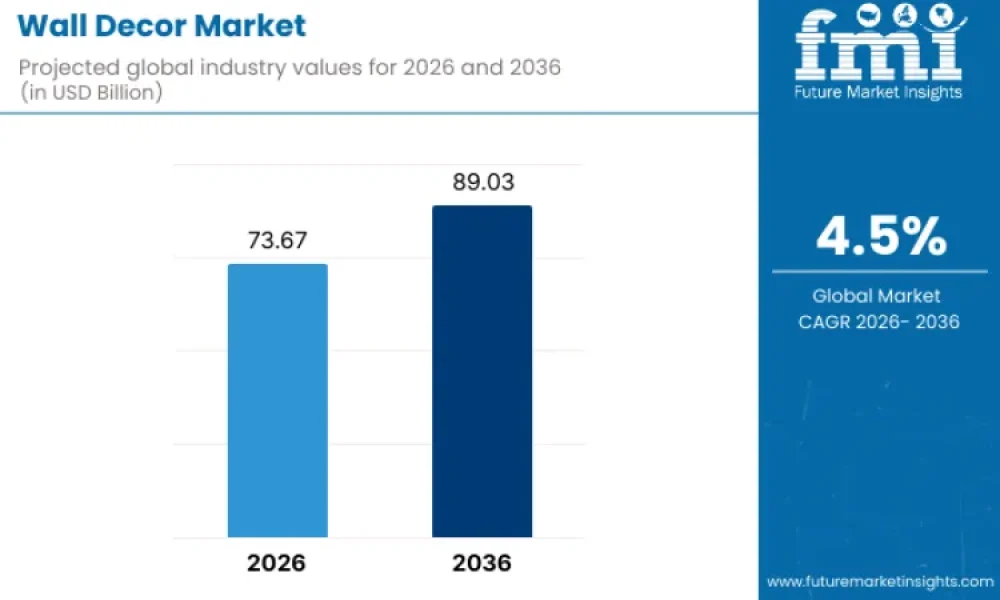
The global wall decor market is set for consistent expansion as interior styling becomes an essential part of modern living and commercial design. Valued at USD 73.67 billion in 2026, the market is projected to reach USD 89.03 billion by 2036, growing at a CAGR of 4.5% during the forecast period. This growth reflects how wall decor has evolved from a finishing accessory into a core design element that shapes ambiance, identity, and personal expression.
Across residential homes, offices, hospitality venues, and retail environments, wall decor products such as wall art, wallpapers, mirrors, murals, panels, and decals are increasingly used to refresh interiors without major structural changes. Both established brands and emerging manufacturers are actively expanding portfolios, introducing new materials, and adopting digital tools to stay competitive in a trend-driven market.
Gain access to detailed segment-wise analysis and forecast statistics – Request the Sample Report Today
Quick Highlights: Wall Decor Market Outlook (2026–2036)
- Market Size (2026): USD 73.67 billion
- Market Forecast (2036): USD 89.03 billion
- Forecast CAGR: 4.5%
- Leading Product Segment: Wall art (framed prints, canvas art, posters)
- Leading Materials: Wood-based and metal-based decor
- Key Growth Regions: Asia Pacific, North America, Europe
- Major Demand Drivers: Home renovation activity, urban housing upgrades, personalized interiors, growth of online home décor retail
- Top Established Players: IKEA, Home Depot, Lowe’s, Wayfair, Williams-Sonoma (West Elm, Pottery Barn)
Market Growth Overview
The steady rise of the wall decor market is supported by ongoing home renovation and remodeling trends, particularly in urban areas where visual upgrades are prioritized over structural alterations. Homeowners increasingly use wall decor to reflect personality, lifestyle, and evolving design preferences. At the same time, commercial spaces such as offices, hotels, cafés, and co-working hubs rely on decorative walls to enhance customer experience and brand identity.
Residential demand remains strong for framed artwork and decorative mirrors, while commercial interiors show rising interest in murals, textured wall panels, and large-scale art installations that create immersive visual environments.
Key Segments of the Wall Decor Market
By Product Type:
- Wall Art
- Wallpapers and Wall Coverings
- Wall Stickers and Decals
- Wall Clocks
- Mirrors
- Other Decorative Wall Accessories
By Material Type:
- Wood
- Metal
- Plastic
- Fabric
- Glass
- Mixed and Other Materials
By Sales Channel:
- Specialty Decor Stores
- Supermarkets and Hypermarkets
- Departmental Stores
- Online Retail Platforms
- Other Distribution Channels
By End Use:
- Residential
- Commercial (Offices, Hospitality, Retail Spaces)
By Region:
- North America
- Europe
- Asia Pacific
- Latin America
- Middle East and Africa
This segmentation highlights how manufacturers tailor products to varied budgets, design tastes, and usage environments while optimizing both physical and digital retail strategies.
Wall Art Leads Global Demand
Wall art accounts for approximately 38% of global wall decor demand, making it the largest product segment. Its popularity stems from versatility, wide price accessibility, and ease of installation. Framed prints, canvas art, posters, and decorative panels allow quick style updates and frequent replacements, encouraged by social media-driven interior trends.
Key reasons for dominance:
- Flexible design options across residential and commercial spaces
- Strong online sales supported by customization tools
- Frequent style refresh cycles driving repeat purchases
Offline Retail Maintains Sales Leadership
Despite rapid digital growth, offline retail channels contribute nearly 55% of total wall decor sales. Consumers prefer physical stores to assess size, texture, color accuracy, and finish before purchasing decorative items. Specialty decor stores and home furnishing outlets also help buyers visualize products in styled environments, supporting higher conversion for premium and oversized items. Online platforms complement this experience through wider selection and digital previews.
Regional and Country-Level Insights
- United States (CAGR 5.2%): Strong DIY culture, frequent home upgrades, and social media influence sustain high demand.
- China (CAGR 6.4%): Urbanization, compact housing, and e-commerce driven access fuel rapid adoption.
- Germany (CAGR 4.8%): Preference for durability, eco-friendly materials, and timeless design.
- United Kingdom (CAGR 5.0%): Rising demand for customized and made-to-order wall decor.
- France (CAGR 4.6%): Focus on artistic detail, premium aesthetics, and curated collections.
Competitive Landscape: Innovation Meets Scale
The wall decor market is highly competitive, featuring global giants, mid-sized brands, digital-first platforms, and independent designers. Established players such as IKEA, Home Depot, Lowe’s, Wayfair, and Williams-Sonoma leverage scale, omnichannel reach, and frequent design updates to maintain leadership.
At the same time, new and emerging manufacturers are gaining traction by introducing:
- Customizable and modular wall decor
- Sustainable and mixed-material designs
- Digital visualization and personalization technologies
E-commerce-driven brands and artist-led platforms continue to reshape competition by offering unique, made-to-order designs that appeal to younger and design-conscious consumers.
Outlook Through 2036
With steady innovation, expanding online reach, and rising demand for personalized interiors, the wall decor market is expected to maintain healthy growth through 2036. Companies that balance creativity, cost efficiency, and digital engagement will be best positioned to expand their presence and capture evolving consumer preferences in both mature and emerging markets.
Have a specific Requirements and Need Assistant on Report Pricing or Limited Budget please contact us – [email protected]
About Future Market Insights (FMI)
Future Market Insights, Inc. (FMI) is an ESOMAR-certified, ISO 9001:2015 market research and consulting organization, trusted by Fortune 500 clients and global enterprises. With operations in the U.S., UK, India, and Dubai, FMI provides data-backed insights and strategic intelligence across 30+ industries and 1200 markets worldwide.



