
The global shift toward circular packaging systems is moving beyond intention into execution, and reusable packaging infrastructure is now under real-world operational pressure. Within this transition, the High-Durability Washing-Resistant Reusable Packaging Components Market is emerging as a critical enabler of scalable reuse models across foodservice, retail, and logistics networks.
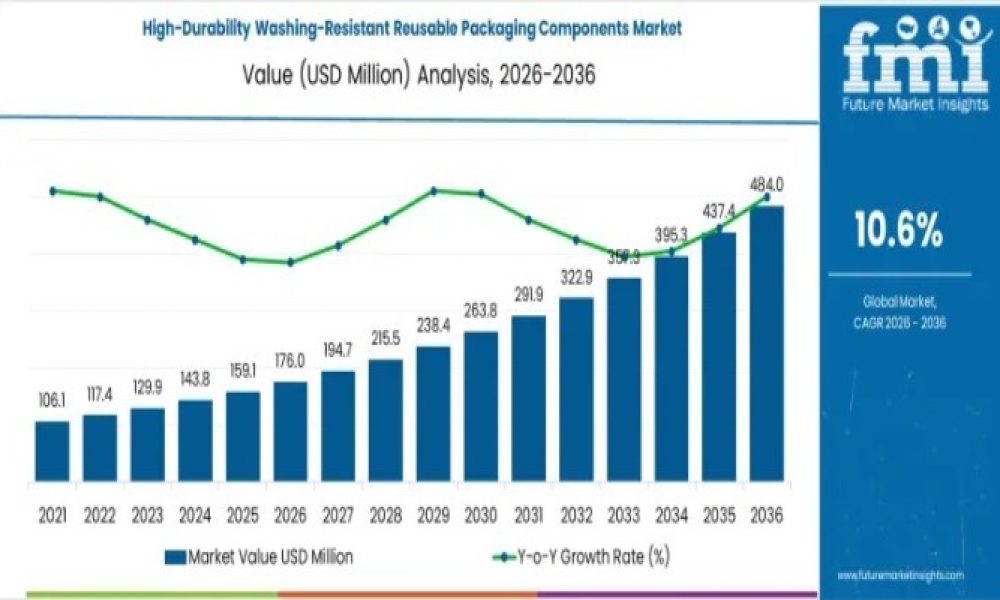
Valued at USD 176 million in 2026, the market is projected to reach USD 484 million by 2036, expanding at a robust CAGR of 10.6%. This growth reflects not only rising adoption of reusable packaging, but also the increasing need for components that can withstand repeated industrial washing, chemical exposure, thermal stress, and mechanical handling without compromising hygiene or performance.
Request Your Sample Now – Unlock Growth Potential and Discover Key Market Opportunities!
Market Momentum Driven by Practical Reuse Economics
Early reusable packaging systems often struggled with durability. Components degraded quickly under industrial wash cycles, increasing replacement costs and operational downtime. The current generation of washing-resistant reusable packaging components such as reinforced cups, trays, lids, seals, and stackable containers—addresses these limitations directly.
Between 2026 and 2031, the market grows from USD 176 million to approximately USD 283 million, representing an early adoption phase. Growth during this period is driven by pilot programs and controlled deployments across cafés, quick-service restaurant (QSR) chains, beverage operators, and closed-loop logistics systems. These early adopters prioritize durability validation, hygiene compliance, and compatibility with existing dishwashing and cleaning infrastructure.
From 2031 to 2036, cumulative market value accelerates sharply, reaching USD 484 million. At this stage, reusable components transition from pilot projects to standardized infrastructure across high-volume foodservice chains, institutional catering, events, and delivery platforms. Repeat procurement cycles, operational efficiency gains, and integration with deposit-return and app-linked tracking systems support sustained value accumulation.
Quick Market Snapshot
- Market Value (2026): USD 176 million
- Forecast Value (2036): USD 484 million
- Forecast CAGR (2026–2036): 10.6%
- Leading Component Types: Reusable cups, trays, bowls, lids, seals, and valves
- Key Growth Regions: North America and Asia Pacific
What Is Driving Demand?
Demand for high-durability, washing-resistant reusable packaging components is shaped by operational realities rather than sustainability messaging alone. Foodservice and logistics operators require components that can endure hundreds of wash cycles while maintaining dimensional stability, sealing integrity, and surface hygiene.
Key demand drivers include:
- Expansion of industrial washing and reverse logistics infrastructure
- Regulatory pressure linked to extended producer responsibility (EPR) and waste reduction mandates
- Lifecycle cost advantages over single-use and low-durability reusable alternatives
- Growing reliance on automation, where component consistency reduces system failures
As reuse systems scale, selection criteria increasingly focus on wash cycle tolerance, lifecycle cost analysis, and digital traceability compatibility, not just material strength.
End-Use and Component Dynamics
Industrial and retail reuse systems account for roughly 35% of total demand, making them the largest end-use segment. These environments feature high circulation volumes and centralized washing facilities, where component failure carries direct operational cost.
Foodservice and beverage applications follow closely, driven by hygiene requirements and frequent handling. Reusable bottle systems depend heavily on valves, closures, and seals, where performance consistency is critical across refill cycles.
By component type:
- Lids, seals, and valves represent about 40% of total demand, reflecting their exposure to wash stress and product contact
- Reinforced handles and hinges address mechanical fatigue points
- Connectors and modular closures support interoperability within pooled reuse systems
Demand remains stable because operators avoid frequent component redesigns once systems are validated.
Regional Outlook: Growth Anchored in Scale and Structure
- India (CAGR 11.5%) leads global growth, supported by expanding organized foodservice, beverage manufacturing, and cost-aligned domestic suppliers.
- China (10.8%) benefits from large-scale manufacturing, urban retail expansion, and automated washing compatibility.
- Germany (8.0%) shows steady growth driven by regulatory support and structured reuse programs.
- United States (7.5%) sees adoption across retail distribution, cafés, and industrial reuse initiatives.
- Brazil (8.0%) grows with beverage and retail distribution expansion.
- Japan (5.0%) reflects a mature market with stable, replacement-driven demand.
Competitive Landscape: Performance Over Scale
Competition in the market is shaped by material resilience, dimensional stability, and proven lifecycle performance.
Key players include:
- Trelleborg – sealing and elastomer solutions for high-stress reuse environments
- Aptar – durable closures and dispensing systems
- Henkel – washing-resistant adhesives and bonding technologies
- Berry Global – rigid reusable components and closures
- YUTO Packaging, UFlex, Toppan, and local converters supporting region-specific reuse models
Validation under real washing conditions and compatibility with automated systems define competitive advantage.
Why FMI: https://www.futuremarketinsights.com/why-fmi
About Future Market Insights (FMI)
Future Market Insights, Inc. (FMI) is an ESOMAR-certified, ISO 9001:2015 market research and consulting organization, trusted by Fortune 500 clients and global enterprises. With operations in the U.S., UK, India, and Dubai, FMI provides data-backed insights and strategic intelligence across 30+ industries and 1200 markets worldwide.



