
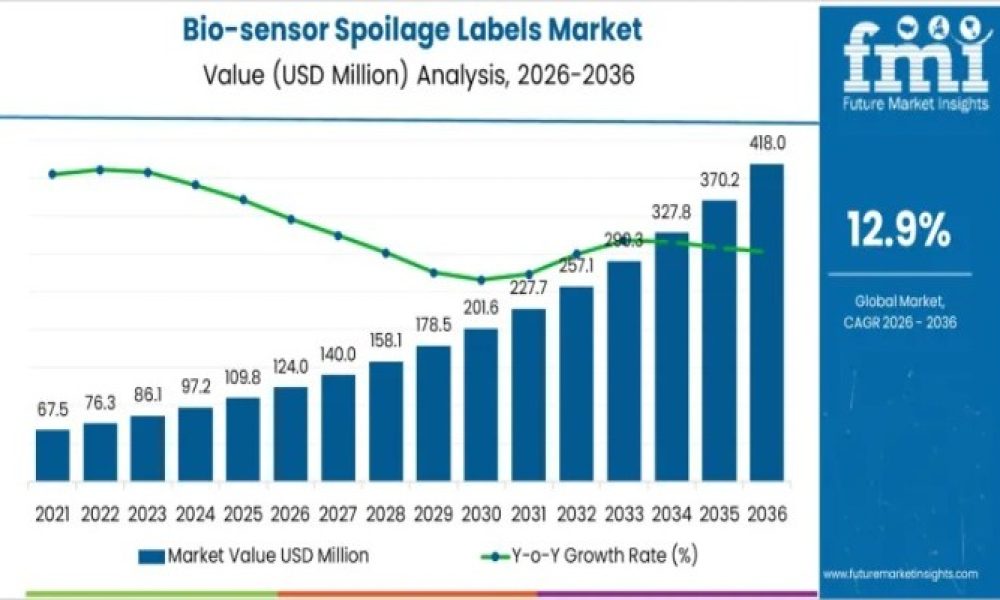
The global bio-sensor spoilage labels market is entering a decisive decade of growth as food safety regulations tighten, cold-chain logistics expand, and brands face rising pressure to deliver real-time transparency across perishable supply chains. Valued at USD 124 million in 2026, the market is projected to reach USD 418 million by 2036, advancing at a robust CAGR of 12.9%. This trajectory reflects the transition of bio-sensor labels from niche pilot tools to functional packaging components embedded in mainstream food and pharmaceutical distribution.
Bio-sensor spoilage labels address a longstanding limitation of traditional date-based expiration systems. Conventional labels estimate shelf life without accounting for actual storage conditions, temperature excursions, or microbial activity. In contrast, bio-sensor labels provide visual, chemical, or colorimetric indicators that respond directly to spoilage-related factors, enabling faster decision-making, reduced waste, and improved consumer safety.
Explore Opportunities – Get Your Sample of Our Industry Overview Now!
Quick Market Snapshot
- Market Value (2026): USD 124.0 million
- Forecast Value (2036): USD 418.0 million
- Forecast CAGR (2026–2036): 12.9%
- Leading Packaging Format: Peel-and-stick sensor labels (55% share)
- Key Growth Regions: India, China, USA, Brazil, Germany, Japan
- Prominent Players: Berlinger / Timestrip, Toppan, Schreiner, UFlex, and regional innovators
Early Growth Phase: Validation and Selective Deployment (2026–2031)
Between 2026 and 2031, the bio-sensor spoilage labels market expands from USD 124 million to approximately USD 220 million, marking the early growth curve. Adoption during this phase is concentrated in high-value perishables, including seafood, ready-to-eat meals, dairy, meat, and temperature-sensitive pharmaceuticals.
Brands and logistics operators deploy peel-and-stick sensor labels and enzyme-based biosensors in controlled pilot programs, validating accuracy, adhesive performance, and compatibility with existing packaging lines. Annual absolute value additions accelerate from roughly USD 14 million to USD 43 million, reflecting rising regulatory scrutiny and heightened food safety awareness.
Key drivers in the early phase include:
- Stricter cold-chain compliance requirements
- Retailer accountability for spoilage and recalls
- Consumer demand for freshness visibility
- Brand-led awareness campaigns around smart packaging
Despite strong momentum, growth remains measured as manufacturers prioritize validation over rapid scale-up.
Late Growth Phase: Commercial Scale and Volume-Led Expansion (2031–2036)
From 2031 to 2036, the market transitions into a late growth curve, expanding from USD 220 million to USD 418 million. Growth during this phase is defined less by experimentation and more by portfolio-wide integration across grocery chains, meal kit services, pharmaceutical logistics, and e-commerce perishables.
Key structural enablers include:
- Production scale-up of enzyme-based and colorimetric sensors
- Standardization of label formats across packaging systems
- Cost optimization through printed electronics platforms
- Integration with IoT-enabled monitoring systems for real-time traceability
As adoption broadens, annual value additions widen significantly, and procurement becomes repeatable rather than project-based. Bio-sensor spoilage labels evolve into standardized quality-assurance tools embedded in operational protocols.
Packaging Format Dynamics Shape Market Adoption
Packaging format plays a defining role in demand patterns, with operational convenience driving adoption decisions more than performance differentiation.
Market share by format highlights:
- Peel-and-stick sensor labels (55%) dominate due to ease of deployment and minimal workflow disruption
- Sleeve sensors gain traction where full container visibility is required
- Tag labels support logistics and retail batch monitoring
- Integratable stickers serve applications requiring permanent placement
Simpler attachment formats consistently outperform complex designs, reinforcing scalability and speed as primary adoption criteria.
Packaging Type Acts as a Structural Filter
Packaging type influences adoption based on material compatibility and environmental exposure:
- Rigid packaging supports higher adoption due to stable surfaces and consistent visibility
- Flexible packaging requires conformable formats without compromising sensor accuracy
- Semi-rigid containers, common in ready meals and seafood, demand adaptable placement
Producers favor label solutions that fit existing materials, avoiding costly packaging redesigns. As a result, demand aligns closely with established packaging practices.
Regional Growth Outlook: Emerging Markets Lead Momentum
Growth varies significantly by geography, reflecting differences in cold-chain maturity and regulatory intensity:
- India (12.0% CAGR): Rapid expansion driven by organized food production and pharmaceutical logistics
- China (11.0% CAGR): Strong uptake across processed foods, urban retail, and e-commerce
- USA (9.8% CAGR): Adoption anchored in dairy, meat, seafood, and ready-to-eat segments
- Brazil (7.5% CAGR): Growth tied to perishable food distribution and retail network expansion
- Germany (7.0% CAGR): Compliance-driven adoption across structured supply chains
- Japan (6.2% CAGR): Stable growth supported by strict safety standards and technical precision
Competitive Landscape: Specialists Meet Scale Players
A mix of specialist indicator label developers and large packaging solution providers shapes competition:
- Berlinger / Timestrip lead in pharmaceutical and cold-chain monitoring
- Schreiner Group maintains strong European presence through smart label integration
- Toppan leverages advanced printing and functional materials expertise
- UFlex targets cost-sensitive applications in emerging markets
- Local innovators drive R&D in enzymatic, gas-sensing, and color-change technologies
Differentiation centers on detection accuracy, response time, regulatory approvals, and packaging line compatibility, with validation cycles and compliance forming the primary entry barriers.
Why FMI: https://www.futuremarketinsights.com/why-fmi
About Future Market Insights (FMI)
Future Market Insights, Inc. (FMI) is an ESOMAR-certified, ISO 9001:2015 market research and consulting organization, trusted by Fortune 500 clients and global enterprises. With operations in the U.S., UK, India, and Dubai, FMI provides data-backed insights and strategic intelligence across 30+ industries and 1200 markets worldwide.



