
The global wear resistant steel plate market is entering a decisive growth decade, driven by accelerating infrastructure investments, mining expansion, and the global push for higher equipment durability and lifecycle efficiency. As industries face rising operating costs and sustainability pressures, wear resistant steel plates—engineered to withstand extreme abrasion, impact, and stress—are increasingly becoming mission-critical materials rather than optional upgrades.
Market Size and Long-Term Growth Outlook (2026–2036)
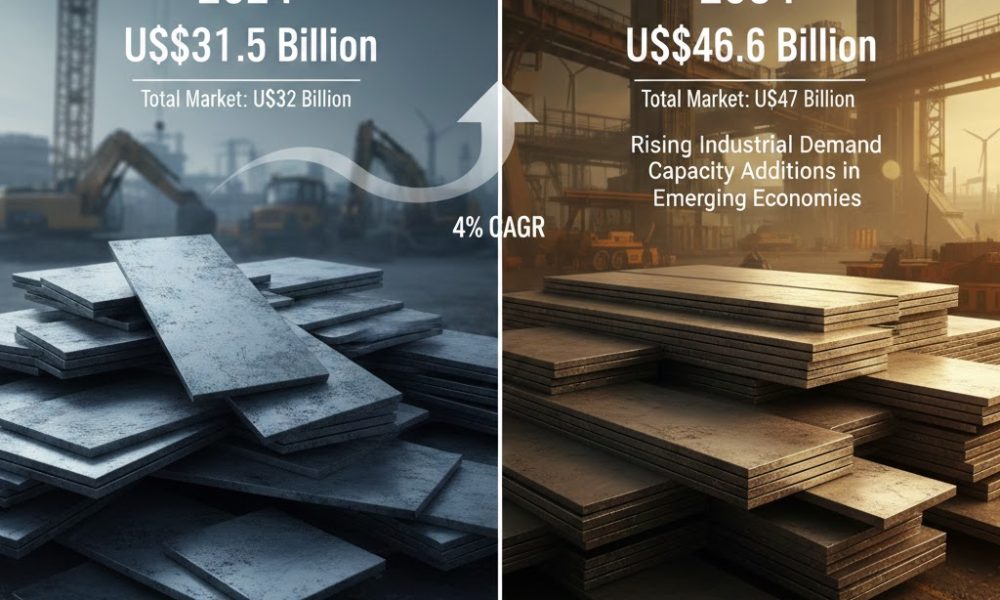
In 2024, the global wear resistant steel plate market was valued at approximately US$31.5 billion, with revenues projected to reach US$46.6 billion by 2034, reflecting a steady ~4% CAGR over the decade. Broader estimates that include adjacent wear-resistant steel products place the total market closer to US$32 billion in 2024, with forecasts indicating expansion toward US$47 billion by 2035, supported by rising industrial demand and capacity additions in emerging economies.
Looking ahead to 2026–2036, market growth is expected to remain resilient, averaging 4–5% annually, with upside potential in regions investing heavily in mining modernization, large-scale infrastructure, and advanced manufacturing. This positions wear resistant steel plates as one of the most stable specialty steel segments over the next decade.
To access the complete data tables and in-depth insights, request a Discount On The Report here: https://www.factmr.com/connectus/sample?flag=S&rep_id=522
Demand Drivers: Mining, Construction, and Heavy Industry
Mining remains the single largest application segment, accounting for over 44% of global demand in 2024, due to the extreme abrasion conditions faced by crushers, conveyors, dump bodies, and liners. With global demand for critical minerals—such as copper, lithium, and iron ore—rising sharply, mining companies are prioritizing materials that reduce downtime and maintenance costs, directly benefiting wear resistant plate adoption.
Construction is emerging as the fastest-growing application, forecast to expand at ~4.7% CAGR through 2030, driven by urbanization, megaprojects, and transport infrastructure in Asia-Pacific, the Middle East, and Africa. Heavy equipment, earth-moving machinery, and structural components increasingly specify abrasion-resistant grades to extend service life under harsh operating conditions.
Manufacturing, cement, agriculture, and recycling industries also contribute to incremental demand, particularly where equipment exposure to impact and friction is constant.
Product and Thickness Trends
From a product perspective, abrasion-resistant steel plates dominate the market, representing nearly 46% of total share in 2024, as they are widely used across mining and construction applications. Impact-resistant plates, while smaller in volume, are expected to record faster growth due to their use in heavy loading and high-stress environments.
Thickness preferences further reflect industrial usage patterns. Plates above 30 mm accounted for over 52% of total volume in 2024, underscoring demand from heavy-duty applications where structural integrity and long wear life are critical.
Regional Dynamics: Where Growth Will Concentrate
Europe currently represents the largest regional market, accounting for around 40% of global demand, supported by its mature mining, construction, and recycling industries. North America follows with approximately 20% share, driven by mining, infrastructure rehabilitation, and energy projects.
However, Asia-Pacific is expected to be the primary growth engine from 2026 onward, led by China, India, Southeast Asia, and Australia. India’s steel industry, in particular, is shifting toward customized, high-value steel products, reflecting growing demand for application-specific wear resistant solutions in infrastructure, mining, and manufacturing.
Competitive Landscape and Capacity Expansion
The market remains moderately consolidated, with global leaders including SSAB, ArcelorMittal, ThyssenKrupp, Nippon Steel, Dillinger, BAOSTEEL, and NLMK Clabecq shaping technology, quality standards, and global supply. These players are investing heavily in advanced metallurgical processes, alloy design, and production efficiency to maintain margins amid raw material volatility.
Strategic capacity expansion is also reshaping the competitive environment. For example, Nippon Steel has announced plans to increase its global crude steel capacity to 100 million tons by the mid-2030s, with a strong focus on overseas growth markets, reinforcing long-term supply capability for high-performance steel products, including wear resistant plates.
Market Entry Insights: Where New Players Can Win
Despite the presence of global majors, the wear resistant steel plate market offers attractive entry opportunities for new and regional players between 2026 and 2036:
Customization and application-specific grades: End users increasingly demand tailored solutions rather than standard plates.
Emerging markets: Local production in Asia, Africa, and Latin America can reduce logistics costs and improve responsiveness.
Value-added services: Cutting, forming, and pre-fabrication services are becoming key differentiators.
Sustainability positioning: Low-carbon steelmaking and longer product lifecycles align with ESG priorities of global miners and contractors.
Emerging Opportunities and Strategic Outlook
Technological innovation will define competitive advantage over the next decade. Advances in alloy design, heat treatment, and composite wear solutions are extending plate lifespan and reducing total cost of ownership for end users. Digitalization and predictive maintenance are further strengthening the business case for premium wear resistant materials.
By 2036, the global wear resistant steel plate market is expected to be larger, more specialized, and more sustainability-driven than ever before. Companies that align capacity expansion with high-growth regions, invest in R&D, and build close partnerships with end-use industries will be best positioned to capture value in this resilient and strategically vital steel segment.
Have a specific Requirements and Need Assistant on Report Pricing or Limited Budget please contact us – [email protected]
To View Related Report :
Cut-Resistant High-Tenacity Blended Yarns Market https://www.factmr.com/report/cut-resistant-high-tenacity-blended-yarns-market
Arc-Flash Resistant Technical Yarn Systems Market https://www.factmr.com/report/arc-flash-resistant-technical-yarn-systems-market



