
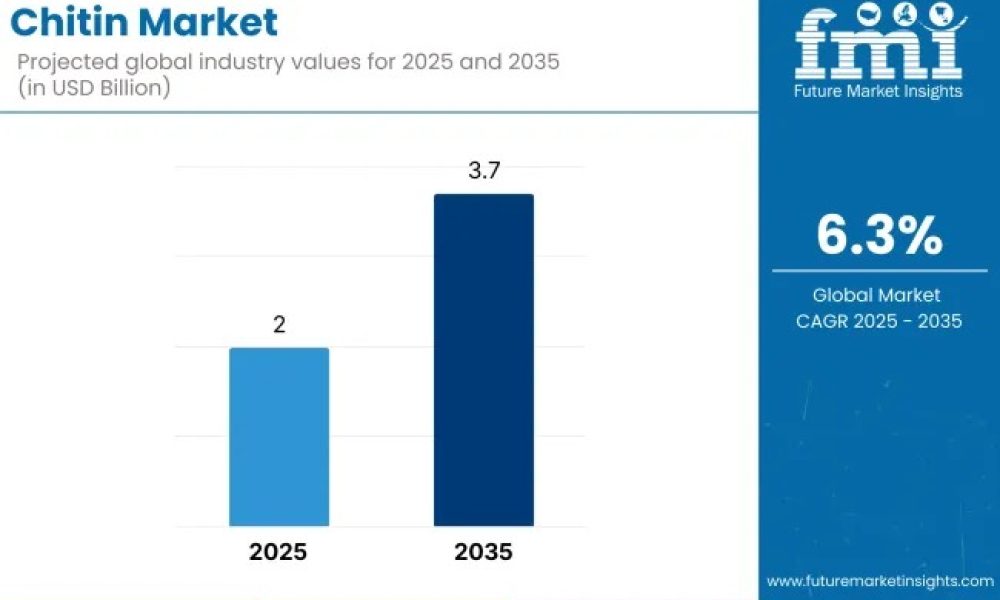
The global chitin market is projected to grow from an estimated USD 2 billion in 2025 to USD 3.7 billion by 2035, reflecting a robust CAGR of 6.3% during this period. The growth is underpinned by rising adoption across biomedical, agricultural, and environmental sectors, alongside increasing global demand for biodegradable and renewable biomaterials.
Chitin’s versatility and non-toxic properties have positioned it as a material of choice for tissue engineering, chronic wound management, and eco-friendly applications. Clinical trials, such as the 2024 study by the University of Tokyo’s Biomaterials Research Department, reported that chitin-based hydrogels accelerated keratinocyte proliferation and epithelialization in full-thickness wound models.
Dr. Hiroshi Nakamura, Chief Innovation Officer at Nitta Gelatin Inc., emphasized in the Q1 2024 strategy review that chitin biofilms are “core to our wound care pipeline, specifically due to their hemostatic and anti-inflammatory response.”
Get Exclusive Access To Data Tables, Market Sizing Dashboards, And Analyst Insights. Request Sample Report!
In agriculture, chitin-based biopesticides gained momentum, particularly in the European Union, following regulatory approval under Annex I of the Sustainable Use of Pesticides Directive. The International Federation of Organic Agriculture Movements highlighted that chitin-treated soil increases beneficial mycorrhizal activity by 25% and reduces pathogen-induced plant mortality by up to 32%. Éric Bonnet, CEO of Agronutris, revealed that production of black soldier fly-derived chitin scaled by 45% to support sustainable agriculture across Europe and Latin America.
Water treatment applications are also expanding, with chitin-based filtration membranes and flocculants demonstrating remarkable efficacy. A February 2025 alliance between Chitosan Lab of France and a Nordic municipal utility achieved 91.2% lead removal efficiency and a 39% reduction in sludge volume in pilot facilities.
Manufacturing innovations are further boosting the market. Enzymatic deacetylation methods introduced by the University of Copenhagen in 2023 increased yield efficiency by 46% while reducing chemical effluents, prompting wider adoption in Southeast Asian clusters. In Vietnam, shrimp shell waste recovery for chitin production rose by 30% year-on-year as of March 2025, driven by automation and process improvements.
Category-Wise Outlook
- Food & Beverage (35% share in 2025): Chitin is increasingly incorporated in food preservation, dietary fiber fortification, and probiotic formulations. Manufacturers like Golden-Shell Pharmaceutical Co., Ltd. and Bio21 Co., Ltd. are supplying food-grade chitin for plant-based meat substitutes, low-calorie functional foods, and biodegradable coatings.
- Chitosan Derivative (50% share in 2025): Chitosan dominates due to applications across pharmaceuticals, water treatment, cosmetics, and food safety. Companies such as Heppe Medical Chitosan GmbH and Advanced Biopolymers AS focus on ultra-pure chitosan for drug delivery systems, wound healing, and effluent treatment.
Key Industry Highlights
- Biomedical Applications: Chitin-based hydrogels, scaffolds, and sutures are gaining traction in tissue regeneration, drug delivery, and wound healing. R&D investment, biotech collaborations, and clinical trial outcomes are driving adoption, despite challenges in cost-effective mass production.
- Bioplastics and Sustainable Packaging: Chitin-based films and composites are emerging as alternatives to petroleum-derived plastics. Blending with PLA, starch, or cellulose enhances mechanical properties while maintaining biodegradability.
- Non-Crustacean Chitin Sources: Fungal and insect-derived chitin are gaining prominence due to allergen concerns and supply constraints. Companies like Kitozyme S.A. are advancing scalable, vegan-friendly chitin production.
- Agricultural Biostimulants: Chitin-based fertilizers and coatings enhance soil health, water retention, and pest resistance. Firms are leveraging micro-encapsulation to improve slow-release efficiency and cost-effectiveness for farmers.
- Pharmaceutical-Grade Chitin: Nanotechnology applications, including chitosan nanoparticles for drug delivery and vaccine carriers, are expanding. Companies are optimizing molecular weight and purity to improve therapy efficacy and bioavailability.
- Waste Valorisation: Seafood waste, including shrimp, crab, and lobster shells, is increasingly processed into high-value chitin products through enzyme-assisted extraction, fermentation, and membrane technologies.
Country-Wise Insights
- China (CAGR 6.7%): Leading in chitin nanomaterials for targeted drug delivery and regenerative medicine.
- USA (CAGR 4.8%): Growth driven by precision agriculture with customized chitin-based biopesticides.
- Japan (CAGR 2.5%): High-end skincare utilizing marine-derived chitin for anti-aging and moisture retention.
Competition Outlook
The market is highly competitive with Tier 1 leaders like Golden-Shell Pharmaceutical Co., Ltd., Heppe Medical Chitosan GmbH, Primex Ehf, and Advanced Biopolymers AS focusing on high-purity applications. Tier 2 and 3 players emphasize agriculture, wastewater treatment, and industrial biopolymers, often collaborating with local agritech and water treatment companies to expand reach.
Subscribe for Year-Round Insights → Stay ahead with quarterly and annual data updates.
Leading Manufacturers
- Kitozyme S.A.
- Primex Ehf
- Heppe Medical Chitosan GmbH
- Advanced Biopolymers AS
- Golden-Shell Pharmaceutical Co., Ltd.
- G.T.C. Bio Corporation
- Panvo Organics Pvt. Ltd.
- Bio21 Co., Ltd.
- Kunpoong Bio Co., Ltd.
- FMC Corporation (DuPont de Nemours, Inc.)
About Future Market Insights (FMI)
Future Market Insights, Inc. (FMI) is an ESOMAR-certified, ISO 9001:2015 market research and consulting organization, trusted by Fortune 500 clients and global enterprises. With operations in the U.S., UK, India, and Dubai, FMI provides data-backed insights and strategic intelligence across 30+ industries and 1200 markets worldwide.



