
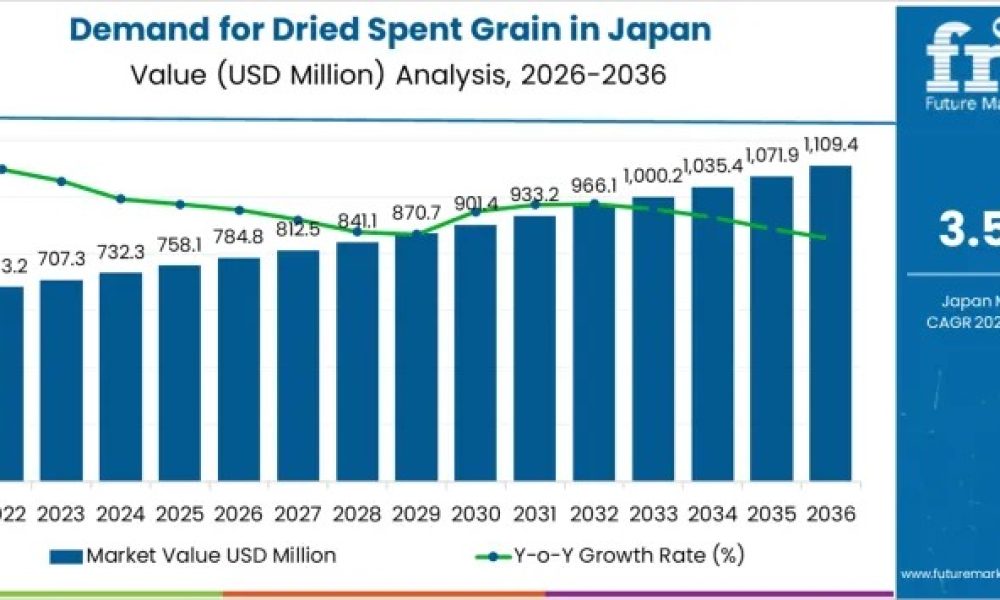
The demand for dried spent grain in Japan is poised to rise from USD 784.8 million in 2026 to USD 1,109.4 million by 2036, reflecting a CAGR of 3.5%. Growth from 2020 to 2026 saw the market expand from USD 637.5 million to USD 784.8 million, supported by consistent use across food, beverage, and bakery applications. Organic variants continue to dominate, fueled by growing interest in fiber-rich ingredients and reformulated products. Wheat remains the leading source, followed by rice and barley, contributing to a diversified processing landscape.
From 2027 onward, the market is expected to grow steadily, reaching USD 933.2 million by 2031 and USD 1,109.4 million by 2036, driven by ongoing adoption in bakery, confectionery, dairy, and health drink applications. Sorghum and millet contribute niche yet stable volumes. This long-term expansion reflects broader integration of upcycled ingredients and stable production from breweries and grain processing facilities.
Get Exclusive Access To Data Tables, Market Sizing Dashboards, And Analyst Insights. Request Sample Report!
Market Forecast and Growth Drivers
Between 2026 and 2031, dried spent grain demand rises from USD 784.8 million to USD 901.4 million, reflecting growth of USD 116.6 million. Expansion during this period is largely shaped by feed industry procurement, mixed rations, and a stable livestock population. The earlier phase of growth was influenced by brewery byproduct availability and consistent adoption in cost-effective feed formulations.
From 2031 to 2036, the market accelerates, increasing by USD 208.0 million to reach USD 1,109.4 million. Growth is supported by wider application in functional feed components, standardized pelletized formulations, and diversified livestock sectors. Regional feed mill expansion, improved logistics, and stronger brewery-feed producer partnerships underpin long-term stability across Japan’s feed supply chain.
Key Market Insights (2026-2036)
- Market Value (2026): USD 784.8 million
- Forecast Value (2036): USD 1,109.4 million
- CAGR: 3.5%
- Leading Nature: Organic (60%)
- Key Growth Regions: Kyushu & Okinawa, Kanto, Kansai
- Top Players: EverGrain Ingredients, Malteurop Group, Grain Processing Corporation
Drivers of Demand
Dried spent grain has emerged as a cost-effective, nutrient-rich solution for breweries and distilleries seeking to optimize by-product utilization. Rich in protein and fiber, it is preserved through drying, enabling its integration into livestock feed for cattle, poultry, and swine. Craft and premium brewery expansion increases by-product availability for commercial drying, making larger-scale feed supply feasible.
Beyond traditional feed, food manufacturers are incorporating dried spent grain into high-fiber foods, plant-based products, and nutritional formulations, where clean-label, sustainable ingredients are increasingly valued. Organic fertilizer and compost applications further broaden its use. Investment in drying, storage, and packaging technology remains pivotal for long-term market growth.
Demand by Nature and Source
Organic dried spent grain accounts for 60% of market demand due to traceability, nutrient consistency, and adoption in certified feed programs. Wheat represents 35% of the market by source, owing to its prevalence in domestic brewery mash formulations and stable drying characteristics. Rice, barley, sorghum, and millet provide complementary contributions in specialized applications.
Regional Market Dynamics
- Kyushu & Okinawa: 4.4% CAGR – Supported by livestock feed operations, food ingredient production, and brewery byproduct utilization.
- Kanto: 4.1% CAGR – Driven by dense food manufacturing clusters, beverage producers, and structured feed networks.
- Kansai: 3.6% CAGR – Bolstered by livestock farms, feed mixing centers, and functional food processors.
- Chubu: 3.1% CAGR – Moderate uptake in dairy and livestock sectors.
- Tohoku: 2.7% CAGR – Influenced by mixed farming and regional feed mills.
- Rest of Japan: 2.6% CAGR – Steady adoption in small-scale farms and localized feed networks.
Usage Across Feed and Food Processing Streams
Feed mills and livestock producers leverage dried spent grain to offset corn and soybean imports, optimize protein-fiber balance, and manage feed costs. Food processors experiment with incorporation into crackers, granola, noodles, and bakery products, enhancing fiber content without compromising flavor or texture. Demand reflects formulation practicality, reliable supply, and product diversification rather than promotional trends.
Subscribe for Year-Round Insights → Stay ahead with quarterly and annual data updates.
Key Players and Industry Impact
Major contributors include EverGrain Ingredients, Malteurop Group, and Grain Processing Corporation, supplying upcycled barley and wheat ingredients to food manufacturers and feed processors. Selection criteria focus on protein content, moisture stability, particle size, and odor control to ensure compatibility across feed and food applications.
About Future Market Insights (FMI)
Future Market Insights, Inc. (FMI) is an ESOMAR-certified, ISO 9001:2015 market research and consulting organization, trusted by Fortune 500 clients and global enterprises. With operations in the U.S., UK, India, and Dubai, FMI provides data-backed insights and strategic intelligence across 30+ industries and 1,200 markets worldwide.



