
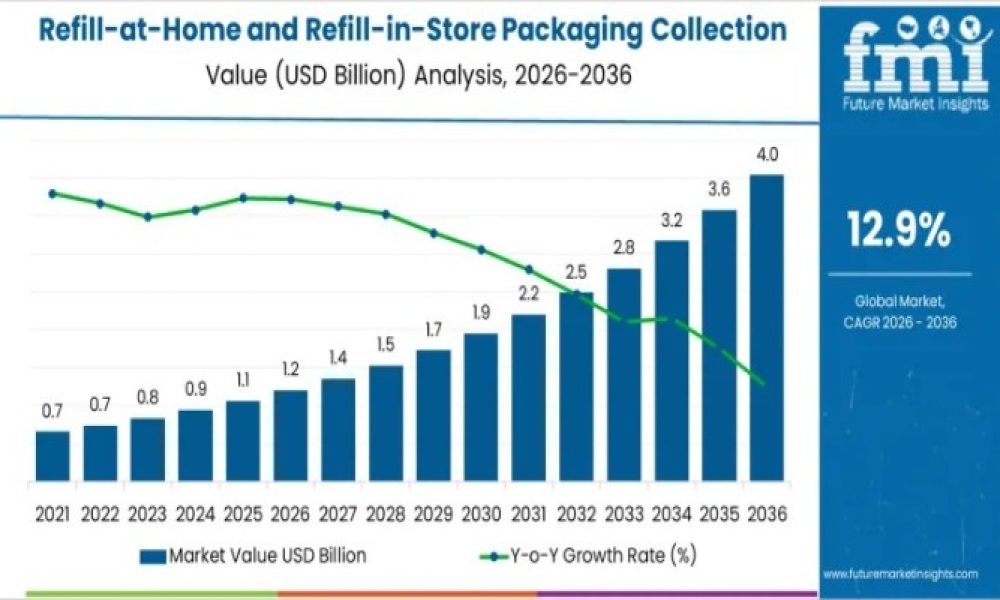
As the global conversation around sustainability shifts from intention to action, refill-at-home and refill-in-store packaging collection and reuse systems are emerging as one of the most practical solutions to tackle single-use plastic waste. According to the latest market outlook, the global refill-at-home and refill-in-store packaging collection and reuse market is expected to grow from USD 1.2 billion in 2026 to USD 4.3 billion by 2036, registering a strong CAGR of 12.9% over the forecast period. This growth marks a significant shift by consumers, brands, and retailers toward circular packaging models that prioritise reuse over disposal.
Refill systems allow consumers to reuse durable containers by refilling products either at home or through in-store refill stations. These models are gaining momentum across food and beverage, personal care & beauty, household cleaning, and other everyday consumer goods, where packaging waste volumes are high and sustainability commitments are increasingly visible. As awareness of environmental impact rises, refillable packaging is no longer a niche concept but a scalable commercial solution aligned with long-term regulatory and consumer trends.
Explore Opportunities – Get Your Sample of Our Industry Overview Now!
Quick Market Snapshot
- Market Value (2026): USD 1.2 billion
- Forecast Value (2036): USD 4.3 billion
- Global CAGR (2026–2036): 12.9%
- Top Refill Format: Refill-at-home solutions (41% share)
- Leading Product Category: Personal care & beauty (38% share)
- Key Growth Regions: India, China, Germany, UK, USA
- Key Players: Loop (by TerraCycle), Unilever, Procter & Gamble (P&G), Seventh Generation, Algramo / FillGood
Market Growth Trajectory: A Decade of Steady Expansion
The refill-at-home and refill-in-store packaging collection and reuse market demonstrates a clear acceleration–maturation pattern across the forecast period. From USD 1.2 billion in 2026, the market grows steadily to USD 1.6 billion by 2028, supported by early adoption in urban retail environments and pilot refill programs by major brands. Between 2028 and 2030, growth accelerates as consumer familiarity improves and refill infrastructure expands, pushing market value to USD 2.0 billion by 2030.
From 2031 onward, growth continues at a slightly moderated pace as refill systems become more mainstream and standardized. By 2035, the market reaches USD 3.6 billion, culminating at USD 4.3 billion in 2036. This trajectory reflects increasing integration of refill models into everyday retail, supported by policy incentives, digital tracking tools, and improved logistics for collection and reuse.
What Is Driving Global Demand?
A combination of environmental urgency, regulatory pressure, and changing consumer behavior is driving the demand for refill-at-home and refill-in-store packaging collection and reuse systems. Governments worldwide are tightening regulations around plastic waste, extended producer responsibility, and circular economy targets. At the same time, consumers are actively seeking brands that offer visible, convenient sustainability solutions.
Refill systems reduce dependence on virgin materials, lower packaging costs over multiple use cycles, and support measurable reductions in waste generation. For retailers and manufacturers, these systems also strengthen customer engagement and brand loyalty, particularly when combined with digital incentives and loyalty programs.
Key Market Segments at a Glance
By Refill Format
- Refill-at-home solutions dominate with 41% market share, offering convenience through refill pouches, bulk deliveries, and subscription services.
- Refill-in-store systems continue to expand as retailers invest in refill stations and return infrastructure.
By Product Category
- Personal care & beauty leads with 38% share, driven by high product usage frequency and strong consumer preference for sustainable beauty brands.
- Household cleaning, food & beverage, and other consumables contribute steadily to overall market growth.
Regional Outlook: Growth Across Major Economies
- India (CAGR 15.3%) leads global growth, supported by rapid retail expansion, rising environmental awareness, and supportive government policies.
- China (14.5%) benefits from strong government backing for sustainability and a fast-growing retail and e-commerce ecosystem.
- Germany (13.4%) continues to set benchmarks in circular economy practices and refill adoption.
- UK (12.9%) and USA (12.8%) show consistent growth as refill models gain acceptance across mainstream retail.
Key Market Dynamics
Drivers
- Rising consumer focus on waste reduction
- Regulatory pressure on single-use plastics
- Retailer and brand sustainability commitments
- Advances in digital tracking, QR codes, and refill apps
Restraints
- High initial infrastructure and logistics costs
- Complexity of collection, cleaning, and redistribution
- Challenges in standardizing packaging formats
Trends
- Digital engagement tools and incentive-based refill programs
- Retail–brand partnerships for shared refill ecosystems
- Data-driven optimization of reuse cycles and logistics
Competitive Landscape
The competitive environment is evolving rapidly as global brands and specialized reuse platforms compete to scale refill ecosystems. Loop (by TerraCycle) remains a prominent player with integrated collection and cleaning infrastructure. Unilever, P&G, and Seventh Generation are embedding refill formats into their core portfolios, while Algramo / FillGood focuses on modular refill dispensers and digital payment integration. Competitive differentiation increasingly depends on ease of use, scalability, and measurable sustainability impact.
Why FMI: https://www.futuremarketinsights.com/why-fmi
About Future Market Insights (FMI)
Future Market Insights, Inc. (FMI) is an ESOMAR-certified, ISO 9001:2015 market research and consulting organization, trusted by Fortune 500 clients and global enterprises. With operations in the U.S., UK, India, and Dubai, FMI provides data-backed insights and strategic intelligence across 30+ industries and 1200 markets worldwide.



