
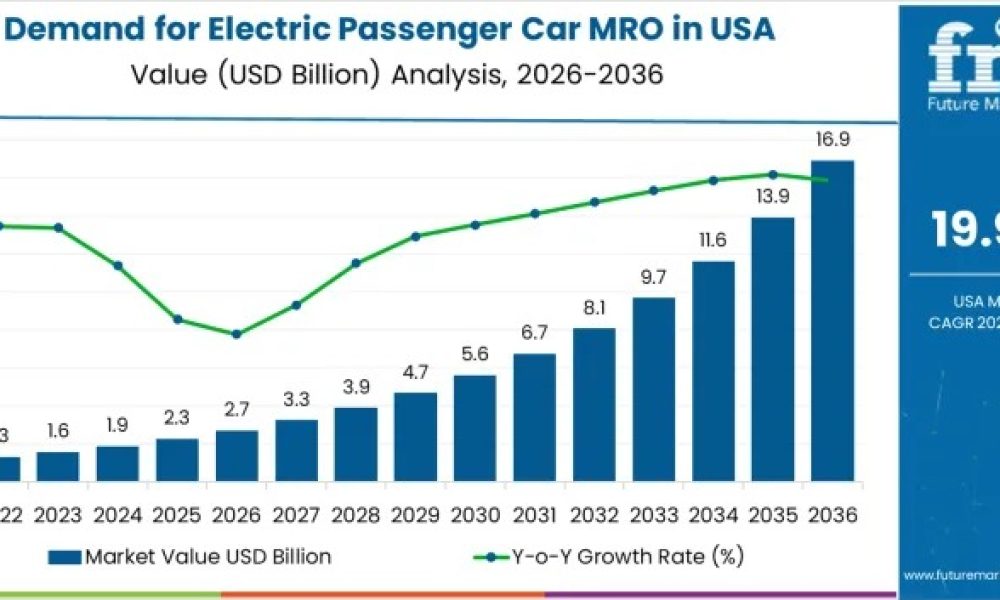
The demand for electric passenger car maintenance, repair, and overhaul (MRO) services in the United States is entering a phase of rapid expansion, reflecting the accelerating transition toward electric mobility. The market is expected to grow from USD 2.3 billion in 2026 to USD 16.9 billion by 2036, registering a robust compound annual growth rate (CAGR) of 19.9% over the forecast period. This sharp rise highlights the emergence of electric vehicle (EV) MRO as one of the most dynamic and strategically important segments of the U.S. automotive aftermarket.
An analysis of the Growth Contribution Index (GCI) reveals that demand growth intensifies significantly after 2027, aligning with the scaling phase of EV adoption nationwide. Early-stage growth remains steady, increasing from approximately USD 1.1 billion in 2026 to USD 1.3 billion in 2027, before accelerating rapidly as EV penetration deepens. By 2029, demand reaches USD 2.3 billion, and by 2031 it more than doubles to USD 4.7 billion, reflecting year-on-year growth of over 30%. The later years of the forecast period show even stronger momentum, with demand projected to reach USD 13.9 billion by 2035 and USD 16.9 billion by 2036.
Electrification Drives Structural Shift in Automotive MRO
This growth trajectory is closely tied to the structural shift underway in the U.S. automotive landscape. As electric vehicles move from early adoption to mass-market penetration, the nature of vehicle maintenance is changing fundamentally. Unlike internal combustion engine (ICE) vehicles, electric passenger cars rely on high-voltage battery systems, electric drivetrains, power electronics, and software-driven controls. These systems require specialized diagnostic tools, safety protocols, and trained technicians, creating a distinct and fast-growing MRO ecosystem.
Battery electric vehicles (BEVs) represent the leading vehicle type, accounting for approximately 40% of total EV MRO demand. The rapid expansion of BEV fleets, supported by federal and state-level incentives, declining battery costs, and growing consumer confidence, is driving sustained demand for services such as battery health diagnostics, thermal management maintenance, power electronics repair, and software updates. While BEVs generally require less routine maintenance than ICE vehicles, the technical complexity and high value of their components elevate the importance of specialized MRO services over the vehicle lifecycle.
Get access to comprehensive data tables and detailed market insights — request your sample report today!
Franchise Repair Networks Expand EV Capabilities
From a service provider perspective, franchise general repair centers account for around 45% of the market, reflecting their accessibility, geographic coverage, and ability to service a broad mix of vehicle types. These providers are increasingly investing in EV-specific tools, technician training, and safety infrastructure to support high-voltage systems. As electric vehicles move beyond warranty periods and into mainstream ownership, franchise repair networks are expected to play a central role in meeting nationwide MRO demand, particularly for routine diagnostics, brake systems, tires, and electrical components.
OEM-authorized service centers and specialized EV service providers also remain critical, especially for advanced battery repairs, proprietary software updates, and warranty-related services. Together, these channels are shaping a diversified service landscape capable of supporting a rapidly expanding EV parc.
Technology Innovation Strengthens the MRO Value Proposition
Technological innovation is a key force amplifying demand for electric passenger car MRO services. Connected vehicle platforms, predictive maintenance algorithms, and remote diagnostics enable earlier fault detection and more efficient service planning. Over-the-air software updates are becoming a standard feature, reducing downtime while increasing the importance of software expertise within the MRO ecosystem. Advances in battery chemistry and energy density further reinforce the need for skilled maintenance to ensure safety, performance, and longevity.
Training and certification programs focused on high-voltage safety, battery diagnostics, and EV powertrains are expanding across the U.S., supporting workforce readiness. At the same time, the high cost of specialized tools and equipment continues to shape competitive dynamics, favoring providers with scale, technical depth, and long-term investment strategies.
Regional Demand Patterns Reflect EV Adoption Hotspots
Regionally, West USA leads the market with a projected CAGR of 22.8%, driven by strong EV adoption in states such as California, robust charging infrastructure, and aggressive emissions policies. The South USA follows at 20.5% CAGR, supported by expanding EV manufacturing, infrastructure development, and growing consumer acceptance in states including Texas and Florida. The Northeast USA, with an 18.3% CAGR, benefits from dense urban populations, sustainability mandates, and state-level incentives, while the Midwest USA shows steady growth at 15.9% as traditional automotive hubs transition toward electric vehicle production and ownership.
Competitive Landscape Anchored by OEMs and Tier-1 Suppliers
The competitive environment is defined by a mix of OEM-led service models and global automotive technology leaders. Tesla, Inc. remains a dominant force through its vertically integrated service network, combining hardware, software, and diagnostics tailored to its vehicle ecosystem. Other key players, including Bosch Automotive Service, Continental AG, ZF Friedrichshafen AG, and Siemens AG, play pivotal roles by supplying advanced components, diagnostic systems, and infrastructure that underpin the broader EV MRO market.
Competition increasingly centers on technical capability, software integration, service reliability, and the ability to scale EV-focused offerings nationwide. Companies that successfully align advanced diagnostics, trained labor, and digital service models are positioned to capture outsized value as the market matures.
Outlook
As electric vehicles become a permanent fixture of the U.S. passenger car fleet, demand for specialized MRO services will continue to rise sharply. The projected growth from USD 2.3 billion to USD 16.9 billion over the next decade underscores the transformation of automotive maintenance into a technology-driven, high-value service sector. With strong regional momentum, accelerating EV adoption, and continuous innovation, electric passenger car MRO is set to become a cornerstone of the U.S. automotive aftermarket through 2036 and beyond.
About Future Market Insights (FMI)
Future Market Insights, Inc. (FMI) is an ESOMAR-certified, ISO 9001:2015 market research and consulting organization, trusted by Fortune 500 clients and global enterprises. With operations in the U.S., UK, India, and Dubai, FMI provides data-backed insights and strategic intelligence across 30+ industries and 1200 markets worldwide.



