
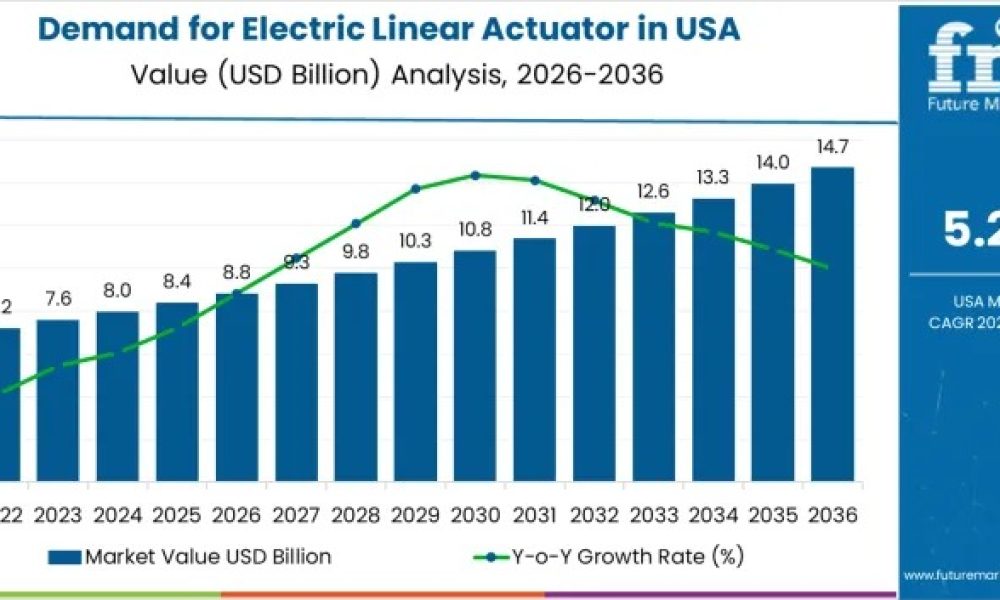
The demand for electric linear actuators in the United States is entering a phase of sustained and structurally supported growth, underpinned by accelerating automation across industrial, healthcare, automotive, and advanced manufacturing sectors. Valued at USD 8.4 billion in 2026, the market is projected to reach USD 14.7 billion by 2036, expanding at a compound annual growth rate (CAGR) of 5.2% over the forecast period. This steady upward trajectory reflects the increasing preference for electric actuation systems that deliver precision motion control, energy efficiency, and operational reliability in comparison to traditional hydraulic and pneumatic alternatives.
Between 2026 and 2029, demand shows consistent year-on-year gains, rising from USD 8.4 billion to approximately USD 8.0 billion by 2029, supported by incremental investments in factory automation, robotics, and smart machinery upgrades. From 2030 onward, growth momentum strengthens, with demand reaching USD 9.3 billion in 2031 and accelerating further to USD 12.6 billion by 2033. This acceleration aligns with wider adoption of intelligent automation systems, tighter energy efficiency targets, and increasing integration of electric actuators into digitally controlled production environments. By 2036, demand peaks at USD 14.7 billion, reflecting the expanding role of electric linear actuators as a foundational component of modern motion control architectures.
A key driver shaping market expansion is the broad-based shift toward automation across U.S. industries. Manufacturing facilities increasingly rely on electric linear actuators for tasks such as material handling, positioning, clamping, lifting, and robotic movement, where accuracy and repeatability are essential. Unlike pneumatic or hydraulic systems, electric actuators offer cleaner operation, lower maintenance requirements, and easier integration with digital control systems, making them well suited for Industry 4.0 environments. As manufacturers pursue productivity gains, reduced downtime, and predictable performance, electric actuation continues to displace legacy motion technologies.
Get access to comprehensive data tables and detailed market insights — request your sample report today!
Technological advancement is further reinforcing demand. The development of compact, high-performance actuators with integrated electronics, sensors, and controls has expanded application scope across industrial automation, medical devices, robotics, and smart infrastructure. In healthcare, electric linear actuators are increasingly embedded in hospital beds, patient lifts, diagnostic equipment, and surgical systems, where precise and quiet motion is critical. In aerospace and advanced equipment manufacturing, actuators capable of operating under stringent reliability and precision requirements are seeing rising adoption.
By type, DC electric actuators dominate the U.S. market, accounting for approximately 55% of total demand. Their leadership is driven by high efficiency, flexible speed and position control, and compatibility with a wide range of electrical systems. DC actuators are widely deployed in robotics, automated assembly lines, adjustable platforms, and medical devices, where fine motion control is required. Their cost-effectiveness and ease of integration further reinforce their role as the preferred solution across both low-load and high-load applications.
From an application perspective, industrial uses represent roughly 50% of total demand, reflecting the central role of electric linear actuators in automated production environments. Manufacturing plants, logistics facilities, and automotive assembly operations increasingly depend on electric actuators to enhance throughput, safety, and operational consistency. As U.S. industries continue to modernize production infrastructure and adopt smart manufacturing practices, industrial demand is expected to remain the primary growth engine through 2036.
Regionally, growth patterns highlight the influence of industrial structure and technology adoption. West USA leads the market with a 6.0% CAGR, driven by strong concentrations of high-tech manufacturing, robotics, renewable energy projects, and automation-focused industries. States such as California, Washington, and Oregon are witnessing expanding use of electric linear actuators in clean energy systems, advanced manufacturing, and precision robotics. South USA follows with a 5.4% CAGR, supported by expanding automotive production, manufacturing capacity, and renewable energy installations. The Northeast USA, growing at 4.8%, benefits from advanced manufacturing, healthcare technology adoption, and clean energy initiatives, while the Midwest, at 4.2%, reflects steady growth anchored in established manufacturing, automotive, and industrial automation hubs.
The competitive landscape of the U.S. electric linear actuator market is characterized by innovation, performance differentiation, and application-specific customization. Leading players such as SKF, Parker Hannifin, Linak, Moteck Electric, and Tolomatic are strengthening their market positions through product innovation, expanded portfolios, and solutions tailored for industrial, medical, and automotive applications. Market leaders emphasize energy efficiency, durability, compact design, and digital compatibility as key differentiators, while ongoing investments in research and development support continuous performance improvements.
Looking ahead, the U.S. electric linear actuator market is positioned for resilient long-term growth as automation intensity increases and energy-efficient motion solutions gain strategic importance. While challenges such as higher initial costs and system integration complexity remain, these are increasingly offset by long-term operational savings, lower maintenance requirements, and improved performance outcomes. As industries continue to prioritize precision, sustainability, and digital integration, electric linear actuators are set to play an increasingly central role in shaping the future of motion control across the U.S. economy.
This evolving market landscape underscores the growing strategic relevance of electric linear actuators as enabling technologies across multiple sectors, signaling strong opportunities for stakeholders seeking deeper insights into demand dynamics, competitive positioning, and future growth pathways.
About Future Market Insights (FMI)
Future Market Insights, Inc. (FMI) is an ESOMAR-certified, ISO 9001:2015 market research and consulting organization, trusted by Fortune 500 clients and global enterprises. With operations in the U.S., UK, India, and Dubai, FMI provides data-backed insights and strategic intelligence across 30+ industries and 1200 markets worldwide.



