
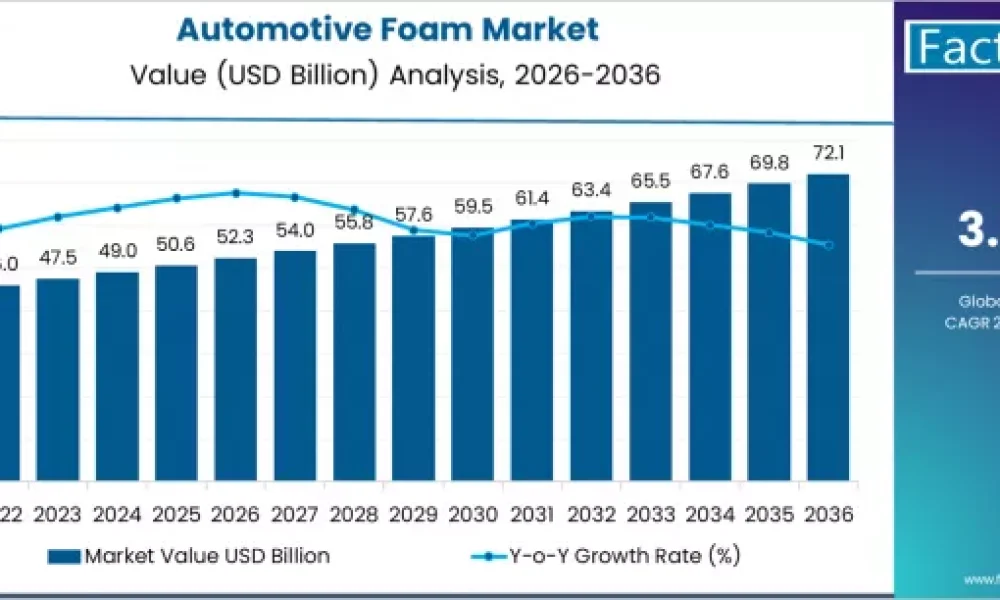
The global automotive foam market is set for steady expansion, supported by rising vehicle production, increasing focus on passenger comfort, and growing adoption of lightweight materials to improve fuel efficiency and reduce emissions. According to Fact.MR, the market is projected to reach USD 72.1 billion by 2036, registering an absolute growth of USD 19.8 billion over the forecast period. Valued at USD 52.3 billion in 2026, the market is expected to grow at a CAGR of 3.3% during the assessment period.
Automotive foams—used extensively in seating, headliners, door panels, insulation, and safety components—play a critical role in enhancing vehicle comfort, noise reduction, thermal insulation, and structural efficiency.
Key Market Drivers
Rising Demand for Lightweight and Fuel-Efficient Vehicles
Automakers are increasingly replacing traditional materials with advanced foam solutions to reduce vehicle weight and meet stringent fuel efficiency and emission regulations. Polyurethane, polyethylene, and polypropylene foams help lower overall vehicle mass while maintaining durability and comfort.
To access the complete data tables and in-depth insights, request a Discount On The Report here: https://www.factmr.com/connectus/sample?flag=S&rep_id=12810
Growth in Vehicle Comfort and Interior Aesthetics
Consumer preference for premium interiors, ergonomic seating, and noise-free cabins is driving the use of high-performance automotive foams. These materials improve cushioning, vibration dampening, and acoustic insulation, enhancing overall driving experience.
Expansion of Electric Vehicle (EV) Production
The rapid rise in electric and hybrid vehicles is boosting demand for specialized foams used in battery insulation, thermal management, and lightweight interior components. Automotive foams contribute to extended battery range and improved safety in EV architectures.
Stricter Safety and Noise Regulations
Governments worldwide are enforcing stricter standards related to passenger safety, crash protection, and noise reduction. Energy-absorbing foams are increasingly used in impact protection zones, headrests, and side panels to meet regulatory requirements.
Regional Growth Highlights
Asia-Pacific: Dominant Manufacturing Hub
Asia-Pacific leads the global automotive foam market, driven by high vehicle production in China, Japan, South Korea, and India. Expanding middle-class populations, rising vehicle ownership, and strong OEM presence support sustained demand.
North America: Focus on Comfort and Innovation
The U.S. automotive industry’s emphasis on premium vehicles, SUVs, and electric models fuels adoption of advanced foam materials. Continuous R&D investments in sustainable and recyclable foams further strengthen market growth.
Europe: Sustainability and Regulatory Compliance Drive Demand
European automakers prioritize lightweight, eco-friendly materials to comply with stringent emission norms. Automotive foam usage is expanding across passenger and commercial vehicles, especially in Germany, France, and the UK.
Latin America & Middle East: Gradual Expansion
Improving automotive production capacity and rising demand for affordable passenger vehicles are supporting moderate growth in emerging regions.
Market Segmentation Insights
By Foam Type
- Polyurethane Foam – Dominates due to versatility, comfort, and cost-effectiveness
• Polypropylene Foam – Gaining traction for lightweight and recyclable properties
• Polyethylene Foam – Used in insulation and impact absorption applications
• Others – Includes advanced specialty foams
By Application
- Seating Systems – Largest application segment
• Interior Components – Door panels, headliners, armrests
• Acoustic & Thermal Insulation – Noise and heat reduction
• Safety Components – Energy-absorbing and crash-protection foams
By Vehicle Type
- Passenger Cars
• Light Commercial Vehicles
• Heavy Commercial Vehicles
• Electric & Hybrid Vehicles
Market Challenges
Despite stable growth prospects, the automotive foam market faces several challenges:
- Volatility in Raw Material Prices impacting production costs
• Environmental Concerns related to petroleum-based foams
• Recycling and Disposal Issues requiring innovation in bio-based alternatives
• Supply Chain Disruptions affecting automotive manufacturing cycles
Competitive Landscape
The automotive foam market is moderately consolidated, with manufacturers focusing on material innovation, sustainability, and strategic OEM partnerships. Companies are investing in bio-based foams, recyclable materials, and advanced molding technologies to maintain competitiveness.
Key Players Include:
- BASF SE
• Covestro AG
• Huntsman Corporation
• Recticel NV
• Woodbridge Group
• Rogers Corporation
• Lear Corporation
Future Outlook: Toward Lightweight, Sustainable, and Smart Automotive Interiors
The automotive foam market is expected to evolve in line with the global shift toward electric mobility, sustainability, and enhanced vehicle comfort. Innovations in bio-based foams, recyclable materials, and high-performance insulation solutions will define the next phase of growth.
Manufacturers that invest in sustainable materials, advanced processing technologies, and long-term OEM collaborations will be best positioned to capitalize on emerging opportunities as the automotive industry undergoes rapid transformation.
Have a specific Requirements and Need Assistant on Report Pricing or Limited Budget please contact us – [email protected]
About Fact.MR
Fact.MR is a global market research and consulting firm, trusted by Fortune 500 companies and emerging businesses for reliable insights and strategic intelligence. With a presence across the U.S., UK, India, and Dubai, we deliver data-driven research and tailored consulting solutions across 30+ industries and 1,000+ markets. Backed by deep expertise and advanced analytics, Fact.MR helps organizations uncover opportunities, reduce risks, and make informed decisions for sustainable growth.



