
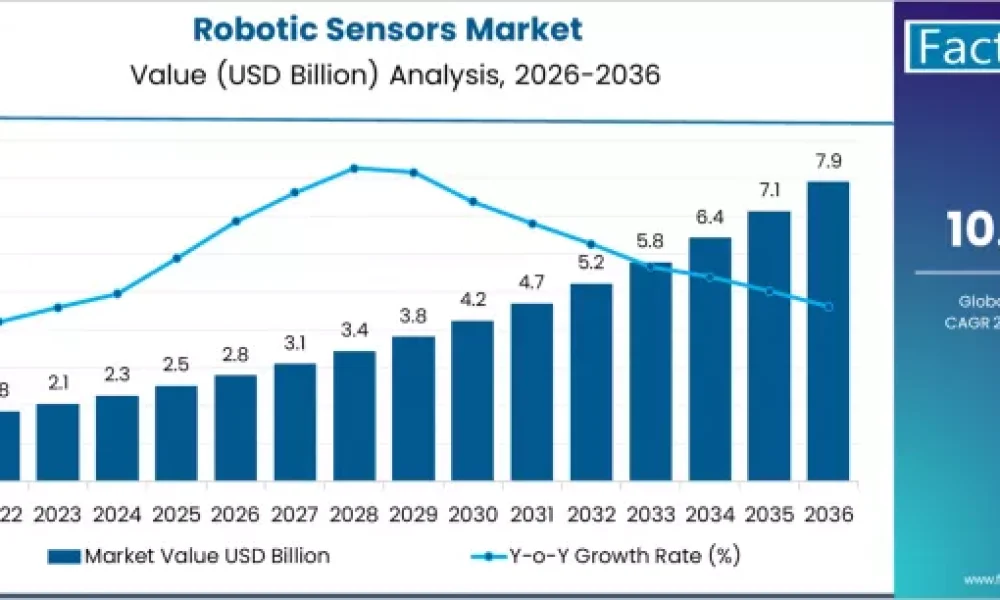
The global robotic sensors market is set for strong and sustained growth, fueled by rising automation across manufacturing, healthcare, logistics, and defense sectors. According to Fact.MR, the market is valued at USD 2.8 billion in 2026 and is projected to reach USD 7.9 billion by 2036, expanding at a robust CAGR of 10.9% during the forecast period.
Robotic sensors—critical for enabling perception, precision, and adaptability in robotic systems—are becoming indispensable as industries embrace Industry 4.0, smart factories, and autonomous operations.
To access the complete data tables and in-depth insights, request a Discount On The Report here: https://www.factmr.com/connectus/sample?flag=S&rep_id=12781
Key Market Drivers
Rapid Expansion of Industrial Automation and Smart Manufacturing
Manufacturers worldwide are deploying robots to improve productivity, reduce downtime, and ensure consistent quality. Robotic sensors enable real-time feedback, precision control, and adaptive decision-making, making them essential components in automated assembly lines and smart factories. In 2026, industrial robotics applications account for 58.3% of total market demand, highlighting the sector’s dominance.
Growing Demand for Force and Torque Sensors
Force and torque sensors are playing a pivotal role in applications requiring high precision, such as assembly, material handling, and collaborative robots (cobots). These sensors allow robots to safely interact with humans and delicate objects. In 2026, the force and torque sensor segment is projected to hold a 31.2% market share, making it the leading sensor category.
Rising Adoption of Collaborative and Service Robots
Cobots and service robots are gaining traction in healthcare, warehousing, food processing, and retail. Advanced sensor technologies—including vision, proximity, tactile, and pressure sensors—enhance safety, flexibility, and human-robot interaction, driving widespread adoption beyond traditional industrial settings.
Technological Advancements in AI and Machine Vision
Integration of artificial intelligence, machine learning, and 3D vision systems is significantly improving sensor accuracy and responsiveness. Smart robotic sensors enable predictive maintenance, object recognition, and autonomous navigation, accelerating deployment across diverse industries.
Regional Growth Highlights
Asia-Pacific: Manufacturing Hub Driving Global Demand
China, Japan, South Korea, and India lead robotic sensor adoption due to strong manufacturing bases and aggressive automation investments. Government-led initiatives promoting smart factories and robotics innovation further support regional growth.
North America: Advanced Robotics and AI Integration
The U.S. remains a key market, driven by high adoption of industrial robots, healthcare automation, and defense applications. Strong R&D capabilities and early adoption of AI-powered robotic systems continue to fuel demand.
Europe: Industry 4.0 and Automotive Automation
Germany, France, and Italy are witnessing significant growth due to advanced automotive manufacturing, logistics automation, and strict safety standards that require high-performance sensor systems.
Market Segmentation Insights
By Sensor Type
- Force & Torque Sensors – Dominant segment with extensive industrial use
• Vision Sensors – Growing rapidly with AI-enabled robotics
• Proximity & Tactile Sensors – Essential for cobots and safety applications
• Temperature & Pressure Sensors – Used in specialized industrial environments
By Application
- Industrial Robotics – Largest market share
• Healthcare & Medical Robotics – Surgical and rehabilitation robots
• Logistics & Warehousing – Autonomous mobile robots (AMRs)
• Defense & Security – Surveillance and unmanned systems
Market Challenges
Despite strong growth prospects, the robotic sensors market faces several challenges:
• High Initial Investment Costs for advanced sensor-integrated robots
• Complex Integration Requirements in legacy manufacturing systems
• Skilled Workforce Shortages for robotics and sensor calibration
• Data Security and Reliability Concerns in connected robotic environments
Competitive Landscape
The robotic sensors market is moderately consolidated, with leading players focusing on sensor miniaturization, AI integration, and enhanced durability. Companies are investing heavily in R&D, strategic partnerships, and customized sensor solutions for industry-specific applications.
Prominent Companies Include:
- ATI Industrial Automation
• SICK AG
• Baumer Group
• Honeywell International
• Balluff GmbH
• Omron Corporation
• FANUC Corporation
Future Outlook: Toward Intelligent, Autonomous, and Human-Centric Robotics
Over the next decade, robotic sensors will evolve from basic feedback tools to intelligent systems enabling fully autonomous, adaptive, and collaborative robots. As industries push for efficiency, safety, and flexibility, advanced sensor technologies will form the backbone of next-generation robotic solutions.
Manufacturers that invest in AI-enabled sensing, real-time analytics, and scalable automation architectures will gain a competitive edge as the robotic sensors market continues its rapid global expansion.
Have a specific Requirements and Need Assistant on Report Pricing or Limited Budget please contact us – [email protected]
About Fact.MR
Fact.MR is a global market research and consulting firm, trusted by Fortune 500 companies and emerging businesses for reliable insights and strategic intelligence. With a presence across the U.S., UK, India, and Dubai, we deliver data-driven research and tailored consulting solutions across 30+ industries and 1,000+ markets. Backed by deep expertise and advanced analytics, Fact.MR helps organizations uncover opportunities, reduce risks, and make informed decisions for sustainable growth.



