
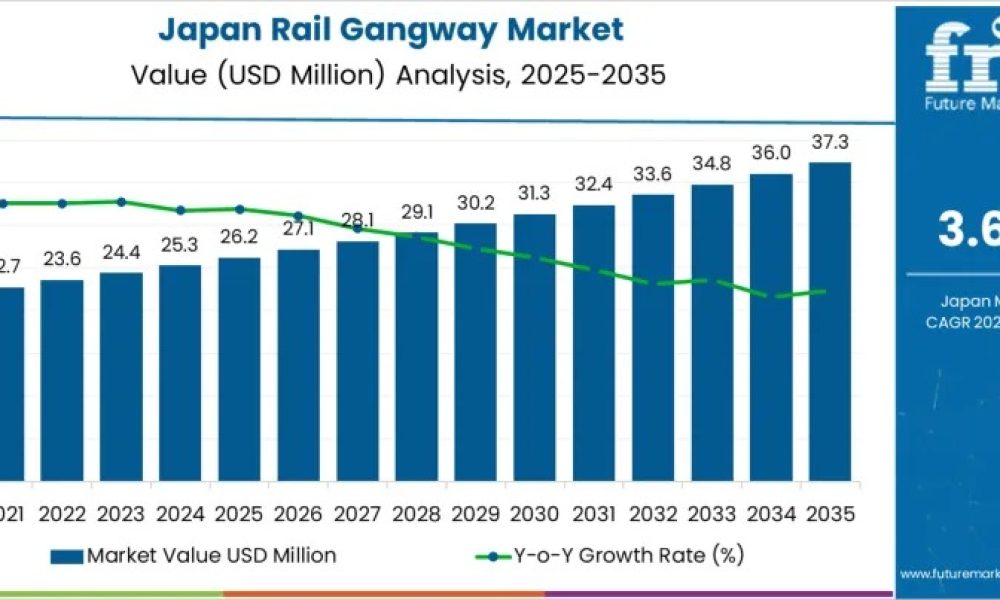
The demand for rail gangways in Japan is projected to grow from USD 26.2 million in 2025 to USD 37.3 million by 2035, registering a compound annual growth rate (CAGR) of 3.6% over the forecast period. This steady expansion reflects Japan’s continued commitment to rail infrastructure modernization, passenger safety enhancement, and improved accessibility across commuter, metro, and high-speed rail networks.
Rail gangways—critical passage systems that enable safe and seamless movement between connected train cars—are becoming increasingly vital as trains grow longer, passenger volumes rise, and service frequency intensifies. In one of the world’s most heavily utilized rail systems, gangways play a pivotal role in supporting smooth passenger flow, emergency evacuation readiness, and overall operational efficiency.
Infrastructure Modernization and Passenger-Centric Design Drive Market Momentum
Japan’s ongoing investments in rail upgrades, fleet renewal, and urban transit expansion are directly supporting demand for advanced gangway solutions. Major metropolitan regions such as Kanto, Kansai, and Chubu continue to prioritize station modernization and rolling stock upgrades, while regions including Kyushu & Okinawa are emerging as high-growth markets due to infrastructure expansion and rising tourism activity.
Get access to comprehensive data tables and detailed market insights – request your sample report today!
Passenger safety, comfort, and accessibility remain central to rail development strategies. As Japan’s population ages, rail operators are placing greater emphasis on barrier-free mobility, encouraging adoption of gangways designed with wider passages, stable flooring, and enhanced sealing to accommodate elderly and disabled passengers. These requirements are reinforcing the need for high-quality, durable, and regulation-compliant gangway systems.
Two-Piece Gangways and Aluminum Materials Dominate Market Adoption
By product type, two-piece gangways account for approximately 78% of total demand, favored for their modular construction, flexibility, and ease of installation and maintenance. Their adaptability across passenger, metro, and high-speed trains makes them particularly suitable for Japan’s dense and diverse rail environment, where operational efficiency and quick replacement cycles are essential.
From a material perspective, aluminum leads the market with a 54.3% share, supported by its lightweight properties, corrosion resistance, and long service life. Aluminum gangways help reduce overall train weight, improve energy efficiency, and lower maintenance requirements—key advantages for high-frequency and high-speed rail operations.
Tailor Your Solution: Request Customization for Your Unique Needs!
Technology Advancements Strengthen Long-Term Outlook
Technological innovation continues to enhance gangway performance and reliability. Manufacturers are integrating improved articulation systems, weather-resistant sealing, noise reduction features, and advanced safety components to meet evolving passenger expectations and regulatory standards. Lightweight designs and simplified installation processes are also helping operators reduce lifecycle costs and downtime during fleet upgrades.
Looking ahead, the integration of smart monitoring technologies, including sensor-based condition tracking, is expected to further optimize gangway performance and maintenance planning, supporting operational reliability across Japan’s rail network.
Competitive Landscape Remains Innovation-Focused
The Japan rail gangway market is shaped by a mix of global and domestic suppliers focused on quality, durability, and compliance with stringent safety standards. Key players include HÜBNER GmbH & Co. KG, Dellner Couplers, Narita Mfg. Co., Jai Dadi Group, and KTK Group. These companies continue to compete through material innovation, modular product designs, and close collaboration with rail operators and rolling stock manufacturers.
Outlook Through 2035
As Japan advances its vision for efficient, safe, and passenger-friendly public transportation, rail gangways will remain a foundational component of modern rolling stock design. Continued investment in rail infrastructure, combined with rising expectations for comfort, accessibility, and safety, positions the Japan rail gangway market for stable, long-term growth through 2035.
Why Choose FMI: Empowering Decisions that Drive Real-World Outcomes: https://www.futuremarketinsights.com/why-fmi
About Future Market Insights (FMI)
Future Market Insights, Inc. (FMI) is an ESOMAR-certified, ISO 9001:2015 market research and consulting organization, trusted by Fortune 500 clients and global enterprises. With operations in the U.S., UK, India, and Dubai, FMI provides data-backed insights and strategic intelligence across 30+ industries and 1200 markets worldwide.



