
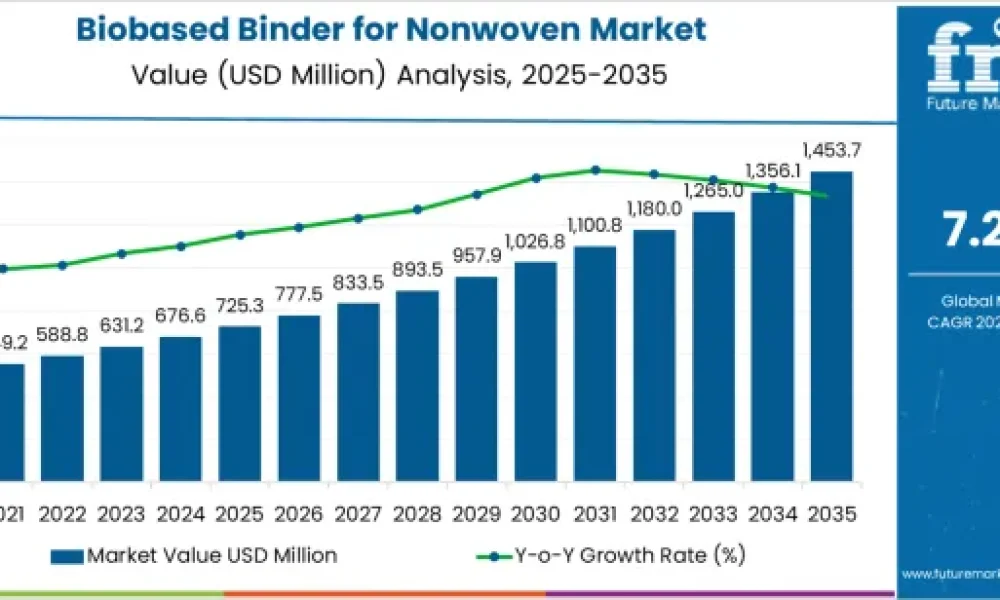
The global biobased binder for nonwoven market is gaining strong momentum, valued at approximately USD 725.3 million in 2025 and projected to reach USD 1,453.7 million by 2035, expanding at a steady compound annual growth rate of 7.2 percent during the forecast period. This growth is being driven by rising demand for sustainable, low-carbon alternatives to petroleum-based binders across hygiene, medical, filtration, textile, and industrial nonwoven applications. Increasing regulatory pressure, corporate sustainability commitments, and advances in bio-polymer chemistry are accelerating the shift toward renewable binder systems without compromising product performance or manufacturing efficiency.
Key Market Insights at a Glance
The market demonstrates consistent long-term growth supported by strong adoption in hygiene and medical nonwovens, where biodegradable and non-toxic materials are becoming essential. Starch-based binders continue to dominate due to their renewability, cost efficiency, and compatibility with existing nonwoven production processes. Medical applications account for a significant share of global demand, reflecting expanding use of eco-friendly materials in surgical gowns, face masks, wound dressings, and disposable healthcare products. The market’s upward trajectory is further reinforced by increasing investments in sustainable material innovation.
Segment Overview
By binder type, starch-based solutions lead the market, benefiting from abundant raw material availability and favorable environmental profiles. Protein-based binders and emerging hybrid bio-synthetic formulations are gaining traction as manufacturers seek improved strength, durability, and moisture resistance. From an application perspective, medical and hygiene segments represent the largest consumption base, followed by agriculture, filtration, construction, and industrial nonwovens. These segments are increasingly prioritizing renewable binders to meet environmental compliance standards and evolving consumer expectations.
To access the complete data tables and in-depth insights, request a sample report here
Regional Overview
Asia Pacific remains a high-growth region, supported by expanding nonwoven manufacturing capacity, favorable government policies, and rapid adoption of sustainable materials in countries such as China and India. Europe continues to be a key market, driven by stringent environmental regulations and strong demand for biodegradable materials across healthcare and industrial sectors. North America maintains steady growth, fueled by technological innovation, established nonwoven industries, and increasing corporate focus on carbon footprint reduction and circular economy practices.
Competitive Landscape
The biobased binder for nonwoven market features a moderately consolidated competitive environment, with global chemical manufacturers and specialized biopolymer companies actively competing through innovation and sustainability-driven product development. Companies are focusing on enhancing binder performance, expanding renewable content, and optimizing processing efficiency to strengthen their market positions. Strategic partnerships, acquisitions, and targeted R&D investments are shaping competition as players respond to evolving regulatory and customer requirements.
Market Outlook: Powering the Next Decade
Over the next decade, the market is expected to benefit from continuous advancements in bio-based adhesive technologies, including hybrid systems that balance sustainability with high-performance characteristics. Increasing adoption of nonwovens in medical, hygiene, and technical applications will further support demand. As global industries intensify their sustainability goals, biobased binders are set to become a critical enabler of environmentally responsible manufacturing, offering long-term value across supply chains.
Key Players of the Sustainable Binder Industry
Major participants driving market growth include Ingredion, OrganoClick, CH-Polymers, Intercol, Sustaina, Suominen, Owens Corning, NIRI, BASF, and Henkel. These companies are actively investing in renewable material platforms, expanding sustainable product portfolios, and strengthening collaborations with nonwoven manufacturers to accelerate market penetration.
Recent Strategic Developments
Recent developments in the market highlight increased focus on innovation, with companies introducing next-generation biobased binders offering improved bonding strength, thermal stability, and biodegradability. Strategic collaborations between binder producers and nonwoven manufacturers are enabling faster commercialization and application-specific customization. Sustainability-driven product launches and capacity expansions continue to reinforce the market’s long-term growth outlook.
Have a specific Requirements and Need Assistant on Report Pricing or Limited Budget please contact us – [email protected]
About Future Market Insights (FMI)
Future Market Insights, Inc. (FMI) is an ESOMAR-certified, ISO 9001:2015 market research and consulting organization, trusted by Fortune 500 clients and global enterprises. With operations in the U.S., UK, India, and Dubai, FMI provides data-backed insights and strategic intelligence across 30+ industries and 1200 markets worldwide.
Why Choose FMI: https://www.futuremarketinsights.com/why-fmi



