
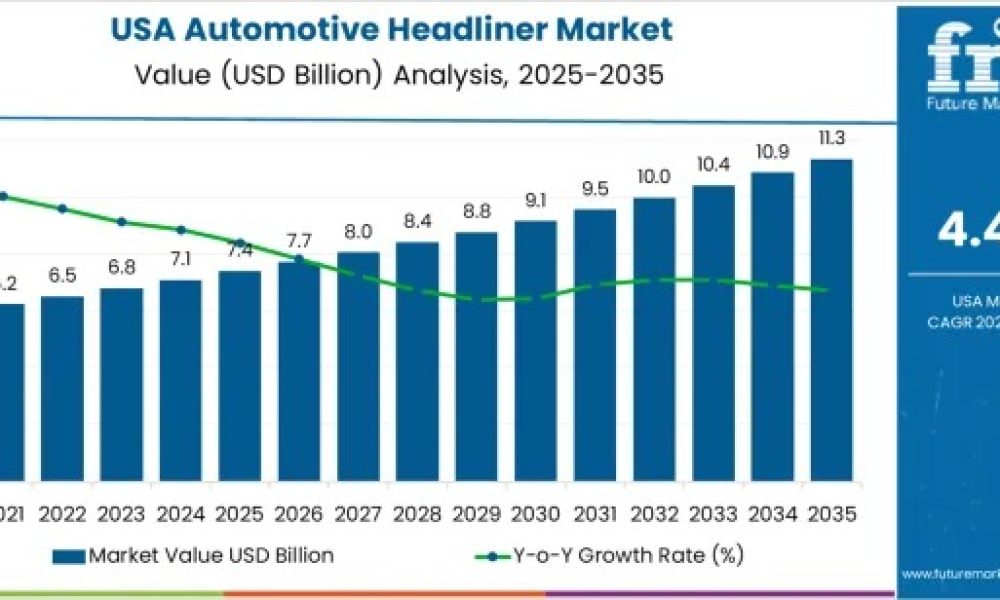
The demand for automotive headliners in the USA is projected to grow from USD 7.4 billion in 2025 to USD 11.3 billion by 2035, reflecting a CAGR of 4.4%, according to the latest market insights. Automotive headliners, which serve as interior roof linings, are essential for noise reduction, thermal insulation, and aesthetic enhancement of vehicle cabins.
The growth is fueled by rising consumer expectations for comfort, luxury, and advanced interior features, alongside the increasing adoption of electric vehicles (EVs), which demand higher cabin comfort standards. The market is expected to grow steadily from USD 7.4 billion in 2025 to USD 8.8 billion by 2029, with continued expansion throughout the 2030s, reaching USD 11.3 billion by 2035.
Get access to comprehensive data tables and detailed market insights – request your sample report today!
Market Insights
- Headliner Type: Soft top headliners dominate the market with 62% share, preferred for their superior sound absorption, flexibility in design, and enhanced interior aesthetics.
- Material: Foam-backed cloth leads at 36% market share, valued for its lightweight, durability, and excellent insulation properties.
- Regional Growth: West USA leads with a 5.0% CAGR, followed by South USA (4.5%), Northeast USA (4.0%), and Midwest USA (3.5%), driven by vehicle production, aftermarket upgrades, and consumer preference for premium interiors.
What is the Growth Forecast for the Automotive Headliner Industry in USA through 2035?
The market growth curve for automotive headliners in the USA is expected to show a consistent upward trend with a relatively smooth and linear progression. The early years (2025 to 2029) will see steady, incremental growth, with demand increasing at a moderate pace. The growth rate will be fairly stable, reflecting steady vehicle production, increasing demand for comfort features, and the continued integration of advanced materials in headliners.
From 2029 onwards, the growth curve will maintain its upward trajectory but may see a slight acceleration as the automotive industry continues to focus on enhancing interior quality, particularly in electric vehicles and premium models. As consumer preferences for high-quality vehicle interiors rise, the demand for automotive headliners will grow more robustly in the latter part of the forecast period. This indicates that while the overall growth is gradual, it will continue to expand steadily, reflecting the ongoing importance of interior comfort and noise reduction features in modern vehicles.
Why is the Demand for Automotive Headliners in USA Growing?
Demand for automotive headliners in the USA is rising as vehicle buyers increasingly value interior comfort, aesthetics, and cabin quality. Headliners the fabric or material lining on the interior roof of cars contribute to sound insulation, thermal comfort, and overall feel of the interior. As automakers compete on cabin quality and consumers expect more comfortable, quieter rides, demand for well finished headliners grows. Growth in production of passenger vehicles and light vehicles further supports demand for headliners as standard interior components. Manufacturers are also under pressure to meet safety, insulation, and noise reduction standards, boosting adoption of high quality headliner materials.
At the same time trends in vehicle technology and design reinforce demand. The shift toward electric vehicles, SUVs, crossovers, and premium trim levels encourages use of lightweight, high performance interior materials including advanced headliners. Automakers are increasingly using improved composites, foams, fabrics and sound insulating materials to deliver better cabin comfort and meet regulatory or consumer expectations. Demand is also driven by aftermarket replacements and upgrades, particularly for older vehicles needing refurbished interiors or improved cabin comfort. As long as consumer demand for comfort, noise reduction, and refined interiors remains high and as vehicle production remains robust demand for automotive headliners in the USA is likely to grow steadily in coming years.
Key Market Drivers
- Rising vehicle production and growing passenger vehicle fleet.
- Increasing consumer focus on cabin comfort, noise reduction, and aesthetic appeal.
- Adoption of lightweight and advanced interior materials to meet EV and fuel-efficiency requirements.
- Expansion of the aftermarket for interior replacements and upgrades.
Tailor Your Solution: Request Customization for Your Unique Needs!
Competitive Landscape
The market is led by Grupo Antolin (32.3% share), followed by International Automotive Components (IAC), Motus Integrated Technologies, Toyota Boshoku Corporation, and Kasai Kogyo Co., Ltd. These players focus on delivering innovative, lightweight, and acoustically optimized headliners that meet OEM specifications and sustainability standards.
Outlook
As the automotive sector evolves toward electric mobility, premium vehicle interiors, and enhanced passenger experience, demand for high-quality headliners in the USA will continue to grow steadily, driven by both OEM and aftermarket requirements. Technological innovations in lightweight, acoustic, and thermal materials are expected to further strengthen market adoption, making headliners a critical component in enhancing vehicle cabin quality.
Why Choose FMI: Empowering Decisions that Drive Real-World Outcomes: https://www.futuremarketinsights.com/why-fmi
About Future Market Insights (FMI)
Future Market Insights, Inc. (FMI) is an ESOMAR-certified, ISO 9001:2015 market research and consulting organization, trusted by Fortune 500 clients and global enterprises. With operations in the U.S., UK, India, and Dubai, FMI provides data-backed insights and strategic intelligence across 30+ industries and 1200 markets worldwide.



