
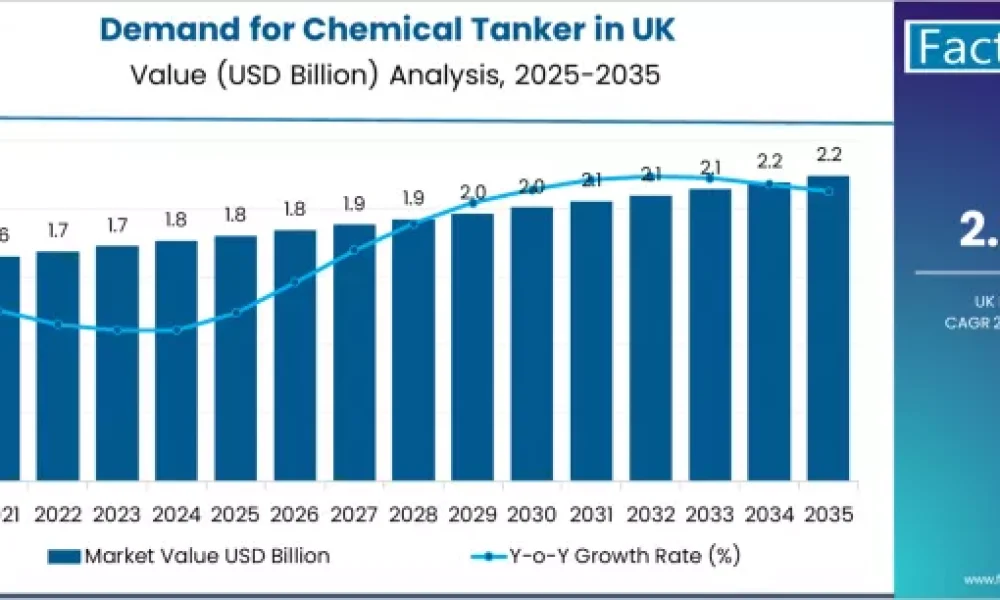
The demand for chemical tankers serving the United Kingdom is forecast to grow gradually through 2035 as the country’s chemical imports, petrochemical intermediates trade, and specialty-chemical logistics remain critical components of maritime commerce. According to market projections, demand is expected to rise from approximately USD 1.8 billion in 2025 to roughly USD 2.2 billion by 2035, representing a CAGR of about 2.2% for the period. The United Kingdom’s established port infrastructure, chemical-handling capabilities, and role as both importer and distributor of liquid chemicals underpin this sustained demand.
Given evolving chemical industry requirements-such as multi-cargo parcel shipments, regulatory compliance, and increased handling of petrochemical intermediates and specialty chemicals-the need for modern, flexible, and compliant chemical tanker capacity is rising. Medium-range (MR) chemical tankers are expected to dominate this demand, owing to their versatility, cargo flexibility, and suitability for UK trade routes.
Quick Stats (2025-2035)
2025 Demand Value: USD 1.8 billion
2035 Projected Demand Value: USD 2.2 billion
Absolute Increase (2025-2035): ≈ USD 0.4 billion
Forecast CAGR: ~2.2%
Leading Vessel Type: MR Chemical Tankers (~46.8% share)
Leading Cargo Segment: Petrochemical intermediates (~42.3% share)
Key Demand Regions in the UK: England (major share), followed by Scotland, Wales, Northern Ireland
To Access the Complete Data Tables & in-depth Insights, Request a Discount on this report: https://www.factmr.com/connectus/sample?flag=S&rep_id=12351
Market Drivers & Demand Catalysts
1. Sustained Petrochemical and Chemical Trade Flows
The UK continues to import, export, and distribute large volumes of petrochemical intermediates and bulk chemicals. As domestic production interplays with international supply chains, chemical tanker shipments remain essential. Because many of these cargos are liquid bulk or require specialized handling, chemical tankers-especially MR-class vessels-are the logical logistics solution to maintain supply continuity.
2. Versatility and Flexibility of MR Tankers
MR chemical tankers provide a balance between cargo capacity and access to varied ports, making them ideal for the UK’s network of major and minor chemical-handling terminals. Their ability to carry multiple parcels in a voyage with different grades of chemicals-often including delicate or corrosive products-matches the complex needs of UK chemical importers, distributors, and industrial users.
3. Growth in Specialty Chemicals & High-Value Cargo
Beyond standard petrochemical feedstocks, demand for specialty chemicals, fine chemicals, and specialty intermediates is rising. Such cargos often require more stringent tanker specifications-clean tanks, corrosion-resistant coatings, and controlled handling-which raises demand for compliant and well-maintained chemical tankers dedicated to such trade.
4. Regulatory, Safety & Compliance Pressures
European and UK regulations on safe carriage of hazardous chemicals, environmental protection, and emissions standards push shipowners and charterers toward modern, compliant tonnage. Older, non-specialized vessels are less likely to meet these requirements; hence, demand gravitates toward newer, properly-equipped chemical tankers that satisfy regulatory and safety norms.
5. Strategic Port Infrastructure & Maritime Logistics in Key UK Regions
Major chemical-importing ports and chemical-processing hubs in England and Scotland, along with well-developed maritime infrastructure, anchor consistent demand. These ports serve as entry, distribution, and redistribution nodes for chemical flows across Europe and globally – reinforcing the need for reliable chemical-tanker capacity.
Market Structure & Segments
By Vessel Type
MR Chemical Tankers (Medium-Range): Dominant segment due to versatility and wide applicability in UK waters and broader European trades.
Parcel Tankers / Handysize Chemical Carriers: Employed for smaller parcels, specialized chemicals, or cargoes requiring smaller volume-useful for short-sea trades, regional distribution, or niche chemicals.
By Cargo Type
Petrochemical Intermediates: Largest cargo share, reflecting bulk chemical trade and base-chemistry flows.
Specialty & Fine Chemicals: Smaller in volume but growing in economic value, especially for high-purity or hazardous chemicals requiring specialized handling.
Food-grade & Vegetable-Oil Based Chemicals: A niche but relevant segment-less dominant but contributing to diversity of tanker cargo requirements.
By Operation Mode
Charter operations include time-charter, spot voyages, and long-term contracted logistics – providing flexibility for chemical producers, distributors, and shipping firms to manage demand cycles, inventory needs, and cargo volume variability.
By Region (within UK)
England commands the largest share due to concentration of ports, refineries, chemical-processing clusters, and import/export terminals; Scotland, Wales, and Northern Ireland represent smaller but steady demand, often for regional distribution, coastal trades, or feeder routes.
Challenges & Market Risks
Commodity Cycles & Chemical Industry Volatility
Chemical product demand and petrochemical feedstock flows are sensitive to global commodity cycles, energy prices, regulatory changes, and competitive pressures. A downturn in chemical production or a shift in sourcing strategies (e.g. increased local production elsewhere) could reduce tanker demand.
Environmental & Emissions Regulations
Tightening environmental regulations – on emissions, ballast-water treatment, and hazardous-cargo transport – raise compliance costs. Owners of older or non-compliant vessels may exit, but expansion requires capital investment, potentially slowing fleet growth.
Competition from Alternative Transport & Changing Trade Patterns
For some chemical flows – particularly short-haul or regional distribution – pipelines, road/rail tankers, or coastal barges may compete with sea-borne chemical tankers. Changes in trade agreements, supply-chain restructuring, or near-shoring of chemical manufacturing could reduce demand for long-haul tanker services.
Port & Infrastructure Constraints
Not all UK ports are equipped for modern chemical-tanker operations; draft restrictions, port congestion, or lack of specialized handling facilities may limit accessibility for larger tankers and constrain operational efficiency.
Opportunities & Strategic Priorities
Fleet Modernization & Compliance-Ready Vessels
Operators investing in modern, coated, multi-grade chemical tankers with emission-compliant engines, updated ballast-water treatment, vapour-recovery equipment, and advanced safety systems are best positioned to capture demand over the next decade.
Flexible Parcelization & Multi-Stop Logistics Services
Given the diversity of chemical cargoes – petrochemicals, specialty chemicals, and smaller-volume fine chemicals – providing flexible parcel and multi-stop capability creates a competitive edge for shipowners and charterers serving the UK market.
Specialty Chemical & Niche Cargo Handling
Growth in specialty chemicals, fine chemicals, and high-value cargo presents an opportunity for specialized tanker services, with premium freight rates for vessels offering high- cleanliness standards and tailored handling procedures.
Short-Sea & Intra-European Connectivity
Strong links between the UK and continental Europe support short-sea trades and feeder services, offering steady demand for smaller parcel tankers and coastal-route operators.
Outlook
The demand for chemical tankers in the United Kingdom is expected to grow steadily through 2035, driven by stable chemical trade flows, rising specialty-chemical handling, and the need for modern, compliant tanker solutions. With an anticipated increase from USD 1.8 billion to USD 2.2 billion in demand over the decade, the market presents a stable growth trajectory. Success will favor operators and owners who invest in flexible, environmentally compliant, and parcel-capable tanker fleets, and who align logistics offerings with evolving chemical-industry needs, regulatory standards, and trade patterns.
Have specific requirements or need assistance on report pricing or have a limited budget? Please contact [email protected]
About Fact.MR:
Fact.MR is a global market research and consulting firm, trusted by Fortune 500 companies and emerging businesses for reliable insights and strategic intelligence. With a presence across the U.S., UK, India, and Dubai, we deliver data-driven research and tailored consulting solutions across 30+ industries and 1,000+ markets. Backed by deep expertise and advanced analytics, Fact.MR helps organizations uncover opportunities, reduce risks, and make informed decisions for sustainable growth.



