
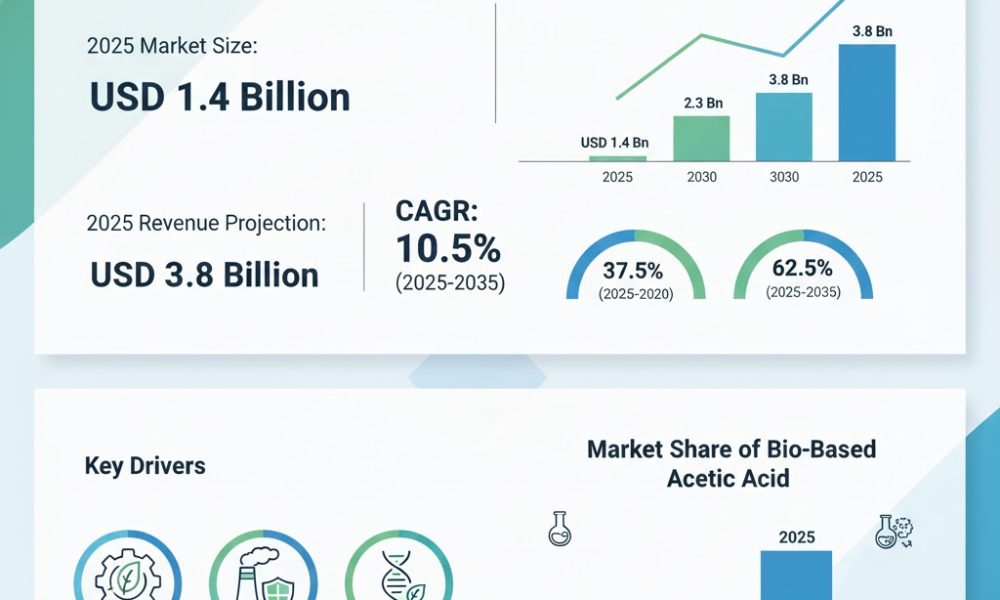
The global bio-based acetic acid market is set to undergo a transformative growth trajectory over the next decade, with revenues projected to surge from USD 1.4 billion in 2025 to USD 3.8 billion by 2035, registering a compound annual growth rate (CAGR) of 10.5%. This growth is fueled by rising demand for sustainable chemicals, stricter environmental regulations, and advancements in biotechnology and circular economy practices.
Market Revenue Forecasts and Growth Dynamics
Between 2025 and 2035, the market is expected to achieve USD 2.4 billion in absolute revenue growth. By 2030, revenue is forecasted to reach approximately USD 2.3 billion, representing 37.5% of the total projected growth for the decade. From 2030 to 2035, continued adoption of advanced bio-manufacturing technologies and renewable feedstock integration is anticipated to drive the market to USD 3.8 billion, contributing 62.5% of total decade growth.
Key drivers include the rising preference for bio-based acetic acid over petrochemical alternatives, driven by its lower carbon footprint and alignment with corporate sustainability goals. By 2035, bio-based acetic acid is projected to account for over 20% of global acetic acid production, up from approximately 9% in 2025.
To access the complete data tables and in-depth insights, request a Discount On The Report here: https://www.factmr.com/connectus/sample?flag=S&rep_id=1189
Innovation Catalysts Driving Market Expansion
1. Advanced Fermentation and Biotechnology
Biomass fermentation remains the dominant production method, accounting for over 60% of market volume in 2025, with projections indicating sustained growth at a CAGR of 10.8% through 2035. Technological innovations, including engineered microbial strains and continuous fermentation systems, are increasing conversion efficiency by 15–20%, reducing production costs and enabling high-purity outputs suitable for pharmaceutical and food applications.
Emerging waste-to-acetic acid technologies leveraging agricultural residues and industrial by-products are expected to capture approximately 25% of the market volume by 2035, up from 12% in 2025, highlighting the increasing adoption of circular economy principles.
2. Circular Economy and Waste Valorization
The market is witnessing a shift toward sustainable feedstocks, with biorefinery-integrated processes expected to account for 30% of global production by 2030, compared to 15% in 2025. Adoption of circular economy models enables companies to reduce feedstock costs by 10–15% while also lowering greenhouse gas emissions by 20–30% per ton of acetic acid produced.
3. Application-Driven Market Growth
In 2025, the food & beverage sector represented 42% of bio-based acetic acid consumption, driven by its use in preservation and flavoring. Industrial applications, including chemical intermediates and pharmaceuticals, accounted for 64% of total consumption. By 2035, food & beverage applications are expected to grow at a CAGR of 9.8%, while industrial applications are projected to expand at 11.2% CAGR, reflecting ongoing demand for renewable chemical inputs.
Regulatory and Sustainability Impact
Regulatory measures are a major market catalyst. Governments worldwide are implementing carbon reduction mandates and renewable content requirements. In the United States, the adoption of bio-based chemicals could reduce industrial carbon emissions by up to 2 million metric tons CO2-equivalent annually by 2030.
Companies are increasingly integrating ESG criteria, with projections indicating that bio-based chemical adoption could reach 25–30% of the chemical manufacturing supply chain by 2035, driven by scope 3 emission reduction targets. Regulatory compliance and incentives for bio-based chemical usage are expected to contribute an estimated USD 0.5 billion in incremental market revenue by 2035.
Regional Market Insights
North America: Expected CAGR of 11.2% (2025–2035), with revenues reaching USD 1.2 billion by 2035 due to strong biotechnology adoption and industrial demand.
Europe: Germany, France, and the UK are projected to grow at 10.3%, 10.1%, and 10.0% CAGR respectively, with combined market revenues reaching USD 1.0 billion by 2035.
Asia-Pacific: South Korea and Japan forecasted CAGRs of 9.8% and 9.6%, driven by high-purity bio-based chemical adoption, contributing approximately USD 0.8 billion in market revenue by 2035.
Competitive Landscape and Market Shares
The market is competitive and fragmented, featuring biotechnology startups, specialty chemical producers, and large industrial players. Leading innovators in waste-to-chemical technologies hold approximately 13% of the global market share, while top chemical manufacturers account for over 40% collectively. Strategic investments in R&D and expansion of biorefinery capacity are projected to increase the market share of advanced producers by 5–7 percentage points by 2035.
Challenges and Market Outlook
Despite strong growth, challenges remain. Production costs for bio-based acetic acid remain 20–30% higher than petrochemical alternatives. Feedstock availability constraints and scaling complexities pose additional hurdles in emerging regions.
However, the long-term outlook is promising. Advances in synthetic biology, waste valorization, and high-efficiency fermentation are expected to reduce production costs by 15–20% by 2035, making bio-based acetic acid increasingly competitive. By the end of the decade, bio-based acetic acid is projected to represent over 20% of global acetic acid production, cementing its role as a cornerstone of the transition to renewable and circular chemical systems.
To View Related Report :
Bio-Based Acetic Acid Industry Analysis in the UK https://www.factmr.com/report/united-kingdom-bio-based-acetic-acid-industry-analysis
USA Bio-Based Acetic Acid Industry Analysis https://www.factmr.com/report/usa-bio-based-acetic-acid-industry-analysis
Thioacetic Acid Market https://www.factmr.com/report/965/thioacetic-acid-market
Chloroacetic Acid Market https://www.factmr.com/report/chloroacetic-acid-market



