
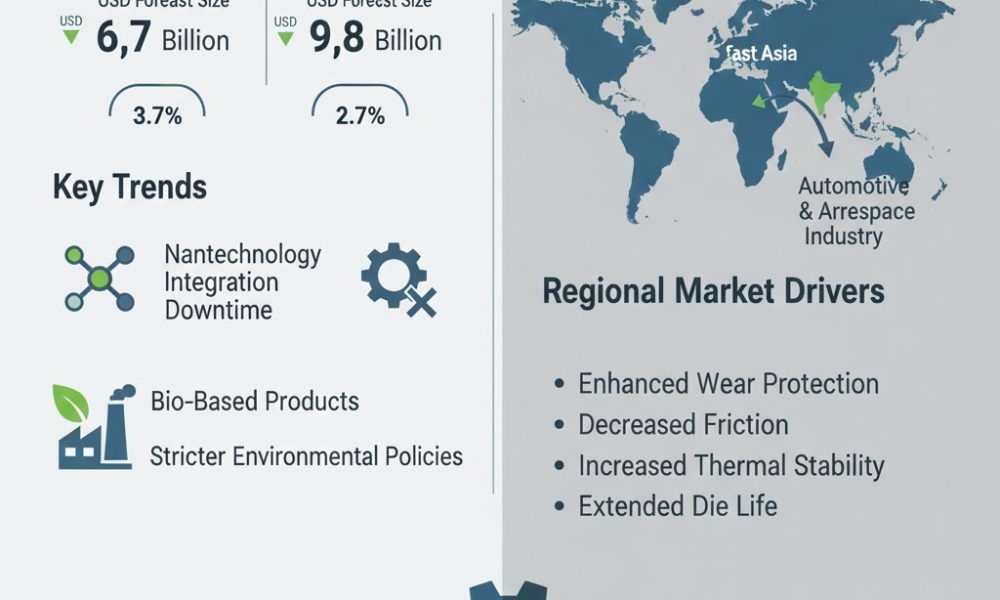
The global forging lubricants market is projected to expand significantly over the next decade, driven by technological innovation, rising industrial demand, and stringent environmental regulations. Valued at approximately USD 6.7 billion in 2025, the market is expected to reach USD 9.8 billion by 2035, registering a compound annual growth rate (CAGR) of 3.7%. Forecasts for 2036 indicate continued steady growth in line with long-term industrial trends.
To access the complete data tables and in-depth insights, request a Discount On The Report here: https://www.factmr.com/connectus/sample?flag=S&rep_id=1078
Market Growth Dynamics
The forging lubricants industry’s growth is underpinned by industrialization, precision manufacturing, and technological advancement:
Automotive and Aerospace Demand: These sectors account for approximately 55% of global forging lubricant consumption, driven by increasing adoption of high-strength alloys and lightweight components.
Heavy Machinery and Industrial Equipment: Representing roughly 25% of the market, these segments demand high-performance lubricants that reduce die wear and maintain operational efficiency.
Emerging Applications: Medical implants, EV components, and renewable energy equipment are expected to contribute ~10% of new market growth by 2030.
Performance Requirements:
Modern forging lubricants must endure temperatures exceeding 1,200°C in hot forging and pressures exceeding 2,000 tons in hydraulic presses. Lubricants that achieve 10–15% longer die life and 3–5% reduction in frictional energy are considered premium-grade solutions.
Regional Insights
The global market exhibits strong regional variation:
Asia Pacific: Dominates with ~45% market share in 2025, projected to grow at a CAGR of 4.5%, fueled by automotive, aerospace, and infrastructure projects in China, India, and South Korea.
North America: Holds ~25% market share, driven by aerospace, defense, and electric vehicle manufacturing. Growth is forecast at 3.2% CAGR, with high adoption of eco-friendly water-based and synthetic lubricants.
Europe: Accounts for ~20% of the market, growing at 3% CAGR, with growth fueled by precision engineering and regulatory compliance requirements.
Latin America and MEA: Combined market share of ~10%, with projected CAGR of 4%, driven by industrial expansion and infrastructure development.
Product Segmentation and Market Trends
Lubricant Type:
| Type | Market Share 2025 | CAGR (2025–2035) |
|---|---|---|
| Oil-based | 55% | 3.3% |
| Water-based | 30% | 4.1% |
| Synthetic/Other | 15% | 3.9% |
Water-based lubricants are gaining momentum due to low VOC content and environmental compliance, expected to account for ~38% of total market by 2035.
Application:
Hot Forging: ~60% of total consumption, CAGR 3.8%, due to high demand in automotive and aerospace.
Cold Forging: ~25% of total consumption, CAGR 3.5%, driven by industrial components.
Other Specialty Forging: ~15%, CAGR 4%, including medical and defense applications.
Forging Material:
Steel: Largest segment, ~50% of market, CAGR 3.6%.
Aluminum: ~20%, CAGR 4%, driven by lightweight automotive and aerospace parts.
Titanium: ~15%, CAGR 5%, fueled by aerospace and medical applications requiring high-performance lubricants.
Others (Copper, Alloys): ~15%, CAGR 3.2%.
Forging Operation:
Hydraulic Press Forging: ~45% of market, CAGR 3.9%, preferred for precision parts.
Mechanical Press Forging: ~35%, CAGR 3.5%, widely used in automotive.
Upset and Other Forging: ~20%, CAGR 4%, applied in specialty components and high-strength alloys.
Competitive Landscape
The forging lubricants market is moderately consolidated, with top players holding ~66% of global market share:
| Company | Estimated Market Share |
|---|---|
| Henkel Corporation | 18% |
| Chem-Trend L.P. | 15% |
| Quaker Chemical Corporation | 12% |
| Houghton International Inc. | 12% |
| Moresco Corporation | 9% |
Key strategies include:
R&D Investment: ~5–7% of annual revenue invested in advanced lubricants and bio-based solutions.
Strategic Alliances: Partnerships with OEMs to co-develop customized solutions.
Geographic Expansion: Asia Pacific and Latin America targeted for market penetration.
Premium products achieve 10–15% higher operational efficiency compared to standard formulations, providing strong ROI for manufacturers.
Strategic Insights for R&D and Market Development
Sustainable Formulations:
With regulatory pressure increasing by 15–20% per decade, investment in bio-based and low-VOC lubricants ensures compliance and market differentiation.Advanced Performance Solutions:
R&D into nano-additives and thermal-stable formulations can improve die life by 10–20%, friction efficiency by 3–5%, and reduce maintenance costs.Regional Expansion:
Asia Pacific and Latin America represent ~50% of total market growth, necessitating localized production and distribution networks.Digital Services:
Automated lubrication systems and real-time monitoring can reduce lubricant consumption by up to 10%, enhancing sustainability and operational efficiency.
Outlook Summary
By 2036, the global forging lubricants market is expected to surpass USD 10 billion, driven by:
Industrial modernization and infrastructure growth.
Advanced automotive and aerospace applications.
Adoption of sustainable and high-performance lubricant technologies.
Companies that integrate innovation, sustainability, and regional expansion strategies will secure long-term market leadership. With precision forging increasingly critical in high-strength alloys, electric vehicles, and aerospace, forging lubricants are positioned as an indispensable industrial enabler.
Have a specific Requirements and Need Assistant on Report Pricing or Limited Budget please contact us – [email protected]
To View Related Report :
Forging Lubricant Industry Analysis in Middle East & Africa https://www.factmr.com/report/forging-lubricant-industry-analysis-in-middle-east-and-africa
Forging Lubricant Industry Analysis in East Asia https://www.factmr.com/report/forging-lubricant-industry-analysis-in-east-asia
Forging Lubricant Industry Analysis in North America https://www.factmr.com/report/forging-lubricant-industry-analysis-in-north-america
Forging Lubricant Industry Analysis in Latin America https://www.factmr.com/report/forging-lubricant-industry-analysis-iin-latin-america



