
The global Mulching Material Market is projected to witness robust growth through 2036, driven by increasing adoption in agriculture, horticulture, and landscaping. Rising consumer awareness about soil conservation, sustainable agriculture, and water retention solutions is driving market demand. Quantitative analysis indicates that the market will grow from US$ 3.93 billion in 2024 to an estimated US$ 8.42 billion by 2034, representing a CAGR of 7.9% over the decade.
Market Growth Forecast & Segmentation
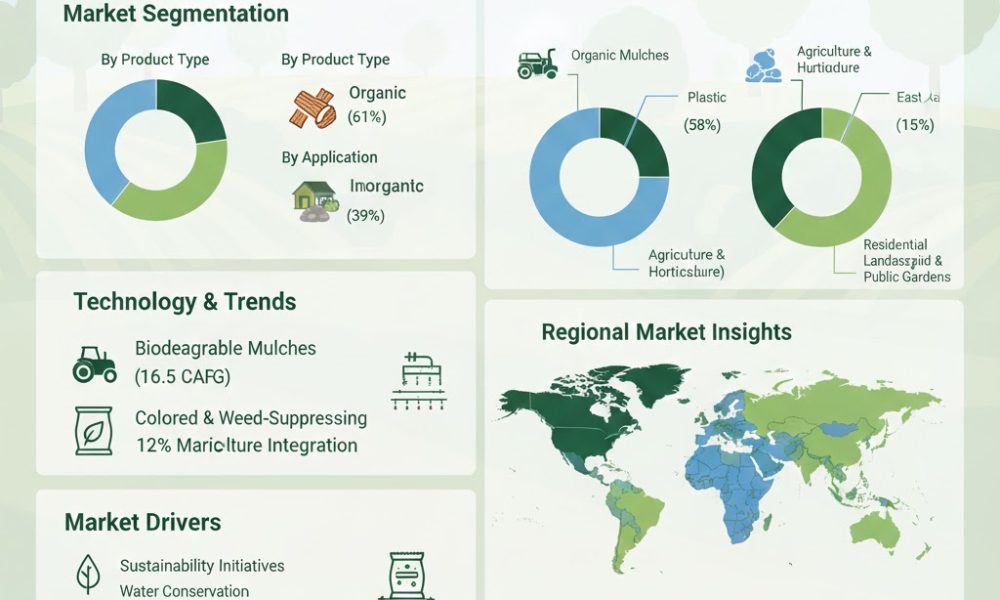
The market is segmented by product type, application, and region, revealing key growth drivers and opportunities:
Organic Mulches dominate the market, accounting for 61% of total revenue in 2024, primarily due to rising preference for biodegradable and eco-friendly materials such as wood chips, bark, and straw.
Inorganic Mulches, including plastic films, landscape fabrics, and stones, hold 39% market share, with demand primarily in commercial landscaping and high-efficiency agricultural applications.
Agriculture and horticulture applications contribute nearly 58% of the global demand, driven by the need for moisture retention, temperature regulation, and weed control.
Residential landscaping is the fastest-growing segment, projected to grow at a CAGR of 9.3%, reflecting the rising trend of home gardening and landscaping aesthetics.
Commercial and public gardens account for 15% of the market, with increasing investments in sustainable urban landscaping.
To access the complete data tables and in-depth insights, request a Discount On The Report here: https://www.factmr.com/connectus/sample?flag=S&rep_id=1005
Pricing Trends & Cost Analysis
The global market exhibits dynamic pricing patterns influenced by raw material costs, product type, and seasonality:
Organic mulches are priced between US$ 30–60 per cubic yard, depending on the type (bark vs. straw) and region.
Inorganic mulches such as black polyethylene films and landscape fabrics are priced 20–35% higher than natural mulches due to higher durability and processing costs.
Biodegradable synthetic mulches currently command a premium, averaging US$ 1.2–1.5 per square foot, but their share is expected to increase from 6% in 2024 to 14% by 2034, reflecting improved production efficiency.
Peak pricing occurs in spring and early summer, with a 5–12% seasonal spike, coinciding with peak landscaping and farming seasons.
Regional Market Insights
North America holds the largest regional market share at 27% in 2024, valued at approximately US$ 1.06 billion, driven by widespread adoption in home gardening, commercial landscaping, and agriculture. The U.S. alone represents 21% of the global market, with around 35% of households engaging in home gardening, which boosts organic mulch consumption.
Europe accounts for 22% of the market, with strong regulatory support for biodegradable mulches and sustainable agricultural practices. Adoption of colored and decorative mulches in urban landscaping projects is contributing to a projected CAGR of 6.8% through 2034.
East Asia is projected to experience the fastest growth, with a CAGR of 9.5%, driven by large-scale commercial agriculture and growing awareness of soil health management. By 2034, East Asia is expected to capture 24.6% of the global market, with China alone contributing nearly 15% of total demand.
South Asia, Latin America, and Oceania are emerging as strategic growth frontiers, with regional CAGRs between 8–10%, reflecting increasing adoption of modern farming techniques and government initiatives to boost sustainable land management.
Competitive Landscape & Strategic Benchmarking
The global market is highly fragmented, with a mix of established players and emerging innovators. Market leaders are leveraging product diversification, R&D, and distribution strategies to gain competitive advantage:
The top 10 players account for roughly 48% of the global revenue, indicating moderate market concentration.
Companies are expanding biodegradable product portfolios, with R&D budgets increasing by 12–15% annually to develop eco-friendly solutions.
E-commerce and retail partnerships are driving 30–40% of urban market sales, while rural demand remains heavily offline.
Technological Innovation & Trends
Innovation is reshaping market dynamics:
Biodegradable mulches are expected to grow from US$ 250 million in 2024 to US$ 1.18 billion by 2034, reflecting a CAGR of 16.5%, driven by regulatory mandates and environmental consciousness.
Colored and weed-suppressing mulches now represent 12% of the total market, up from 7% in 2020, reflecting aesthetic-driven demand in residential and commercial landscapes.
Integration with precision agriculture technologies, such as drip irrigation systems under mulch films, is enhancing yield efficiency and water conservation, further boosting adoption in high-value crops.
Market Drivers & Opportunities
Key factors driving the market include:
Sustainability initiatives: Government subsidies and environmental regulations incentivize the use of organic and biodegradable mulches.
Water conservation needs: Mulching reduces soil evaporation by 30–50%, making it essential in water-stressed regions.
Rising disposable income and urban gardening trends: The urban landscaping segment is expected to generate US$ 1.92 billion by 2034, growing faster than traditional agriculture applications.
E-commerce expansion: Online platforms now account for nearly 25% of retail mulch sales, enabling direct-to-consumer reach and regional market penetration.
Outlook to 2036
By 2036, the global mulching material market is expected to exceed US$ 9.5 billion, with organic mulches maintaining dominance but inorganic and biodegradable variants increasing market share. Strategic imperatives for industry players include:
Investing in R&D for high-performance and biodegradable materials.
Optimizing supply chains to manage raw material cost volatility and seasonal demand fluctuations.
Targeting emerging markets in Asia-Pacific, South Asia, and Latin America for accelerated growth.
Leveraging e-commerce platforms to capture urban consumer segments.
With increasing global emphasis on sustainable agriculture, water conservation, and eco-friendly landscaping, the mulching material market is set to remain a high-growth, data-driven opportunity for manufacturers, investors, and stakeholders through 2036.
Have a specific Requirements and Need Assistant on Report Pricing or Limited Budget please contact us – [email protected]
To View Related Report :
Materials Informatics Market https://www.factmr.com/report/materials-informatics-market
Mono-Material Recyclable Stretch Yarn Market https://www.factmr.com/report/mono-material-recyclable-stretch-yarn-market
Armor Materials Market https://www.factmr.com/report/5152/armor-materials-market
Coating Materials for Energy Sector Market https://www.factmr.com/report/1192/coating-materials-energy-sector-market



