
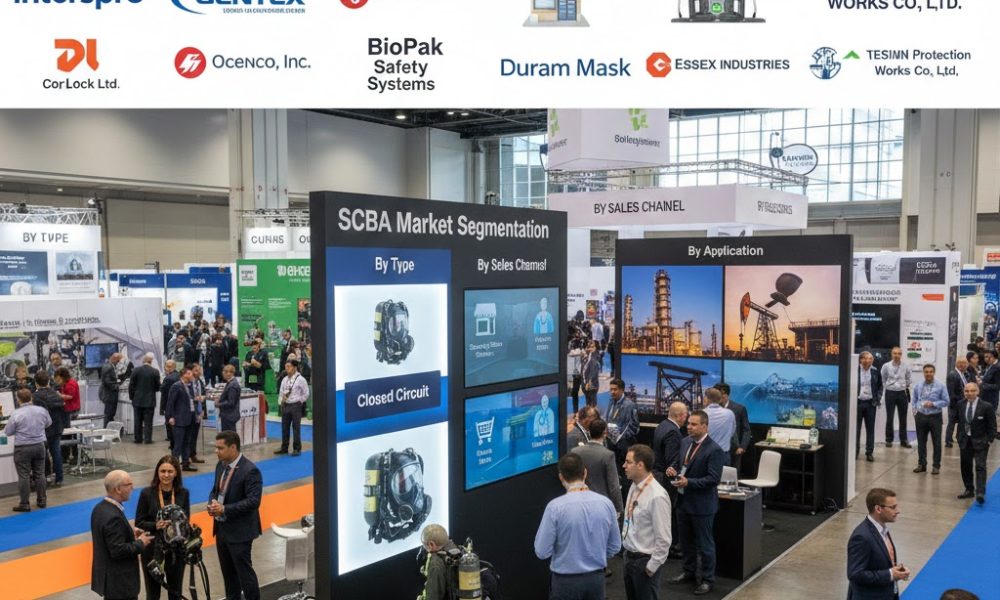
The global Self-Contained Breathing Apparatus (SCBA) market is poised for steady growth over the forecast period from 2026 to 2036, fueled by rising safety regulations, technological innovation, and increasing industrial and emergency response applications. In 2025, the market was valued at approximately USD 2.04 billion and is projected to reach USD 2.31 billion by 2035, registering a CAGR of 1.27%.
This growth trajectory reflects increasing global focus on occupational safety, modernization of emergency response fleets, and expansion of high-risk industrial sectors requiring advanced respiratory protection.
To access the complete data tables and in-depth insights, request a Discount On The Report here: https://www.factmr.com/connectus/sample?flag=S&rep_id=763
Market Drivers and Key Insights
1. Regulatory Compliance and Safety Standards
Stringent safety standards in North America, Europe, and emerging Asia-Pacific markets are driving SCBA adoption. For instance:
North America, contributing ~35% of the global market, mandates compliance with OSHA standards for industrial safety.
Europe accounts for ~28%, driven by EN 137 fire safety regulations.
Asia-Pacific, growing at ~2.1% CAGR, is seeing rising adoption due to industrialization and urbanization.
These regulations are particularly critical in firefighting, chemical, petrochemical, and oil & gas sectors, where SCBA systems are mandatory for personnel operating in low-oxygen or hazardous environments.
2. Technological Advancements
Technological innovation is reshaping SCBA demand:
Smart SCBA systems with IoT sensors, real-time air monitoring, and integrated communication solutions are increasing adoption among industrial and emergency service users.
Ergonomic designs and lightweight composite cylinders have reduced average SCBA user fatigue by 15–20%, enhancing usability during prolonged operations.
The closed-circuit SCBA segment, though smaller (~25% of the market in 2025), is growing faster than open-circuit units (~75%), due to its ability to recycle exhaled air and support longer mission durations, particularly in mining and confined space operations.
3. Sector-Specific Demand
Firefighting remains the largest application, representing ~40% of total demand, driven by municipal and industrial fire department fleet upgrades.
Industrial sectors including chemicals, petrochemicals, and oil & gas account for ~35%, with growth supported by workplace safety initiatives.
Mining and confined space operations are emerging segments, contributing ~15–20% and showing the highest relative CAGR of ~2.3%, driven by increased infrastructure projects in Asia-Pacific and Latin America.
Regional Insights
North America leads the market with ~35% share, fueled by regulatory mandates, strong public safety budgets, and frequent replacement cycles.
Europe holds ~28%, with moderate CAGR (~1.1%) due to regulatory harmonization and consistent safety investments.
Asia-Pacific is projected to grow at ~2.1% CAGR, with adoption increasing in China, India, and Southeast Asia driven by industrialization and mining activities.
Latin America and Middle East & Africa together account for ~12–15% market share, reflecting early-stage adoption with high growth potential as industrial and urban safety standards evolve.
Market Segmentation
By Type
Open-Circuit SCBA: ~75% of 2025 revenue, growth steady at 1.1% CAGR.
Closed-Circuit SCBA: ~25% of 2025 revenue, fastest-growing segment at 2.3% CAGR, driven by long-duration applications in hazardous environments.
By Sales Channel
Direct Sales dominate ~60% of total revenue, supported by government contracts and industrial bulk procurement.
Distribution Channels account for ~40%, primarily catering to smaller organizations or international resellers.
By Application
| Application | Market Share (2025) | CAGR (2026-2036) |
|---|---|---|
| Firefighting | 40% | 1.2% |
| Chemicals & Petrochemicals | 35% | 1.4% |
| Mining & Confined Spaces | 15-20% | 2.3% |
| Oil & Gas | 10% | 1.1% |
Competitive Landscape
The global SCBA market is moderately consolidated with a few key players controlling a majority of the market:
MSA Safety Inc.: ~20% global market share, leader in smart SCBA systems.
Honeywell International: ~15% share, strong presence in industrial and first-responder markets.
Drägerwerk AG: ~12% share, notable for European operations and high-performance units.
Avon Protection and 3M Scott Fire & Safety: ~10% combined, specialized in tactical and thermal performance SCBAs.
Competitive strategies focus on R&D investment, product innovation, certification compliance, and global distribution.
Future Outlook (2026-2036)
The SCBA market is expected to continue steady growth, driven by:
Regulatory enforcement and modernization cycles in firefighting and industrial sectors.
Increasing adoption of smart SCBA systems with digital integration, supporting operational efficiency and safety analytics.
Expansion in emerging markets, particularly Asia-Pacific and Latin America, as industrialization accelerates.
Rising corporate and governmental focus on worker health and safety protocols globally.
While the market has historically grown moderately, the combination of technological innovation, regulatory pressure, and industrial expansion positions SCBA solutions as a critical investment for public safety and industrial risk mitigation over the next decade.
Have a specific Requirements and Need Assistant on Report Pricing or Limited Budget please contact us – [email protected]
To View Related Report :
Insulation Monitoring Systems Market https://www.factmr.com/report/insulation-monitoring-systems-market
Ballistic Fabrics Market https://www.factmr.com/report/ballistic-fabrics-market
Freight Transport Market https://www.factmr.com/report/freight-transport-market
Electric Power Transmission Distribution Equipment Market https://www.factmr.com/report/electric-power-transmission-distribution-equipment-market



