
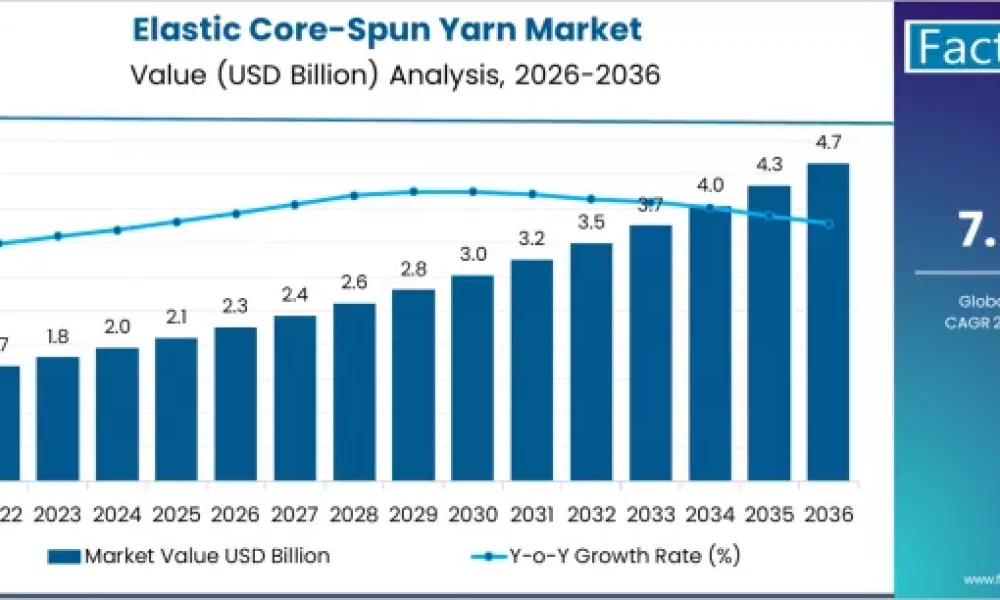
The market for elastic core-spun yarn is expected to expand at a compound annual growth rate (CAGR) of 7.5% between 2026 and 2036, from USD 2.26 billion in 2026 to USD 4.65 billion. This growth trend is indicative of rising demand for technical textile applications, sportswear, and fashion.
With the expanding popularity of athleisure wear, sportswear, intimate apparel, and technical textiles, elastic core-spun yarns are becoming a mainstay in modern textile and apparel manufacturing. Their versatility enables enhanced garment fit, performance, and wearer comfort across numerous end uses.
Market Overview
Elastic core-spun yarns are engineered by covering a stretchable core (commonly spandex) with non-elastic fibers to improve tactile properties, strength, and dyeability. These yarns are widely used in knitted and woven fabrics where elasticity and recovery are essential. Core-spun yarn structures also improve durability and fabric aesthetics compared to composite or covered yarns.
The market’s expansion reflects growing consumer preference for comfort-oriented garments, along with textile industry innovation in functional fabrics.
Quick Market Snapshot (2025–2035)
- Elastic Core-Spun Yarn Market Value (2026): USD 2.26 billion
- Elastic Core-Spun Yarn Market Forecast Value (2036): USD 4.65 billion
- Elastic Core-Spun Yarn Market Forecast CAGR: 7.5%
- Leading Core Material in Elastic Core-Spun Yarn Market: Spandex/Elastane Core (58.0%)
- Key Growth Regions in Elastic Core-Spun Yarn Market: China, Brazil, Europe
- Key Players in Elastic Core-Spun Yarn Market: Lycra Company, Hyosung, Asahi Kasei, Indorama Ventures, Toray Industries
To access the complete data tables and in-depth insights, request a Discount On The Report here: https://www.factmr.com/connectus/sample?flag=S&rep_id=12726
Key Demand Drivers
1. Rising Demand for Athleisure and Sportswear
Athleisure and performance apparel segments are major contributors.
Consumer preference for comfort and flexibility
High elasticity for active movement
Broad use in leggings, T-shirts, and performance outfits
Elastic core-spun yarns deliver the necessary stretch and recovery.
2. Growth of Comfort and Intimate Apparel
Comfort is a key purchasing driver.
Seamless fit and stretch for undergarments
Soft hand feel with supportive structure
Consumer focus on long-wear comfort
These yarns support design and performance requirements in intimate textiles.
3. Expansion of Technical and Functional Fabrics
Technical textiles use elastic cores for performance.
Medical textiles and compression garments
Automotive textile components
Protective and workwear fabrics
Stretch and durability are essential in functional applications.
4. Fast Fashion and Customization Trends
Fashion cycles are shortening.
Brands increasing SKU variety with stretch components
Custom fit and body-contouring garments
Demand for versatile yarns in diversified collections
Elastic core-spun yarns enable design flexibility and quick turnaround.
Market Segmentation Analysis
By Core Material
Spandex/Elastane Core Yarns:
Most widely used due to superior stretch and recovery.Lycra Core Yarns:
Premium branded stretch performance with consistent quality.
Other specialized elastomers are emerging in niche performance markets.
By Cover Fiber Type
Polyester Covered Yarns:
High strength, moisture management, and cost-effective.Cotton Covered Yarns:
Natural feel and comfort with stretch properties.Nylon Covered Yarns:
Excellent abrasion resistance and recovery.Viscose and Blends:
Soft hand feel, aesthetics, and enhanced dyeability.
Cover fiber choice impacts fabric feel, appearance, and application fit.
By End-Use Application
Sportswear & Activewear:
Largest segment due to performance and comfort needs.Casual & Everyday Apparel:
Stretch elements in denim, tops, and bottoms.Intimate & Lingerie Wear:
Fit, flexibility, and softness are key.Technical & Functional Textiles:
Compression, medical, and protective fabrics.Home Textiles & Other Uses:
Stretchable furnishings and specialty fabrics.
Sportswear and intimate apparel represent core demand bases.
Regional Market Insights
Asia-Pacific:
Largest and fastest-growing region owing to textile manufacturing hubs, rising middle class, and export-oriented apparel sectors.North America:
High adoption supported by strong sportswear brands and technical fabric innovation.Europe:
Steady growth due to premium brands and advanced fashion markets.Rest of World:
Emerging demand in Latin America and Africa as textile industries expand.
Regional growth aligns with apparel production intensity and consumer preferences.
Challenges and Market Restraints
1. Volatility in Raw Material Prices
Price fluctuations in spandex/elastane feedstock
Impact on yarn cost and profit margins
2. Technical Manufacturing Complexity
Core-spinning requires specialized equipment and expertise
Quality control critical for consistent performance
3. Competition from Alternative Stretch Technologies
Stretch knits and elastomeric finishes may replace some applications
Need to justify cost with performance benefits
Emerging Trends and Opportunities
1. Sustainable and Recycled Core-Spun Yarns
Use of recycled polyester and eco-friendly elastomers
Sustainability credentials increasingly valued
2. Integration with Smart and Functional Textiles
Yarns embedded with conductive or sensor-capable elements
Wearable tech applications
3. Technological Innovations in Spinning Processes
Automation for precision and quality
New machinery that enhances productivity and reduces waste
4. Customization for Niche Markets
Bespoke yarns for luxury and performance brands
Tailored stretch profiles for specific garments
Competitive Landscape Overview
Market players are focusing on:
R&D to improve performance and comfort
Partnerships with apparel brands for application development
Expansion of production capabilities in key textile hubs
Investment in sustainable fiber technologies
Competitive differentiation is built on quality consistency, technical capability, and material innovation.
Future Outlook
The elastic core-spun yarn market is expected to continue strong growth through 2035, supported by expanding applications in activewear, casual apparel, intimate wear, and technical textiles. As comfort and performance remain top priorities for consumers, yarns that deliver optimal stretch and recovery will maintain high relevance.
Innovation in sustainable materials and production efficiency will further expand opportunities. Manufacturers that align with both fashion trends and performance demands — while addressing cost efficiencies and environmental responsibility — will be well positioned to capture long-term market potential.
Have specific requirements or need assistance on report pricing or have a limited budget? Please contact [email protected]
About Fact.MR:
Fact.MR is a global market research and consulting firm, trusted by Fortune 500 companies and emerging businesses for reliable insights and strategic intelligence. With a presence across the U.S., UK, India, and Dubai, we deliver data-driven research and tailored consulting solutions across 30+ industries and 1,000+ markets. Backed by deep expertise and advanced analytics, Fact.MR helps organizations uncover opportunities, reduce risks, and make informed decisions for sustainable growth.



