
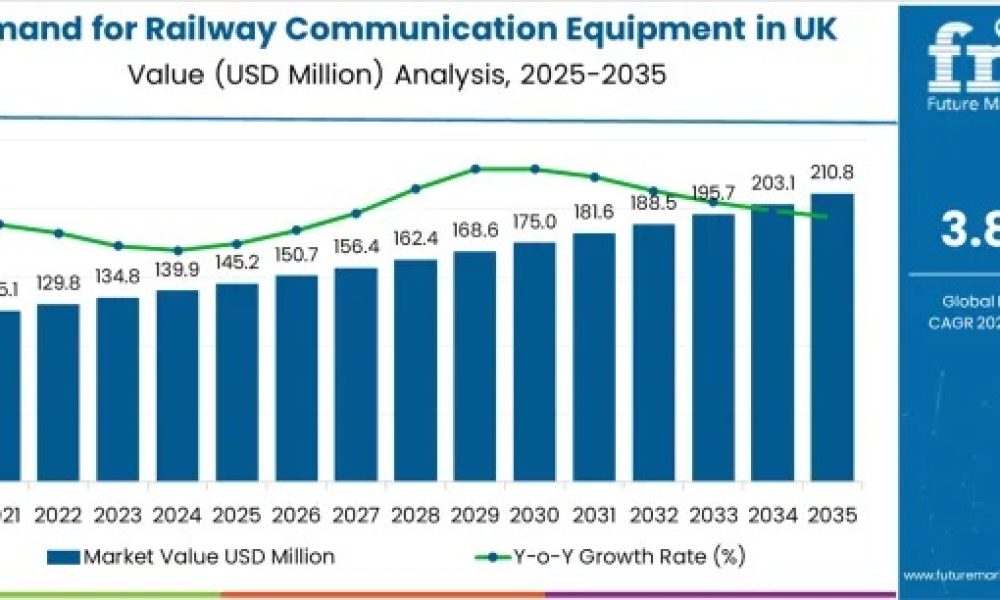
The UK railway communication equipment market is entering a decade of steady, infrastructure-led growth, underpinned by national rail modernization programs, rising safety expectations, and the accelerating shift toward digital communication architectures. According to the latest industry assessment, demand for railway communication equipment in the UK is projected to rise from USD 145.2 million in 2025 to approximately USD 210.8 million by 2035, generating an absolute value increase of USD 54.6 million over the forecast period. This represents total growth of 37.6%, with the market expanding at a compound annual growth rate (CAGR) of 3.8% between 2025 and 2035.
This growth trajectory reflects the UK rail sector’s strategic focus on operational reliability, passenger safety, and network resilience across both passenger and freight corridors. Communication systems capable of supporting real-time train monitoring, automated traffic management, and coordinated emergency response are no longer optional enhancements; they are becoming foundational components of modern railway operations.
Early-Stage Momentum Driven by Network Upgrades
Between 2025 and 2030, the market is expected to capture 43.0% of total decade growth, as major transport hubs and high-traffic corridors prioritize upgrades to train-to-ground communication, signaling connectivity, and centralized operational control. These early investments are closely aligned with rail network renewal programs targeting capacity enhancement, congestion management, and improved service reliability.
Get access to comprehensive data tables and detailed market insights – request your sample report today!
From 2030 to 2035, demand is forecast to accelerate further, rising from USD 168.7 million to USD 210.8 million, accounting for the remaining 57.0% of decade expansion. This later phase is characterized by the rollout of next-generation communication platforms, deeper integration with advanced signaling systems, and the deployment of specialized digital communication pathways across passenger, freight, and urban rail applications.
Digital Radio Systems Anchor Technology Demand
By technology type, digital radio systems are projected to account for 38.4% of total UK railway communication equipment demand in 2025, making them the leading technology category nationwide. Their dominance reflects proven reliability, strong compatibility with existing railway infrastructure, and the ability to enhance safety and voice clarity without requiring complete system replacement.
In a market defined by extensive legacy rail assets, digital radio platforms offer a practical balance between modernization and operational continuity. Continuous innovation in signal processing, audio clarity, and system integration is strengthening confidence among operators, enabling large-scale deployments across operational rail facilities while minimizing disruption.
Beyond digital radio, demand is strengthening for onboard communication modules, dispatch communication frameworks, passenger information systems, and integrated communication control platforms. These systems are increasingly evaluated on their ability to deliver uninterrupted connectivity, cybersecurity compliance, interoperability with multi-vendor environments, and long-term lifecycle support.
Passenger Rail Applications Lead Adoption
By application, passenger rail is expected to represent 46.7% of UK railway communication equipment demand in 2025, underscoring the critical role of communication technologies in passenger safety, service reliability, and experience optimization. Commuter rail, intercity services, and passenger information systems generate consistent demand for communication platforms that support high availability, regulatory compliance, and real-time operational coordination.
Passenger rail’s leadership is reinforced by strong deployment activity in England and Scotland, where dense passenger networks and high service frequency elevate the importance of advanced communication capabilities. Communication-enabled safety systems are also reducing operational risk and enhancing cost efficiency compared with conventional alternatives.
Regional Dynamics Highlight England’s Leadership
Regionally, the UK market demonstrates balanced but differentiated growth across England, Scotland, Wales, and Northern Ireland:
- England leads with a projected CAGR of 4.1% (2025–2035), driven by extensive rail infrastructure, strong innovation ecosystems around London and major transport hubs, and early adoption of premium digital systems.
- Scotland follows at 3.6% CAGR, supported by substantial passenger and freight operations and concentrated rail expertise in cities such as Glasgow and Edinburgh.
- Wales is expected to grow at 3.4% CAGR, reflecting ongoing railway modernization and increasing emphasis on operational competitiveness.
- Northern Ireland posts 3.2% CAGR, driven by expanding rail facilities and coordinated regional transport initiatives.
England’s position as the dominant demand center reflects its emphasis on comprehensive safety programs, system integration excellence, and technology leadership across diverse railway operations.
Tailor Your Solution: Request Customization for Your Unique Needs!
Competitive Landscape Focused on Integration and Reliability
The UK railway communication equipment market is characterized by competition among global industrial leaders and specialized rail technology providers. Siemens, Thales, Hitachi Rail, Alstom, and Nokia remain central to market momentum, leveraging strong system integration capabilities, established supply chains, and deep railway domain expertise.
Competitive differentiation is increasingly defined not by hardware alone, but by the ability to deliver end-to-end communication solutions, including cybersecurity assurance, interoperability across mixed rail environments, certification readiness, and long-term maintenance support. Strategic partnerships, technology infrastructure investment, and early execution in large-scale projects continue to shape competitive positioning.
Outlook: Communication as a Strategic Rail Asset
As the UK advances toward a more digital, safety-driven rail ecosystem, communication equipment is evolving from a supporting function into a strategic operational asset. Rising safety standards, regulatory clarity, and network optimization initiatives are creating predictable, long-term demand for high-performance communication systems across passenger, freight, and urban transit applications.
With demand projected to exceed USD 210 million by 2035, the UK railway communication equipment market offers sustained opportunities for technology providers, system integrators, and stakeholders aligned with digital rail transformation. The full market report provides detailed forecasts, segment-level insights, competitive analysis, and strategic recommendations for organizations seeking to position themselves at the forefront of the UK’s evolving railway communication landscape.
Why Choose FMI: Empowering Decisions that Drive Real-World Outcomes: https://www.futuremarketinsights.com/why-fmi
About Future Market Insights (FMI)
Future Market Insights, Inc. (FMI) is an ESOMAR-certified, ISO 9001:2015 market research and consulting organization, trusted by Fortune 500 clients and global enterprises. With operations in the U.S., UK, India, and Dubai, FMI provides data-backed insights and strategic intelligence across 30+ industries and 1200 markets worldwide.



