
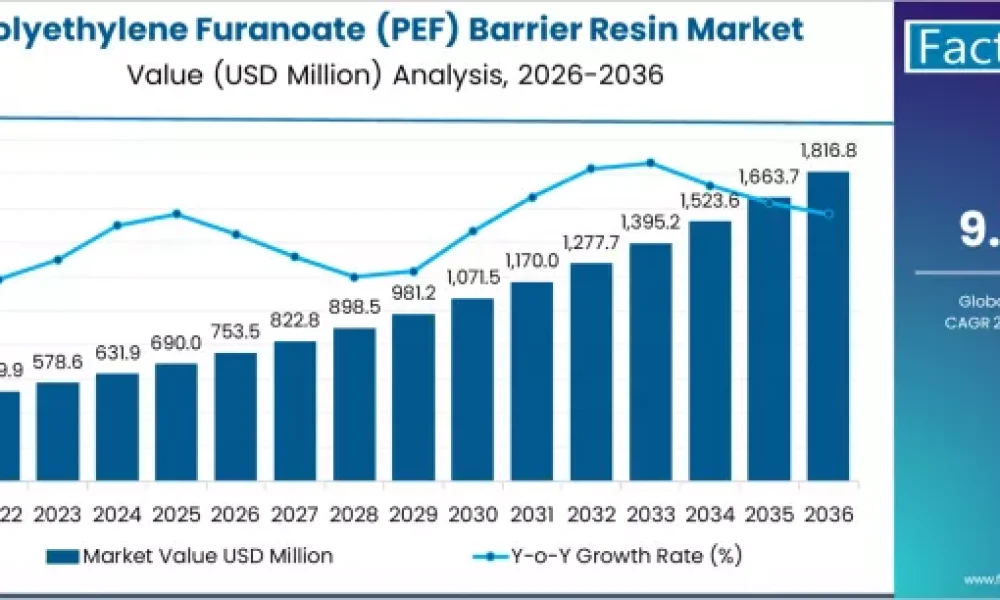
The global market for polyethylene furanoate (PEF) barrier resin is expected to increase at a compound annual growth rate (CAGR) of 9.2% between 2026 and 2036, from USD 753.5 million in 2026 to USD 1,817.6 million. The market is expected to increase at a compound annual growth rate (CAGR) of 9.2% between 2026 and 2036, translating into a total growth of 141.2%. In 2026, the virgin PEF resin segment is expected to account for 52.0% of the PEF barrier resin market.
Key Takeaways for PEF Barrier Resin Market
- PEF Barrier Resin Market Value (2026): USD 753.5 million
- PEF Barrier Resin Market Forecast Value (2036): USD 1,817.6 million
- PEF Barrier Resin Market Forecast CAGR: 9.2%
- Leading Resin Format in PEF Barrier Resin Market: Virgin PEF Resin (52.0%)
- Key Growth Regions in PEF Barrier Resin Market: China, Brazil, Europe
- Key Players in PEF Barrier Resin Market: Avantium, Mitsubishi Chemical Group, ALPLA, Toray Industries, Teijin
To access the complete data tables and in-depth insights, request a Discount On The Report here: https://www.factmr.com/connectus/sample?flag=S&rep_id=12714
Market Overview
Polyethylene furanoate barrier resins provide enhanced oxygen, moisture, and aroma barrier properties compared with traditional thermoplastics. These properties extend the shelf life of perishable goods, improve product quality, and reduce food waste — a key sustainability objective for manufacturers and retailers. PEF is produced through polymerization of bio-based monomers such as furandicarboxylic acid (FDCA) and mono-ethylene glycol (MEG), both of which can be sourced sustainably. Its increasing adoption reflects broader global trends toward sustainable materials and circular economy principles.
Key Market Drivers
1. Sustainability and Regulatory Pressures
Environmental sustainability is a major catalyst for PEF adoption.
Increasing regulations restricting single-use plastics
Incentives for bio-based and biodegradable materials
Corporate commitments to reduce packaging carbon footprint
Manufacturers are actively seeking alternatives to petroleum-based resins to meet compliance and sustainability goals.
2. Superior Barrier Performance
PEF barrier resins outperform conventional polymers in critical metrics.
Enhanced oxygen and carbon dioxide barrier properties
Improved aroma retention for food and beverage applications
Better moisture barrier characteristics
These properties help extend product shelf life and improve quality retention.
3. Rising Demand from Food and Beverage Industry
The food and beverage sector remains a leading end user.
Bottled water, carbonated drinks, and juices
Perishable food packaging requiring long shelf stability
Ready-to-eat meals and convenience foods
Demand for recyclable and high-performance packaging is driving uptake.
4. Growing Focus on Bio-Based Materials
Consumers and brands increasingly prefer products with environmental credentials.
Preference for bio-based and renewable materials
Marketing advantage from sustainable packaging claims
Consumer willingness to pay premium for green solutions
This trend supports long-term growth potential.
Market Segmentation Analysis
By Resin Type
Standard PEF Resins:
Core bio-based grade with balanced barrier and mechanical properties.Modified/Enhanced PEF Resins:
Tailored formulations for improved processability or specific application requirements.
By Application
Beverage Packaging:
Bottles for water, soft drinks, juices, and alcoholic beverages.Food Packaging:
Trays, containers, films, and pouches for perishable foods.Pharmaceutical Packaging:
Protective packaging for sensitive drug products.Specialty & Industrial Packaging:
Includes technical packaging requiring enhanced barrier and durability.
By End-Use Industry
Food and beverage manufacturers
Pharmaceutical companies
Cosmetic and personal care brands
Consumer packaged goods companies
Food and beverage continues to dominate demand, followed by pharmaceuticals and specialty applications.
Regional Market Insights
North America:
Strong growth supported by sustainability initiatives, advanced packaging infrastructure, and high consumer awareness.Europe:
Leading region due to stringent packaging regulations, early adoption of bio-based materials, and strong research ecosystem.Asia-Pacific:
Fastest-growing region driven by expanding food processing industry and rising demand for sustainable packaging solutions.Rest of World:
Gradual adoption as regulatory frameworks and sustainability practices evolve.
Challenges and Market Restraints
1. Higher Production Costs
PEF currently costs more than traditional petroleum-based resins
Price sensitivity among cost-conscious manufacturers
2. Scale-Up and Supply Chain Limitations
PEF production relies on emerging bio-refinery infrastructure
Limited commercial scale compared with entrenched plastics supply chains
3. Processing and Compatibility Issues
Optimization of processing parameters required for new resin systems
Compatibility with existing packaging lines may necessitate adjustments
Emerging Trends and Opportunities
1. Integration with Circular Economy Models
Recyclability and closed-loop initiatives
Compatibility with existing recycling streams through design improvements
2. Advanced PEF Formulations
High-performance blends with improved heat resistance
Modified PEF resins for specific application needs
3. Strategic Partnerships and Collaborations
Resin producers collaborating with brand owners and converters
Joint R&D to accelerate commercial adoption
4. Expansion of Sustainable Packaging Mandates
Retailer and brand commitments to eco-friendly packaging
Regulatory incentives for renewable materials
Competitive Landscape Overview
Market participants focus on:
Development of cost-competitive PEF variants
Expansion of production facilities and feedstock supply
Technical support and application development for converters
Partnerships with brands seeking sustainable solutions
Innovation, production scale, and supply reliability are key differentiators.
Future Outlook
The polyethylene furanoate (PEF) barrier resin market is expected to witness strong growth through 2035. As sustainability transitions from a niche trend to mainstream business strategy, demand for bio-based, high-performance barrier materials will expand across food and beverage, pharmaceutical, and specialty packaging applications. Advances in production technology, cost optimization, and recycling infrastructure will enhance market accessibility and competitiveness.
Companies that invest in scalable production, tailored PEF formulations, and strategic collaborations with end-users will be well positioned to capture significant market share in the evolving polymer landscape. The convergence of environmental goals, consumer demand, and performance requirements sets a favorable stage for PEF barrier resins to emerge as a next-generation packaging material.
Have specific requirements or need assistance on report pricing or have a limited budget? Please contact [email protected]
About Fact.MR:
Fact.MR is a global market research and consulting firm, trusted by Fortune 500 companies and emerging businesses for reliable insights and strategic intelligence. With a presence across the U.S., UK, India, and Dubai, we deliver data-driven research and tailored consulting solutions across 30+ industries and 1,000+ markets. Backed by deep expertise and advanced analytics, Fact.MR helps organizations uncover opportunities, reduce risks, and make informed decisions for sustainable growth.



