
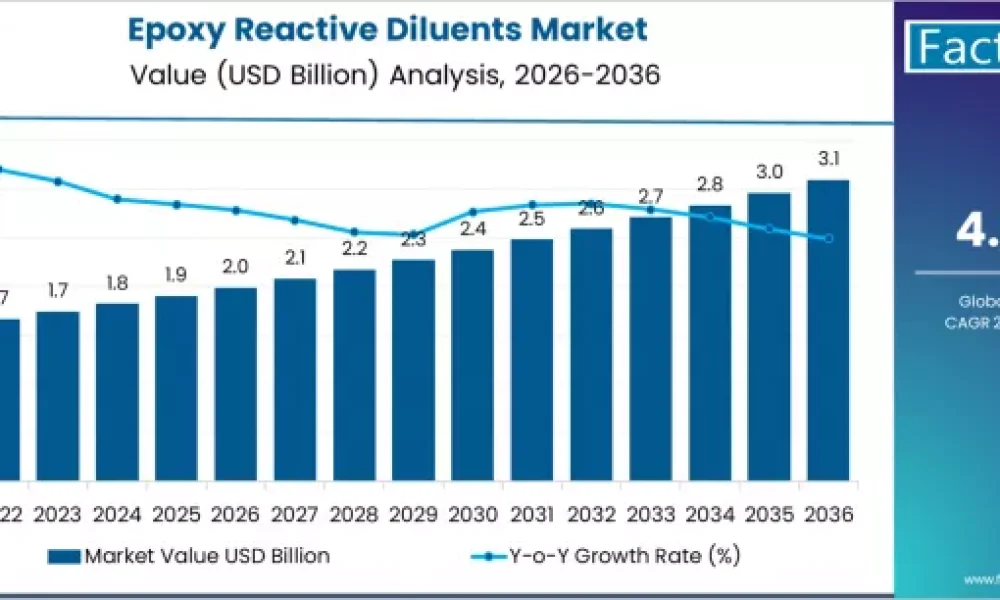
The Global Epoxy Reactive Diluents Market is poised for significant expansion over the next decade, driven by sustained industrial demand, regulatory transitions toward green chemistry, and accelerated uptake across diverse applications such as coatings, adhesives, composites, and advanced materials. The market is projected to grow from approximately USD 1.99 billion in 2026 to USD 3.09 billion by 2036, representing a Compound Annual Growth Rate (CAGR) of 4.5% through 2036.
Market Overview & Growth Trajectory
Epoxy reactive diluents are specialty additives used to modify viscosity, processing characteristics, and performance attributes of epoxy resin systems. They play a critical role in lowering the viscosity of epoxy formulations without significantly compromising mechanical properties, thus enhancing application efficiency in coatings and paints, adhesives, and composite materials. Their functionality makes them indispensable, particularly in high‑performance industrial sectors such as automotive, construction, electronics, and protective coatings.
The global epoxy reactive diluents market’s growth reflects broad macroeconomic trends, including industrialization in emerging markets, infrastructure development, and the push toward lightweight and durable materials in manufacturing processes. Over the forecast period 2026–2036, total market value is projected to expand by over 55%, underscoring the sector’s resilience and steady adoption across regions.
To access the complete data tables and in-depth insights, request a Discount On The Report here: https://www.factmr.com/connectus/sample?flag=S&rep_id=12689
Key Market Drivers
1. Broad Industrial Demand Across End‑Use Sectors
A major driver of market expansion is the coatings and paints industry, which accounts for the largest application share—approximately 38% of total epoxy reactive diluent consumption in 2026. Coatings producers increasingly rely on reactive diluents to tailor application properties and improve flow, adhesion, and durability in industrial, protective, and architectural coatings.
Moreover, construction and infrastructure projects across Asia‑Pacific, Latin America, and the Middle East necessitate advanced epoxy coatings with superior weathering and chemical resistance, further fueling demand. In addition, automotive and transport manufacturing continues to adopt epoxy systems with reactive diluents for high‑performance adhesives and composites that support weight reduction and safety standards.
2. Innovation and Sustainable Chemistry Trends
Environmental sustainability is reshaping the chemical sector. Manufacturers are increasingly investing in bio‑based, low‑VOC (volatile organic compound) epoxy diluents to comply with stringent regulations in North America, Europe, and other key markets. Adoption of these formulations is driven not only by regulatory frameworks but also by consumer and industrial demand for greener products that reduce environmental impact.
Companies are developing next‑generation diluent chemistries that blend ecological compliance with performance enhancements such as improved flexibility, thermal stability, and reduced processing energy requirements. As a result, sustainability is no longer an optional motif—it is a core direction of product development in the epoxy reactive diluents landscape.
3. Expansion of Electronics & Advanced Materials Use Cases
The electronics industry has emerged as a robust growth area for epoxy reactive diluents, particularly in printed circuit board (PCB) manufacturing, electronic encapsulation, and insulation systems where epoxy systems are preferred for their electrical and thermal performance. As global electronics output continues to rise, demand for high‑quality epoxy formulations is expected to expand proportionately.
Similarly, the rising adoption of epoxy reactive diluents in composites manufacturing—especially for lightweight aerospace and renewable energy applications—underscores long‑term prospects. These sectors increasingly rely on advanced resin systems for carbon fiber composites and high‑strength structural components, cementing the role of reactive diluents in specialized material development.
Regional Market Dynamics
Asia‑Pacific: The Growth Powerhouse
Asia‑Pacific is projected to be one of the fastest‑growing regions in the epoxy reactive diluents market, driven by rapid industrial expansion in China, India, Southeast Asia, and Latin America. In China alone, the competitive chemical manufacturing landscape, coupled with infrastructure investments and an expanding coatings industry, is expected to sustain strong growth with a higher regional CAGR than global averages through 2036.
Emerging markets benefit from cost‑competitive production ecosystems and growing downstream applications such as automotive assembly, consumer electronics, and commercial construction—all of which underpin the rising use of epoxy diluents.
North America and Europe: Innovation and Regulatory Leadership
In developed markets like North America and Europe, market growth is more moderate but strongly influenced by technological innovation and regulatory compliance. Demand is supported by a shift toward high‑performance coatings and specialty formulations that cater to automotive refinishing, industrial protective coatings, and niche composites applications.
Strict environmental standards also encourage the adoption of sustainable diluents and premium chemistries that cater to low‑VOC formulations, placing these regions at the forefront of eco‑friendly product development.
Competitive Landscape & Strategic Opportunities
The epoxy reactive diluents market is characterized by the presence of large multinational chemical firms and specialized materials producers. Leading companies highlighted in the 2026–2036 forecast include:
Hexion Inc.
Huntsman Corporation
Olin Corporation
BASF SE
Evonik Industries AG
Cardolite Corporation
Atul Ltd.
Aditya Birla Chemicals
Mitsubishi Chemical Group
These players are engaging in strategic initiatives such as product innovation, portfolio expansion, and supply chain integration to strengthen their market presence. Key growth strategies include investments in bio‑based diluent platforms, collaborations with end‑users for customized formulations, and expansions into emerging regions.
Market Entry Insights
For new entrants, differentiation through sustainability and performance optimization is essential. Entry strategies that focus on eco‑compliant chemistries, strong regulatory alignment, and partnerships with downstream sectors (like automotive OEMs or electronics manufacturers) will likely be more successful.
Investors should also consider regional manufacturing hubs like China and India, where cost advantages and growing industrial demand provide fertile ground for establishing production facilities or distribution channels.
Emerging Opportunities & Future Outlook
Looking ahead, the epoxy reactive diluents market is expected to mature with incremental technological innovations and greater cross‑sector adoption. Bio‑based reactive diluents, multi‑functional performance additives, and smart chemical systems represent high‑potential areas for R&D focus.
The anticipated growth trajectory, driven by both demand and innovation, positions the global epoxy reactive diluents market as a dynamic and resilient industrial segment through 2036. Business stakeholders equipped with strategic foresight and sustainability alignment will be well positioned to capitalize on this evolution.
Have a specific Requirements and Need Assistant on Report Pricing or Limited Budget please contact us – [email protected]
To View Related Report :
Epoxy Adhesives Market https://www.factmr.com/report/epoxy-adhesives-market
Epoxy Curing Agents Market https://www.factmr.com/report/3057/epoxy-curing-agents-market
Epoxy Resin Market https://www.factmr.com/report/epoxy-resins-market
Epoxy Hardener Market https://www.factmr.com/report/4954/epoxy-hardener-market



