
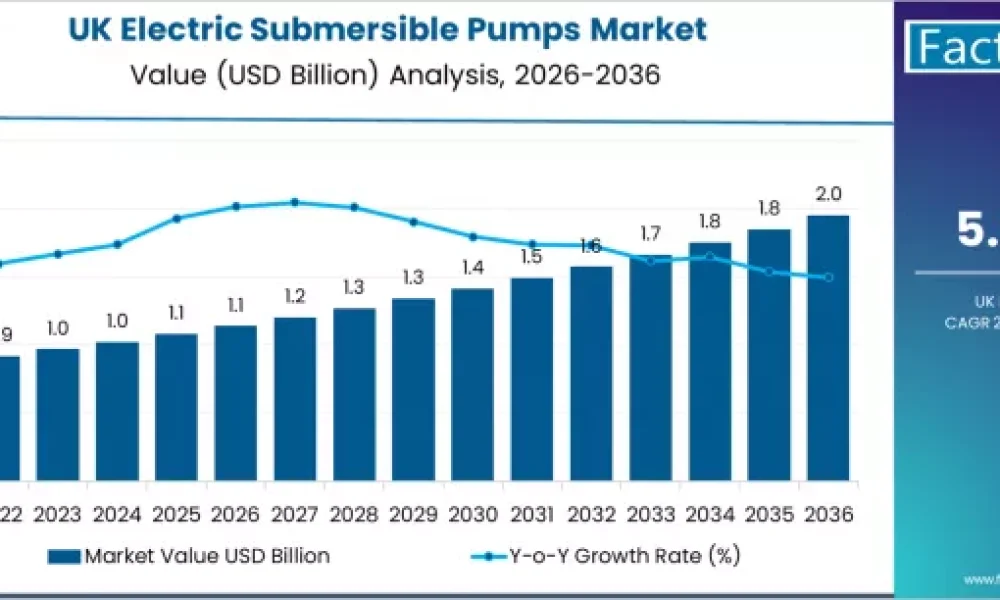
In the UK, the demand for electric submersible pumps is expected to rise from USD 1.14 billion in 2026 to around USD 1.95 billion in 2036. The industry is expected to grow at a CAGR of 5.5%. The nation’s drive for contemporary water infrastructure, growing industrial fluid handling requirements, and a greater focus on reliable extraction systems in both public and private facilities are all reflected in momentum.
Growing investments in infrastructure upgrades, rising construction activities, and heightened focus on environmental sustainability are key factors supporting demand across residential, commercial, industrial, and agricultural sectors.
Quick Market Snapshot (2025–2035)
- UK Electric Submersible Pump Sales Value (2026): USD 1.14 billion
- UK Electric Submersible Pump Forecast Value (2036): USD 1.95 billion
- UK Electric Submersible Pump Forecast CAGR: 5.5%
- Leading Product Type in UK Electric Submersible Pump Industry: Borewell Pumps (47.3%)
- Key Growth Regions in UK Electric Submersible Pump Industry: England, Scotland, Wales, and Northern Ireland
- Regional Leadership: England holds the leading position in demand
- Key Players in UK Electric Submersible Pump Industry: Xylem Incorporated, Sulzer Limited, KSB SE & Co. KGaA, Grundfos Holding A/S, Atlas Copco AB, Flowserve Corporation, Wilo SE, Homa Pump Technology GmbH, LEO Group Pump (Zhejiang) Co. Limited, VANSAN Water Technologies
To access the complete data tables and in-depth insights, request a Discount On The Report here: https://www.factmr.com/connectus/sample?flag=S&rep_id=12701
Market Overview
Electric submersible pumps operate with motors sealed within the pump body, enabling direct operation within the liquid medium without requiring priming. Their design offers advantages such as lower noise, increased reliability, and improved pumping efficiency. In the UK, ESPs are deployed extensively across water supply networks, drainage and flood control systems, sewage treatment plants, industrial effluent management, and irrigation applications.
The market is influenced by government initiatives to improve water infrastructure resilience, stringent regulatory standards for wastewater management, and rising adoption of advanced, energy-efficient pump systems.
Key Demand Drivers
1. Water Infrastructure Modernization
The UK continues to invest in water and wastewater infrastructure.
Upgrading aging sewage systems
Expansion of potable water distribution networks
Flood control and stormwater management projects
Electric submersible pumps are integral to these systems for efficient fluid handling and reliability.
2. Industrial and Commercial Growth
Various industrial sectors use ESPs extensively.
Manufacturing plants requiring effluent pumping
Food and beverage processing facilities
Chemical and pharmaceutical production lines
Industries adopt submersible pumps for robust, low-maintenance fluid management.
3. Energy Efficiency and Regulatory Compliance
Energy performance standards influence equipment choices.
Need for pumps with high efficiency and low operating cost
Regulatory emphasis on reducing carbon emissions
Smart monitoring and automation for energy optimization
Energy-efficient ESPs increase operational savings and align with environmental goals.
4. Urban Development and Construction Activity
Building and civil projects support pump demand.
Basement and below-grade drainage systems
Construction site dewatering
Residential and commercial plumbing systems
Electric submersible pumps support reliable water movement in confined or flood-prone areas.
Market Segmentation Analysis
By Pump Capacity
Low Capacity Pumps:
Suitable for residential drainage, shallow well water supply, and light industrial use.Medium Capacity Pumps:
Used in commercial buildings, municipal drainage, and moderate industrial applications.High Capacity Pumps:
Deployed in large wastewater treatment plants, flood control systems, and heavy industrial operations.
By Application
Water Supply & Distribution:
Drinking water systems and booster pumping.Wastewater & Sewage Handling:
Municipal sewage plants and effluent removal.Drainage & Flood Control:
Stormwater pumping and site dewatering.Industrial Fluid Handling:
Chemical, manufacturing, and process water applications.Agriculture & Irrigation:
Field irrigation and livestock water supply.
By End User
Municipal and public utilities
Industrial and manufacturing sectors
Commercial and residential developers
Agricultural operations
Municipal utilities and industrial sectors account for the largest demand share due to scale and long-term infrastructure needs.
Regional Demand Trends in the UK
England:
Highest demand driven by dense population, extensive municipal infrastructure, and diverse industrial base.Scotland & Wales:
Steady demand supported by rural water projects and flood management systems.Northern Ireland:
Ongoing infrastructure upgrades and agricultural use contribute to consistent demand.
Challenges and Market Restraints
1. Higher Initial Investment Costs
Advanced ESPs can carry higher up-front prices
Budget constraints for smaller municipalities or agricultural users
2. Maintenance and Technical Expertise
Need for trained technicians for installation and upkeep
Downtime risk if maintenance is inadequate
3. Competitive Alternatives in Specific Applications
Surface pumps and custom fluid handling solutions in niche cases
Edges where submersible design is not ideal
Emerging Trends and Opportunities
1. Adoption of Smart and IoT-Enabled Pumps
Remote monitoring and predictive maintenance
Integration with SCADA and utility automation systems
2. Focus on Energy Optimization
High-efficiency motor designs
Variable speed drives and improved control systems
3. Expansion of Modular Pump Solutions
Easy installation, scalability, and upgradeability
Custom configurations for specific fluid characteristics
4. Growth in Sustainable and Green Infrastructure Projects
Stormwater harvesting and reuse systems
Renewable–powered pumping installations
Competitive Landscape Overview
Market players focus on:
Energy-efficient and low-maintenance designs
Broad product portfolios covering multiple capacities
Local service support and rapid parts availability
Integration with digital control and monitoring technologies
Differentiation is shaped by performance, reliability, service network, and total cost of ownership.
Future Outlook
The demand for electric submersible pumps in the UK is expected to grow through 2035, supported by continuous investment in water and wastewater infrastructure, industrial fluid handling needs, and expanding construction activity. As sustainability and energy efficiency remain central priorities, advanced submersible pump systems with smart features and high performance will gain increased preference.
Manufacturers and suppliers that offer robust, energy-optimized, and easy-to-service ESP solutions — along with strong technical support — will be best positioned to capture long-term opportunities in both municipal and industrial segments.
Have specific requirements or need assistance on report pricing or have a limited budget? Please contact [email protected]
About Fact.MR:
Fact.MR is a global market research and consulting firm, trusted by Fortune 500 companies and emerging businesses for reliable insights and strategic intelligence. With a presence across the U.S., UK, India, and Dubai, we deliver data-driven research and tailored consulting solutions across 30+ industries and 1,000+ markets. Backed by deep expertise and advanced analytics, Fact.MR helps organizations uncover opportunities, reduce risks, and make informed decisions for sustainable growth.



