
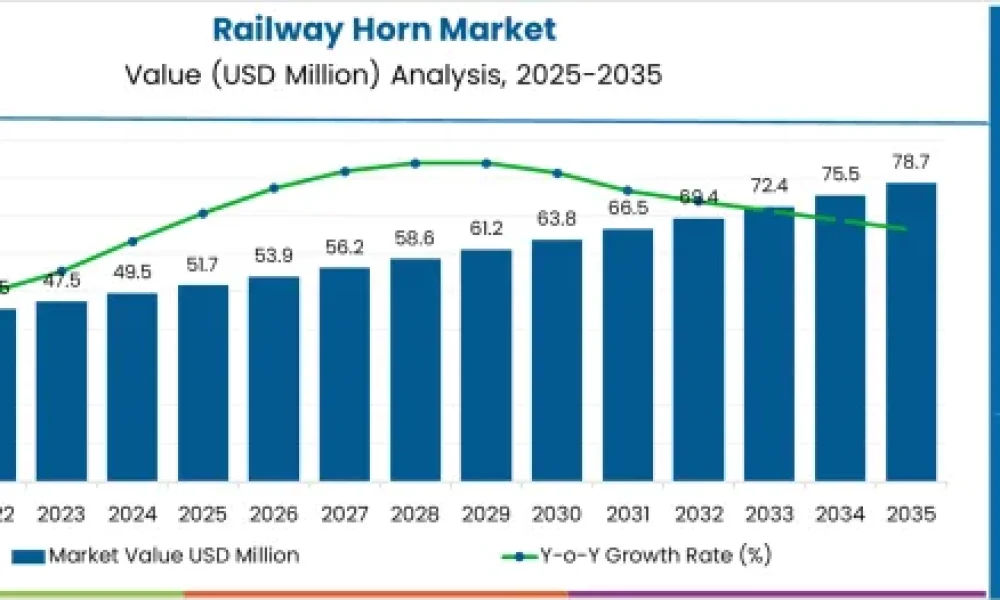
The global Railway Horn Market is witnessing steady growth, reflecting the increasing emphasis on rail safety, vehicle efficiency, and modernization of train systems. Valued at USD 51.7 million in 2025, the market is projected to reach USD 78.7 million by 2035, achieving a CAGR of 4.3% over the forecast period.
Railway horns play a critical role in ensuring operational safety, alerting both passengers and pedestrians, and preventing accidents at crossings and along tracks. The rising deployment of passenger trains, freight corridors, and urban commuter rail systems is driving demand across North America, Europe, and the Asia-Pacific regions.
Key Market Drivers
Passenger Train Modernization: Passenger trains represent the largest segment, accounting for 48.5% of market share, as rail operators upgrade horn systems to meet safety regulations and improve commuter experience. Electric horns, particularly popular in passenger and commercial vehicles, are expected to lead the market due to their adjustable volume, ease of installation, and cost-effectiveness.
Get access to comprehensive data tables and detailed market insights – request your sample report today!
https://www.futuremarketinsights.com/reports/sample/rep-gb-16098
Safety Regulations and Standards: Strict international and national safety standards govern the volume and intensity of railway horns. OEMs are producing horns that are loud enough to ensure visibility and audibility without causing abrupt distraction or noise pollution. Compliance with these standards continues to drive replacement and upgrade cycles.
Technological Innovations: Companies like AirChime, Ltd., Leslie Controls, and Denso Corporation are innovating horn designs to enhance longevity, reduce maintenance needs, and improve acoustic performance. Flat horn designs dominate due to their compact size and durability compared to spiral or trumpet designs.
Emerging Trends
Replacement and Lifecycle Opportunities: Railway horns typically have a life cycle of two to four years, creating consistent replacement demand and steady market opportunities for manufacturers. The shift toward modular and electric horn systems is accelerating market adoption.
Integration with Rail Safety Programs: Modern railways are increasingly embedding horn upgrades within broader safety and smart rail initiatives. Start-ups and government programs in India, for instance, are leveraging innovation grants to scale operations, improve infrastructure, and enhance operational efficiency.
Regional Insights
- Asia-Pacific: Dominates the market due to rapid urbanization, increased vehicle production, and rail expansion projects. China leads with a CAGR of 4.9%, while India’s railway horn market is expected to grow at 5.9%, driven by strong aftermarket prospects and the expanding automotive industry. Japan also shows steady growth, supported by rigorous safety regulations.
- Europe: Germany and Italy contribute significantly to the Western European market, with Germany holding 4.5% share. The UK grows at 3.4% CAGR, aided by the recovery of light commercial vehicle sales and enhanced rail safety measures.
- North America: The region is poised for the fastest growth, with the USA leading due to rising vehicle production and adoption of hybrid and electric rail vehicles. Canada is also experiencing market expansion, driven by passenger and light commercial rail growth and noise reduction initiatives.
Personalize Your Experience: Ask for Customization to Meet Your Requirements
https://www.futuremarketinsights.com/customization-available/rep-gb-16098
Competitive Landscape
The railway horn market remains regionally fragmented with active participation from domestic and international players. Key companies include AirChime, Buell Air Horns, Gustin Bacon Mfg. Co., Leslie Controls, Prime Manufacturing, Westinghouse Air Brake Co., and Denso Corporation. Strategic activities such as acquisitions, partnerships, and expansions are shaping the competitive landscape:
- Acquisition: Armstrong International’s acquisition of Leslie Controls enhances global reach in control systems and rail safety equipment.
- Expansion: Bosch’s new AIoT smart campus in Bengaluru, India, emphasizes innovation in rail and transportation safety.
- Partnerships: FIAMM Energy Technology and Aruba reinforce collaboration in power continuity solutions, highlighting the intersection of rail safety and energy infrastructure.
Outlook
The Railway Horn Market is set to maintain steady growth over the next decade, supported by modernization of passenger and freight rail networks, regulatory compliance, and innovation in electric and air horn technologies. With increasing demand for safer and more reliable rail transport, the market presents significant opportunities for manufacturers, technology providers, and service integrators.
Why Choose FMI: Empowering Decisions that Drive Real-World Outcomes: https://www.futuremarketinsights.com/why-fmi
About Future Market Insights (FMI)
Future Market Insights, Inc. (FMI) is an ESOMAR-certified, ISO 9001:2015 market research and consulting organization, trusted by Fortune 500 clients and global enterprises. With operations in the U.S., UK, India, and Dubai, FMI provides data-backed insights and strategic intelligence across 30+ industries and 1200 markets worldwide.



