
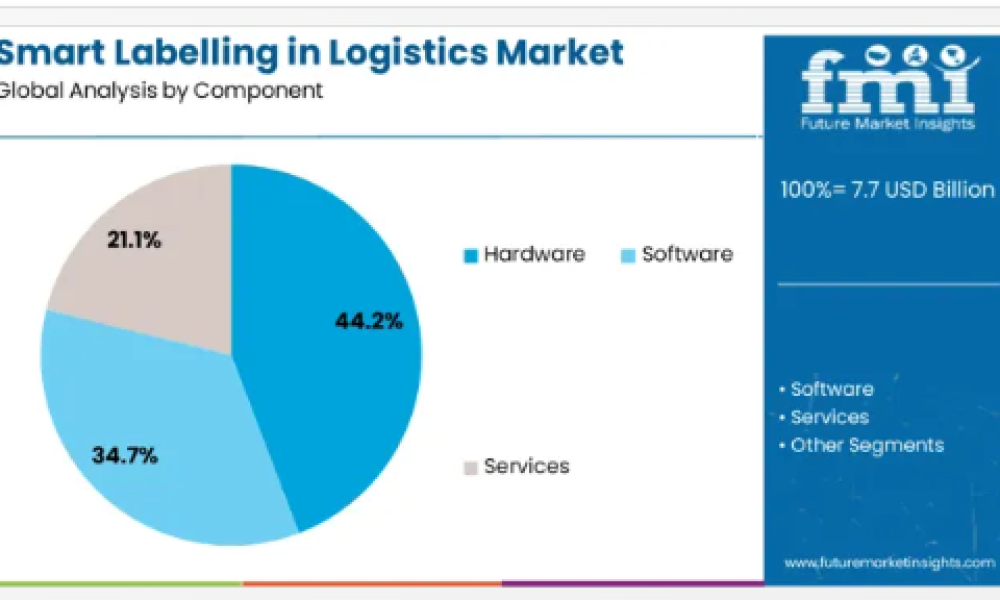
A new era of logistics efficiency is unfolding as the global smart labelling in logistics market is forecasted to expand from approximately USD 7.7 billion in 2025 to USD 12.6 billion by 2035, reflecting a compound annual growth rate (CAGR) of 5%.
By embedding intelligence in labels and tags, supply-chain operators are unlocking real-time visibility, enhanced traceability and cost reductions — and the momentum is just beginning.
Below are the key findings and strategic take-aways shaping this fast-evolving market.
Key Market Insights at a Glance
- Global market size is estimated at USD 7.7 billion in 2025, rising to USD 12.6 billion by 2035.
- Hardware components command the largest share (~44.2% in 2025) of total market revenues.
- Among product types, RFID labels lead with ~48.5% share in 2025, reflecting strong uptake in non-line-of-sight tracking.
- The cloud-based deployment model is dominant in 2025, with over 53% share, underscoring the shift toward digital, networked logistics systems.
- Primary applications include inventory management (≈20-25%), parcel/shipment tracking (≈35-40%), cold-chain monitoring (≈15-18%), and healthcare/pharmaceutical logistics (≈10-12%).
- Growth drivers include e-commerce expansion, stringent regulatory traceability requirements, and rising adoption of IoT/analytics-enabled logistics infrastructure.
- Key restraints include high initial investment, integration complexity with legacy systems and data security concerns.
Segment Overview
The smart-labelling landscape is segmented by component (hardware, software, services), product (RFID, NFC, ESL, others), deployment (cloud-based vs on-premises), company size (SME vs large enterprises) and application (inventory management, asset tracking, parcel tracking & delivery, cold chain monitoring, others). Hardware dominates component share; RFID labels dominate product share; cloud deployment leads; and parcel tracking & shipment visibility is among the fastest growing applications.
Regional Overview
- North America holds the largest share, powered by mature logistics infrastructure, high automation levels and strong e-commerce ecosystems.
- Europe follows, with particular emphasis on regulatory traceability, sustainability and supply-chain visibility solutions.
- Asia-Pacific is emerging as a high-growth region: for example, China is forecast to grow at about ~6.8% CAGR, India at ~6.3% as modern logistics networks and retail/distribution infrastructures accelerate.
- Other regions (Latin America, Middle East & Africa) show steady but lower growth, driven by emerging adoption of cost-efficient smart label solutions.
Competitive Landscape
The market remains moderately fragmented. Leading players such as Avery Dennison, Zebra Technologies, Honeywell International Inc., Oracle Corporation, Sato Holdings, Smartrac N.V., Impinj, and others are advancing hardware-software integrated smart labelling ecosystems. Differentiation is shifting from hardware alone to value-added services — real-time analytics, IoT integration, sustainability credentials and end-to-end supply-chain solutions. Partnerships, acquisitions and platform expansions are common strategic moves across vendors.
Market Outlook: Powering the Next Decade
Over the 2025-2035 horizon, smart labelling is positioned as a foundational enabling technology for the digital logistics ecosystem. As supply chains evolve toward autonomous operations, multi-modal visibility and just-in-time execution, smart labels will underpin data-rich tracking, condition monitoring (especially in cold-chain and pharmaceuticals), anti-counterfeiting, and reverse-logistics workflows. The projected growth to USD 12.6 billion reflects not just increased unit adoption but rising value per label via added sensors, connectivity and analytics. Sustainability pressures (reduced waste, tamper-proof solutions, recyclable labels) will further intensify demand. Businesses that adopt smart labelling as part of broader “connected supply chain” strategies stand to gain cost efficiencies, visibility edge and competitive differentiation.
Key Players of Sustainable Label Industry
- Avery Dennison: Pioneering RFID and eco-friendly smart labels, aligning with circular-economy goals.
- Zebra Technologies: Delivering end-to-end identification and tracking systems tailored for logistics hubs and fulfilment centres.
- Honeywell International Inc.: Offering integrated hardware-software stack for logistics automation and smart label deployment.
- Sato Holdings: Focused on durable, high-performance labels and printers adapted for harsh logistics environments.
Smaller innovators and startups are also entering with niche solutions (e.g., sensor-embedded labels, low-cost NFC/QR tag offerings) which intensifies competition and fosters innovation.
Recent Strategic Developments
- Logistics service providers and label vendors are forming joint alliances to embed smart labelling into warehouse-management and transport-management systems, enabling seamless data flow across the chain.
- Sustainable label materials (biodegradable substrates, lower-power RFID tags, battery-free sensors) are gaining commercial traction as environmental regulation and customer demand increase.
- Pilot deployments in cold-chain logistics (especially food & beverage, pharmaceuticals) are showing tangible ROI through spoilage reduction, compliance reporting and real-time condition alerts.
- Cloud-native deployment models are proliferating, enabling remote updates, global asset tracking and seamless scalability across geographies — a shift from legacy on-premises label-printing systems.
As global supply chains continue to evolve in complexity, speed and regulatory sensitivity, smart labelling is no longer optional — it’s becoming mission-critical. Organizations that embrace this transformation now will be positioned to lead in efficiency, visibility and sustainability.
For further information about market sizing, forecasts, segmentation and vendor strategies, audiences are encouraged to review full-length research and vendor whitepapers.
To access the complete data tables and in-depth insights, request a sample report here: https://www.futuremarketinsights.com/reports/sample/rep-gb-23016
Why FMI: https://www.futuremarketinsights.com/why-fmi
About Future Market Insights (FMI)
Future Market Insights, Inc. (ESOMAR certified, recipient of the Stevie Award, and a member of the Greater New York Chamber of Commerce) offers profound insights into the driving factors that are boosting demand in the market. With a vast team of over 400 analysts worldwide, FMI provides global, regional, and local expertise on diverse domains and industry trends across more than 110 countries.



