
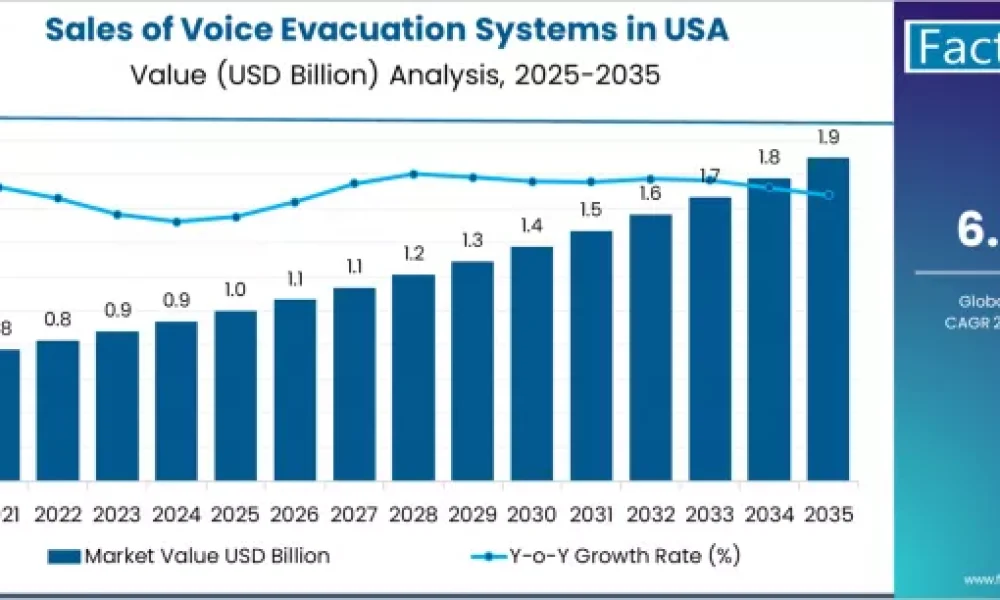
According to the latest analysis the U.S. voice evacuation systems market is poised for strong expansion, rising from USD 1.0 billion in 2025 to approximately USD 1.9 billion by 2035.
This reflects an absolute value increase of USD 0.9 billion and an impressive total growth of 87.5%, translating to a CAGR of 6.6% throughout the forecast period.
Voice evacuation systems—critical in ensuring safe, rapid, and intelligible emergency communication—are gaining significant traction across commercial, industrial, and public infrastructure projects nationwide. Their rising adoption is linked to tightening fire safety codes, increased smart building development, and heightened focus on mass-notification efficiency.
Key Market Drivers
Strengthening Fire & Life Safety Regulations Boost Deployment
The U.S. has seen stricter enforcement of NFPA, OSHA, and IBC standards across sectors, pushing organizations to modernize legacy alarm systems. Voice evacuation systems provide clearer, more human-centric emergency instructions, significantly improving evacuation outcomes and regulatory compliance.
To access the complete data tables and in-depth insights, request a Discount On The Report here: https://www.factmr.com/connectus/sample?flag=S&rep_id=11352
Growing Integration in Smart Buildings & IoT-Based Security
As smart infrastructure grows, voice evacuation technology is increasingly integrated with:
- Building management systems (BMS)
- Smart sensors
- Emergency lighting
- Access control
This interoperability enhances real-time threat detection and synchronized emergency response, making the systems indispensable in next-generation building designs.
Rising Demand from Public Venues & High-Density Facilities
Airports, stadiums, schools, malls, transportation hubs, and corporate campuses increasingly require mass-notification solutions capable of guiding large crowds. Voice-guided systems ensure fast, coordinated evacuation compared to traditional alarms that lack voice clarity.
Technological Advancements in Audio Clarity & IP-Based Systems
Next-gen systems now offer:
- IP network compatibility
- High-definition voice quality
- Multi-zone announcements
- Remote system diagnostics
These innovations significantly enhance usability and safety performance.
Regional Growth Highlights
Northeast USA: Strongest Institutional Adoption
Dense urban infrastructure and strict fire compliance standards drive exceptional adoption in New York, Massachusetts, Pennsylvania, and New Jersey.
South & Midwest: Rapid Growth from Industrial and Commercial Expansion
Manufacturing facilities, logistics hubs, and new construction projects in Texas, Ohio, Illinois, Georgia, and Florida increasingly integrate voice evacuation systems into safety plans.
West Coast: Technology-Driven Market Surge
California and Washington lead in smart building technologies, mass transportation upgrades, and campus security modernization.
Market Segmentation Insights
By Product Type
- Conventional Voice Evacuation Systems – Widely used in small to mid-sized facilities.
- Networked/IP-Based Systems – Fastest growth driven by smart building adoption and remote control capabilities.
By End Use
- Commercial Buildings – Offices, malls, hotels, co-working spaces.
- Industrial Facilities – Manufacturing units, warehouses, chemical plants.
- Public Infrastructure – Airports, rail stations, stadiums, schools, universities.
- Healthcare & Hospitality – Hospitals, long-term care centers, large hotel chains.
Market Challenges
Despite solid potential, the U.S. voice evacuation systems market faces several challenges:
- High Installation & Integration Costs: Advanced systems require professional integration, impacting cost-sensitive buyers.
- Legacy System Replacement Barriers: Old buildings may require significant retrofitting.
- Complex Multi-System Integration: Ensuring seamless interoperability with fire panels, PA systems, and network infrastructure requires expertise.
- Maintenance & Compliance Complexity: Regular testing and certification are necessary to meet safety regulations.
Competitive Landscape
The market is moderately consolidated, with leading companies expanding R&D initiatives, enhancing audio clarity, and integrating AI-driven features. Manufacturers focus on offering scalable, modular solutions that support multi-building deployments and real-time notifications.
Prominent Companies Include:
- Honeywell International
- Johnson Controls
- Bosch Security Systems
- Siemens Building Technologies
- Eaton Corporation
- TOA Electronics
- Cooper Safety
These companies continue to innovate through IP-based platforms, cloud monitoring, and advanced emergency communication technology.
Future Outlook: Toward Smarter, Faster, and More Connected Emergency Response
Over the next decade, the U.S. market will transition toward AI-enhanced, cloud-integrated, and networked voice evacuation platforms capable of delivering highly targeted communications during emergencies.
With rapid growth in smart city projects, infrastructure modernization, and corporate safety priorities, voice evacuation systems will remain a core component of national emergency preparedness strategy.
Manufacturers investing in IoT integration, real-time analytics, and cost-efficient scalable systems are expected to lead the next wave of market expansion.
Have a specific Requirements and Need Assistant on Report Pricing or Limited Budget please contact us – [email protected]
About Fact.MR
Fact.MR is a global market research and consulting firm, trusted by Fortune 500 companies and emerging businesses for reliable insights and strategic intelligence. With a presence across the U.S., UK, India, and Dubai, we deliver data-driven research and tailored consulting solutions across 30+ industries and 1,000+ markets. Backed by deep expertise and advanced analytics, Fact.MR helps organizations uncover opportunities, reduce risks, and make informed decisions for sustainable growth.



