
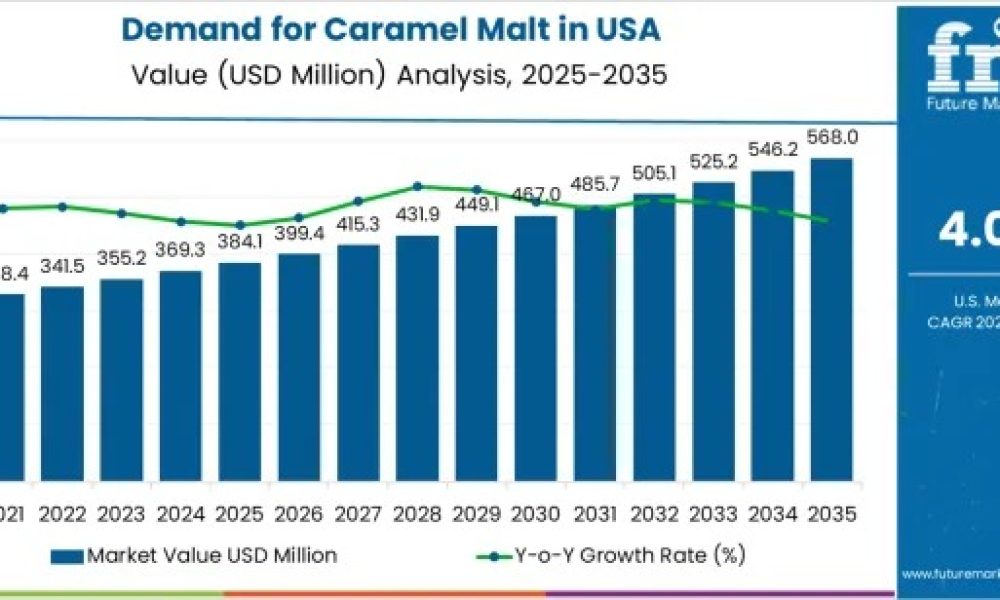
The demand for caramel malt in the USA is projected to grow steadily from USD 384.1 million in 2025 to USD 568.0 million by 2035, reflecting a CAGR of 4.0%. Growth is supported by the widening footprint of craft breweries, rising production of malt-forward beer styles, and the ingredient’s critical role in delivering color, sweetness, and body across both commercial and specialty formulations.
Caramel malt continues to gain momentum across U.S. breweries as producers increasingly rely on specialty malts to differentiate flavor profiles in lagers, ales, and emerging non-alcoholic malt beverages. The surge in experimentation with amber ales, red lagers, and artisan styles reinforces sustained demand. Light caramel malt remains the most widely adopted colour segment, valued for its versatility, mild sweetness, and dependable performance in pale ales and blended malt formulations.
Explore trends before investing – request a sample report today! https://www.futuremarketinsights.com/reports/sample/rep-gb-28699
Market Snapshot: Key Data Points
- Market Value (2025): USD 384.1 million
- Forecast Value (2035): USD 568.0 million
- CAGR (2025–2035): 4.0%
- Leading Colour Segment: Light caramel malt
- Fastest-Growing Regions: West, South, Northeast
- Major Suppliers: Bairds Malt Limited, Weyermann, Castle Malting, Thomas Fawcett Malting, Great Western Malting
Regional Growth Dynamics Driven by Craft Expansion
Demand is concentrated in regions with established and fast-growing craft beer ecosystems. The West leads with a 4.6% CAGR, followed by the South (4.1%), Northeast (3.7%), and Midwest (3.2%). These regions benefit from high brewery density, deeper consumer engagement with specialty styles, and expanding distribution networks.
West (4.6% CAGR)
High brewery concentration across California, Oregon, Colorado, and Washington fuels experimentation with caramel malt. Breweries use multiple malt grades to enhance body and balance bitterness in hop-forward ales.
South (4.1% CAGR)
Taproom expansion across Texas, Florida, Georgia, and North Carolina supports rising adoption of caramel malt for amber and brown beers crafted around regional preferences.
Northeast (3.7% CAGR)
Dominated by mature craft clusters, the Northeast sees strong year-round consumption of malt-forward ales, supported by robust specialty retail channels.
Midwest (3.2% CAGR)
With long-standing brewing traditions, the Midwest maintains consistent ingredient sourcing for lagers, amber ales, and hybrid regional styles.
Segment-Level Insights: Colour, Source, and Drying Method
Light Caramel Malt Leads with 35% Market Share
Light caramel malt dominates U.S. demand due to its clean malt character, mild sweetness, and balanced color contribution. Its reliable performance across batches makes it a staple for commercial and craft beer producers.
Key functional attributes include:
- Mild caramel notes without roast intensity
- Enhanced foam stability
- Suitable for sessionable and pale beer styles
- Predictable color development
Wheat-Based Caramel Malt Holds 45% Share
Wheat remains the top source, preferred for softer mouthfeel, improved head retention, and compatibility with wheat ales and lighter beer styles. Rye variants (30%) support craft experimentation, while barley and others represent the remaining 25%.
Kilned Caramel Malt Accounts for 60% of Demand
Kilned malt leads due to controlled caramelization and flavor stability. Its predictable extraction and performance benefit both high-volume and artisanal brewing operations. Roasted variants, holding 40% share, serve darker styles requiring richer caramel and burnt sugar profiles.
What Is Driving Demand for Caramel Malt in the USA?
Caramel malt usage is increasing alongside the growth of craft beer, specialty ales, and non-alcoholic malt beverages. Breweries rely on its attributes to achieve desired body, sweetness, color consistency, and foam stability. Food applications—such as baked goods, snacks, and flavor concentrates—are also expanding its utility beyond beverage production.
However, challenges persist. Declining mainstream beer consumption, raw material price fluctuations, and competition from alternative malt types or extracts can pressure growth trajectories. The rise of low-alcohol and seltzer segments may further moderate long-term specialty malt procurement.
Breakpoint Outlook Through 2035
The USA caramel malt market is expected to experience two strategic breakpoints:
- 2026–2029: Early growth phase driven by expanding craft and regional breweries, greater small-batch production, and increased recipe diversification.
- 2031–2033: Transition to more stable, process-driven demand as larger breweries optimize formulations, leading to predictable procurement.
These shifts reflect an industry maturing from craft-led acceleration to stable, formulation-driven malt usage.
Subscribe for Year-Round Insights → Stay ahead with quarterly and annual data updates! https://www.futuremarketinsights.com/reports/brochure/rep-gb-28699
Competitive Landscape: A Moderately Concentrated Market
The U.S. caramel malt industry is characterized by consistent product innovation and strong supplier reliability. Bairds Malt Limited leads with approximately 28.2% market share, supported by advanced color grading and strong relationships with regional and craft breweries.
International players such as Weyermann, Castle Malting, and Thomas Fawcett Malting maintain competitive advantages through robust roasting capabilities and broad caramel malt portfolios. Great Western Malting strengthens domestic supply with regional production advantages across the West and Midwest.
Competition centers on colour accuracy, flavor stability, moisture control, and dependable supply—qualities essential for breweries seeking consistent batch performance in both flagship and seasonal beer lines.
About Future Market Insights (FMI)
Future Market Insights, Inc. (ESOMAR certified, recipient of the Stevie Award, and a member of the Greater New York Chamber of Commerce) offers profound insights into the driving factors that are boosting demand in the market. FMI stands as the leading global provider of market intelligence, advisory services, consulting, and events for the Packaging, Food and Beverage, Consumer Technology, Healthcare, Industrial, and Chemicals markets. With a vast team of over 400 analysts worldwide, FMI provides global, regional, and local expertise on diverse domains and industry trends across more than 110 countries.



