
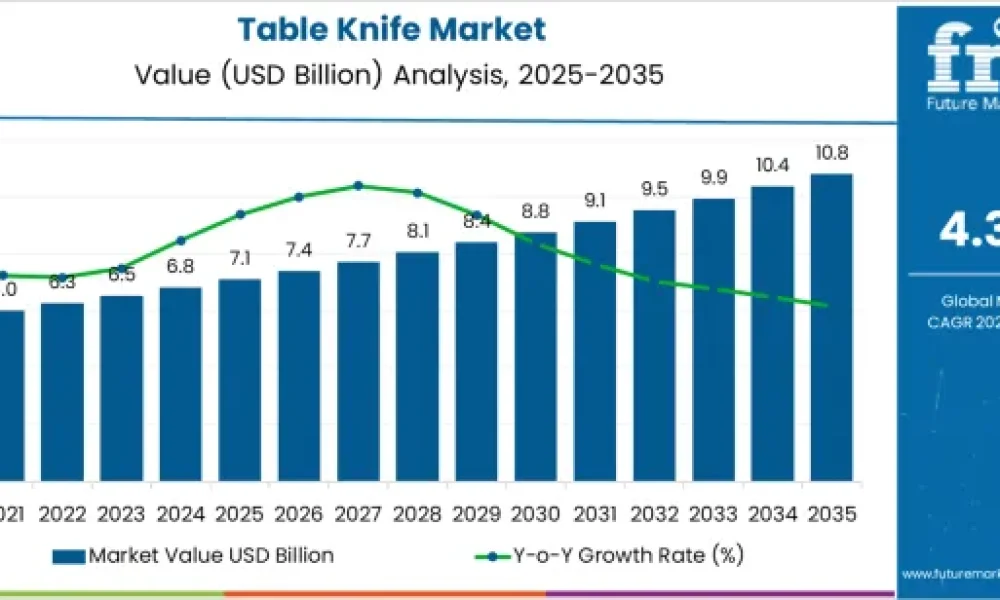
The global table knife market is projected to grow from USD 7.1 billion in 2025 to USD 10.9 billion by 2035, expanding at a steady compound annual growth rate (CAGR) of 4.3%. This growth trajectory reflects dynamic shifts in consumer preferences, product innovation, and expanding culinary sophistication across key global markets. Anchored by stainless steel’s dominance and a rising premium segment, the market evolution underscores strong opportunities for manufacturers and distributors committed to advanced material technologies, ergonomic design, and digitized consumer engagement.
Subscribe for Year-Round Insights → Stay ahead with quarterly and annual data updates : https://www.futuremarketinsights.com/reports/sample/rep-gb-28178
Market Overview and Growth Drivers
The initial growth phase, spanning 2025 to 2030, is primarily fueled by household demand for upgraded kitchen tools and increased standardization of durable, ergonomically designed knives by food service operators. Stainless steel retains its leadership position due to its corrosion resistance, reliable edge retention, and familiar handling characteristics. Home users represent the largest consumer segment, reflecting a global surge in home cooking and elevated expectations for kitchen quality and dining experiences.
From 2030 onward, the market’s expansion accelerates with an increased focus on premium table knives featuring optimized blade geometry, balanced weight, and superior handle ergonomics. This second phase sees heightened adoption in the restaurant and hotel sectors, where replacement cycles are increasingly performance-driven, prioritizing knives that maintain sharpness and durability through rigorous use.
Revenue streams are diversifying beyond initial knife purchases. The market is witnessing a shift toward premium steel blends, direct-to-consumer online sales, and supplementary maintenance offerings such as sharpening tools and care programs. Competitive advantage is now closely tied to blade composition, precision finishing, ergonomic innovation, and transparent quality tiering rather than purely decorative aesthetics.
Market Segmentation and Material Insights
Stainless steel dominates with a 54% market share, owing to its blend of durability, corrosion resistance, and operational longevity. Its capability to deliver consistent cutting performance with minimal maintenance continues to resonate with both household and commercial buyers. Ceramic and high-carbon steel knives are gaining traction among consumers seeking specialized, high-performance options—ceramic knives, in particular, appeal due to their lightweight, rust-free properties and long-lasting sharpness.
Silverware systems, holding 22% of the market, maintain relevance through their premium aesthetic appeal and traditional association with fine dining, primarily favored in upscale households and hotels. Plastic knives, accounting for 7%, cater to institutional and bulk food service segments that prioritize cost-effective and safety-compliant solutions.
Application Dynamics: The Home Segment Leads Growth
The home segment commands approximately 60% of the market share and is projected to grow at a robust 5.1% CAGR. This is driven by widespread adoption of quality kitchen equipment as households invest in culinary experience enhancements and kitchen modernization. Consumers seek versatile, high-performing knife systems that integrate seamlessly with existing kitchen infrastructure to streamline food preparation.
Commercial applications including hotels and restaurants continue to sustain substantial demand, propelled by operational needs for durable, high-performance knives that withstand intensive usage. Institutional applications, such as schools, are also notable for their growth, reflecting procurement programs focused on safety and durability.
Regional Outlook: East Asia and Developed Markets Lead
East Asia, North America, and Western Europe emerge as key growth regions, with China leading globally at a 5.8% CAGR. China’s expansion is driven by aggressive household modernization and culinary development initiatives, combined with rising disposable incomes and e-commerce penetration. India follows closely with a 5.4% growth rate, supported by a burgeoning middle class and expanding retail infrastructure focused on quality kitchenware.
In Europe, Germany exemplifies market leadership through its heritage of premium craftsmanship and precision manufacturing, sustaining a 4.9% CAGR. The U.S. and U.K. represent steady performers with growth rates of 4.1% and 3.7%, respectively, benefiting from ongoing kitchen modernization and food service sector expansion. Brazil’s 4.5% growth reflects rising middle-class incomes and increasing awareness of the benefits of quality kitchen equipment.
Key Trends and Market Imperatives
- Premiumization: Growing consumer preference for knives with superior metallurgy, ergonomic handles, and balanced weight is driving the premium segment’s market share, expected to capture nearly half of future revenues.
- E-commerce and Direct Sales: Online platforms account for an increasing proportion of sales, enabling brands to build loyalty through customer reviews, digital marketing, and subscription-based sharpening and maintenance services.
- Ergonomic Innovation: Advanced handle designs and balanced knife weight are becoming crucial differentiators, enhancing user comfort and performance.
- Value-Based Pricing: Transparent quality tiers tied to material composition, manufacturing precision, and warranty coverage empower consumers to make informed purchasing decisions.
- Integrated Care Programs: Subscription models for knife sharpening and maintenance are gaining popularity, creating recurring revenue streams beyond one-time sales.
Strategic Recommendations for Market Players
- Focus on Durability and Functionality: Design knives prioritizing operational longevity and cutting performance over purely aesthetic appeal.
- Bundle Offerings: Develop value packages combining knives with sharpening guides, storage solutions, and care instructions to drive higher customer retention.
- Digitization and Online Presence: Invest in direct-to-consumer e-commerce platforms, leverage social media engagement, and incorporate customer feedback mechanisms to enhance brand credibility.
- Quality by Design: Employ advanced metallurgy standards and ergonomic testing to deliver products that meet evolving consumer expectations and professional requirements.
- Flexible Pricing Models: Offer clear quality segmentation with options for subscriptions and customization to appeal to diverse consumer segments.
Conclusion
The table knife market is entering a decade marked by steady expansion and qualitative transformation. With a projected valuation approaching USD 11 billion by 2035, the market reflects evolving culinary practices, heightened quality consciousness, and technological innovation in cutlery design. Manufacturers and distributors who align their product portfolios with premium materials, ergonomic advancements, and digital sales channels are positioned to capitalize on sustained demand growth across both household and commercial sectors.
Have a specific Requirements and Need Assistant on Report Pricing or Limited Budget please contact us – [email protected]
About Future Market Insights (FMI)
Future Market Insights, Inc. (FMI) is an ESOMAR-certified, ISO 9001:2015 market research and consulting organization, trusted by Fortune 500 clients and global enterprises. With operations in the U.S., UK, India, and Dubai, FMI provides data-backed insights and strategic intelligence across 30+ industries and 1200 markets worldwide.



